
Ever heard the term “white label” but weren’t quite sure what it meant? It’s a surprisingly simple concept with a huge impact on how businesses operate and grow.
A white label solution is essentially a product or service built by one company that other companies can legally rebrand and sell as their own. Imagine a high-quality, generic t-shirt. You can buy a bunch, slap your own cool logo on them, and sell them as part of your unique clothing line. You didn't have to weave the fabric or stitch the shirt, but you still get to offer a great product under your brand.
That’s the core idea. It lets you offer a fully developed product to your customers without building it from scratch.
Understanding White Label Solutions in Simple Terms
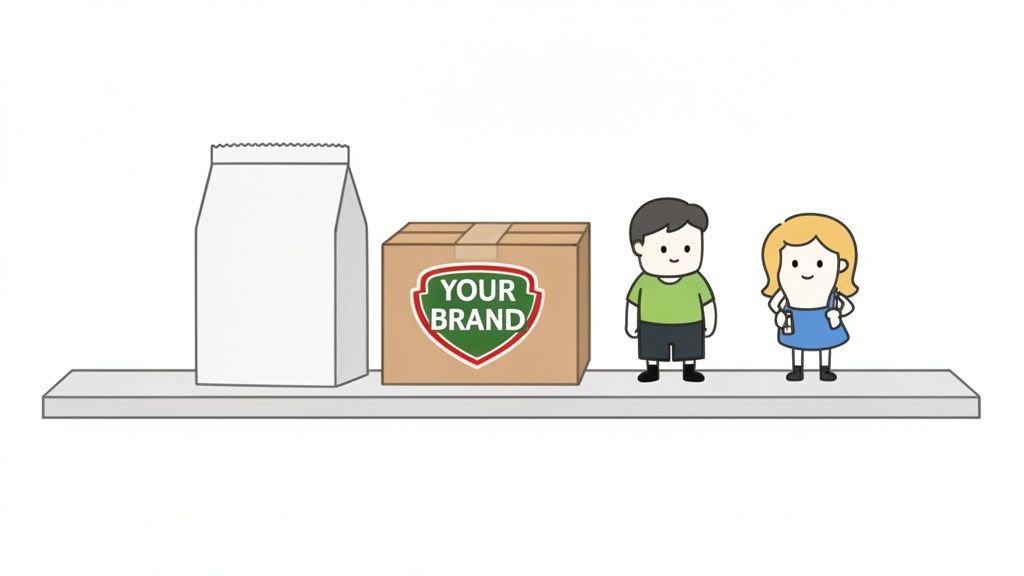
Let’s stick with a real-world example: think about the store-brand cereal at your local supermarket. The grocery store chain almost certainly doesn't own and operate a massive cereal factory. Instead, they buy a ready-made cereal from a large food manufacturer, put it in a box with their own store logo, and sell it on their shelves.
The exact same thing happens in the tech world. A white label software solution lets your business take a powerful, market-tested product—like a secure client portal or a document collection system—and integrate it seamlessly into your own offerings, all under your company’s banner.
The Two Sides of the White Label Coin
Every white label partnership has two key players. Getting these roles straight is the first step to understanding how it all works.
- The Provider: This is the company that did all the heavy lifting. They invested the time, money, and expertise to develop the original product. They handle the coding, the bug fixes, the updates—all the complex backend stuff.
- The Reseller: This is you! As the reseller, you purchase the right to use the provider's product. You then customize it with your branding—your logo, your color scheme, even your own domain—and offer it to your customers as if you built it yourself.
It’s a win-win. You get to expand your services and look like a hero to your clients almost overnight. The provider, in turn, gets a new channel to sell their product without having to build a massive sales team. For a deeper dive, this article does a great job of explaining What Is A White Label Solution Really.
White Labeling vs Building from Scratch at a Glance
So, what's the real difference between grabbing a white label solution and just building your own? Here's a quick side-by-side comparison.
| Aspect | White Label Solution | Building from Scratch |
|---|---|---|
| Time to Market | Fast. You can launch in days or weeks. | Slow. Development can take many months or even years. |
| Initial Cost | Low. Typically a subscription or licensing fee. | Very High. Requires significant investment in development. |
| Maintenance | Handled by the provider. No need for a tech team. | Your responsibility. Ongoing costs for updates and fixes. |
| Core Focus | On your business. Lets you focus on sales & service. | On product development. Can distract from core operations. |
| Customization | Limited. Usually branding and some features. | Unlimited. You can build exactly what you want. |
| Expertise Required | Minimal. No deep technical knowledge needed. | Extensive. Requires a skilled team of developers. |
As you can see, the choice really depends on your resources, timeline, and long-term goals.
The core idea is simple yet powerful: use an existing, proven solution to boost your brand and get to market faster. Why spend months or years in development when you can launch a professional, new service in a fraction of the time?
Ultimately, your customers interact with a product that looks, feels, and acts like it came directly from you. This builds incredible trust and strengthens your brand, all while you get to focus on what you do best—taking care of your clients. The provider remains your silent, invisible partner, handling all the technical work behind the scenes.
How the White Label Process Actually Works
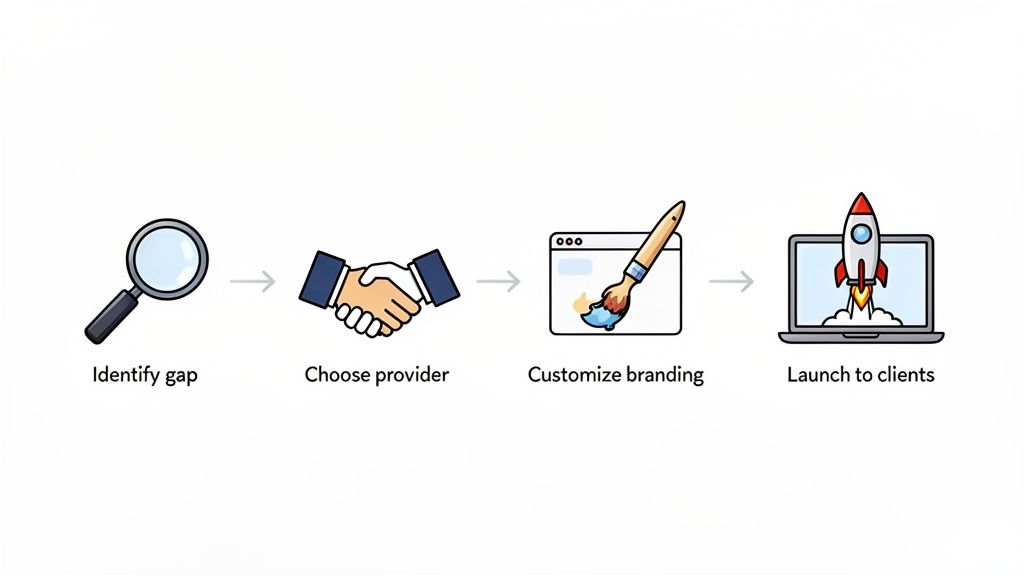
It’s one thing to understand what a white-label solution is, but it’s another to see how it all comes together in the real world. The journey from spotting a need to launching a new service under your own brand is a pretty straightforward process. It’s less about getting bogged down in technical weeds and more about making smart choices for your business and your customers.
Let's walk through the exact steps you’d take to bring a white-label platform into your business. This isn't just theory—it’s a practical roadmap for adding powerful features to your services without the massive headache of building them from scratch.
Step 1: Identify the Gap in Your Service
Everything starts with a problem. Maybe you run a busy accounting firm, and the constant back-and-forth of emailing sensitive documents is becoming a major bottleneck. It's clunky, feels unprofessional, and frankly, it’s a security risk for your clients.
That’s your gap: you need a secure, simple way to collect client documents. You realize that fixing this won't just clean up your own workflow; it will seriously level up the experience for your clients. The goal is now clear: find a tool that makes document collection easy and safe.
Step 2: Research and Select the Right Provider
Once you know what you need, it's time to find the right partner. This means looking for white-label providers who specialize in what you do, like secure client portals. But your evaluation shouldn't stop at a feature list.
As you do your research, ask these key questions:
- Customization: How much can you truly make it yours? Can you add your logo, match your company colors, and use your own domain for a seamless look?
- Scalability: Will this solution grow with you? You need something that can handle more clients and more documents down the road without slowing down.
- Support: What happens when you need help? A good partner will have your back with reliable support to make sure everything runs smoothly.
This stage is all about finding a provider whose tech and overall approach fit with where you want to take your business.
Step 3: Customize and Brand the Platform
After you’ve picked a provider, the fun begins—making the platform your own. This is where the “white label” gets painted with your colors. You’ll usually get access to a simple dashboard where you can upload your logo, pick your brand’s color scheme, and tweak settings so the tool feels like a natural part of your website.
A critical part of this step is setting up a custom domain. Instead of sending clients to
genericprovider.com/your-business, you can point them to a professional URL likeportal.yourbusiness.com. This small change makes a huge difference in reinforcing your brand’s credibility.
The best part? This process is almost always designed for non-technical users, so you don't need to know how to code. In just a little bit of time, you can turn a generic tool into a branded asset that builds trust with every client interaction.
Step 4: Launch Your New Branded Service
With your platform fully customized, you're ready to roll it out to your clients. A good launch is more than just flipping a switch. You need to clearly communicate the benefits—show them how this new feature makes their lives easier and their data safer.
For our accounting firm example, this could be a simple announcement email introducing their new, secure "Client Document Portal." From that day on, all document requests go through a professional-looking portal that carries their brand, instantly boosting their image and streamlining their work.
The Core Benefits of Using a White Label Solution
Going with a white label solution isn't just a clever workaround; it's a strategic move with some serious, tangible upsides. For any business, but especially for small and medium-sized ones, the choice between building a new feature from scratch and buying a ready-made one can make or break your growth.
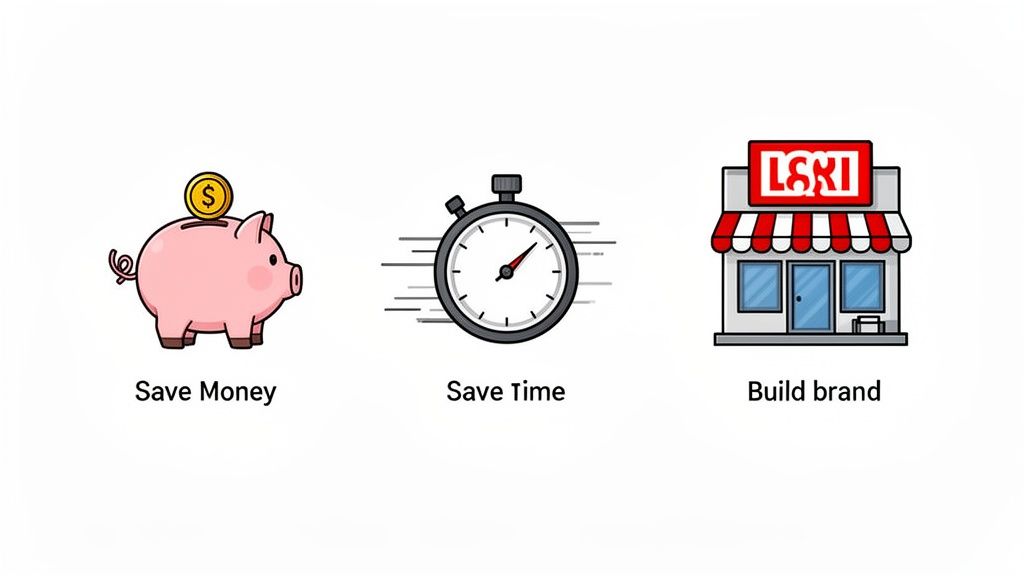
The white label path gives you a clear leg up in three critical areas: saving money, saving time, and building your brand. These advantages work in tandem, letting you deliver a better, more complete service to your clients faster and more affordably than you ever could on your own. Let's break down how this actually plays out.
Drastically Reduce Your Development Costs
Building quality software from the ground up is a massive financial commitment. The cost isn't just about hiring a few developers. You've got to factor in research, design, coding, testing, and deployment—a process that can easily spiral into tens or even hundreds of thousands of dollars.
A white label solution lets you sidestep nearly all of that. The provider has already sunk that huge initial investment. Instead of a massive one-time expense, you pay a predictable monthly or annual fee. This frees up your cash for what really matters: marketing, sales, and actually serving your customers.
Think of it this way: instead of building a car factory just to get a delivery vehicle, you're leasing a top-of-the-line van with your logo on the side. You get all the functionality without the overwhelming upfront cost and constant maintenance headaches.
This approach is changing how businesses get their hands on powerful tools. The SaaS white label market is expected to hit an incredible $908.21 billion by 2030, growing at a powerful 18.7% each year. This boom is driven by businesses in legal, real estate, and other fields that need custom-branded tools without the painful price tag of in-house development. In fact, some firms have been able to slash development costs by as much as 70%. You can discover more insights about the white label market's rapid growth on whitelabelwonder.com.
Accelerate Your Time to Market
In today's world, speed is everything. An idea that takes a year to build might be irrelevant by the time it finally launches. A white label solution gives you an unbeatable shortcut, letting you roll out a polished, new service in a matter of days or weeks, not months or years.
This speed gives you an immediate edge. While your competitors are bogged down in long development cycles, you're already out there solving client problems and bringing in revenue.
This rapid deployment lets you:
- Respond quickly to market demand: Spot a gap in what you offer? You can fill it almost instantly.
- Test new ideas with low risk: Launching a new service feels a lot less like a gamble when you haven't poured a year's worth of resources into it.
- Focus on your core business: Your team can stick to what they do best instead of getting pulled into a complex software project.
That kind of agility is a game-changer. It means you can pivot, adapt, and grow at a pace that would be totally impossible if you were building everything yourself.
Strengthen and Build Your Brand Identity
Maybe the most powerful benefit of a white label solution is what it does for your brand. When a client uses your service, you want every single interaction to reinforce their trust in your company. A generic, third-party tool can shatter that seamless experience, making your business feel less established.
A white label platform solves this by putting your brand front and center. By customizing the interface with your logo, colors, and domain, you create a cohesive and professional experience. For more on this, check out our guide on how to create a fully branded client portal.
This consistent branding hits several key goals:
- Boosts Credibility: It signals that you’ve invested in a professional, integrated solution for your clients.
- Increases Client Trust: People feel more secure when they’re on a platform that clearly belongs to a brand they already know.
- Enhances Brand Recall: Every time a client logs in, they’re reminded of your company and the value you provide.
Ultimately, a white label solution gives you the best of both worlds: a world-class product, built and maintained by experts, presented entirely under the banner of your trusted brand. This strengthens client relationships, builds loyalty, and positions your business as a serious player in your industry.
White Label Solutions in Action Across Different Industries
The theory behind white-labeling is great, but its real value clicks when you see how it solves everyday business headaches. Its magic lies in its adaptability, tackling specific, nagging problems in any industry that relies on smooth client communication and secure document handling.
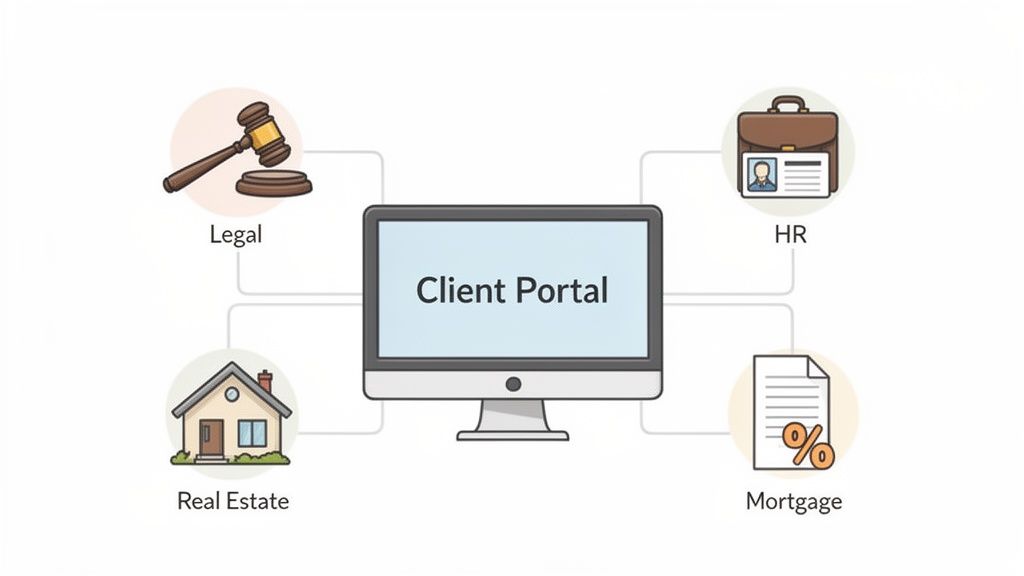
Think about law offices buried in case files or HR teams trying to onboard new hires efficiently. The core goal is always the same: create a seamless, branded experience that makes life easier for everyone. Looking at how different fields use these tools takes us from abstract ideas to practical, real-world wins. These examples show how a single type of tool—like a client portal for collecting documents—can be tailored to the unique demands of completely different professions, all while making them more efficient and building trust.
Streamlining Legal and Financial Workflows
Anyone in the legal or financial world knows the drill: you’re constantly juggling an incredible amount of sensitive information. The old way of gathering documents for a legal case, mortgage application, or investment account—usually endless email chains—is slow, messy, and a huge security risk.
A white-label client portal hits these pain points head-on.
- For Lawyers: A law firm can set up a branded portal for the discovery phase of a case. Instead of clients emailing confidential files back and forth, they upload everything to a secure, encrypted platform that looks and feels like the firm’s own website. This doesn’t just protect sensitive data; it organizes every case document in one central spot, saving hours of administrative work.
- For Mortgage Brokers: The loan application process is a paper-chase nightmare. A white-label portal lets a broker create a branded checklist for their clients. Borrowers see exactly what they need to provide—pay stubs, tax returns, bank statements—and can upload it all through one simple, secure link. The broker gets organized files, and the client gets a refreshingly smooth and professional experience.
This kind of focused solution is changing how small and mid-sized businesses work. The white-labeling market, valued at $28.3 billion in 2025, is expected to explode to $75 billion by 2033. That growth shows a clear shift away from expensive, custom-built software and toward flexible platforms like Superdocu, which helps document-heavy businesses launch branded portals without touching a single line of code. You can learn more about this market growth on htfmarketinsights.com.
Enhancing Human Resources and Real Estate Operations
It’s not just about law and finance. Any industry drowning in paperwork sees massive benefits. HR departments and real estate agencies face almost identical challenges when it comes to collecting documents from new employees, tenants, or property owners.
Key Insight: A white-label solution turns a boring administrative task into a positive brand moment. It transforms a potentially frustrating process into a slick, professional interaction that makes your whole organization look good.
This makes a huge difference in how clients and new hires see you from the very beginning.
Human Resources Onboarding
An HR team can use a white-label portal to design a polished onboarding experience. New hires get one link where they can submit all their paperwork—I-9s, direct deposit forms, and signed company policies.
- Cuts down on admin work by automatically chasing up missing documents.
- Keeps you compliant by storing all sensitive employee data in one secure system.
- Makes a great first impression with a professional and organized welcome.
Real Estate Management
For real estate agents and property managers, juggling tenant applications, lease agreements, and maintenance requests can feel like chaos. A branded portal brings order to that chaos.
- Simplifies tenant applications with easy-to-use digital forms and secure file uploads.
- Manages lease renewals by sending out automated reminders and handling e-signatures.
- Centralizes communication with property owners, creating one place to find every important document.
In every one of these cases, a common business problem gets a simple and effective fix. By taking a proven piece of technology and putting their own brand on it, these businesses don't just solve an operational headache—they elevate their client experience, slash manual work, and build a much stronger, more credible brand.
How to Choose the Right White Label Partner
Picking a white-label solution is a lot like picking a business partner. The right one can fuel your growth, but the wrong one can cause a world of pain. This isn't just about ticking boxes on a feature list. You're handing over a critical piece of your client experience to someone else, so you need to be sure they're a good fit for your brand, your tech stack, and where you want to go.
A great partner doesn't just sell you software; they give you a solid foundation to build on. You’re looking for a provider who can be a silent, reliable extension of your own team. That means digging into everything from their technical chops to how they handle a support ticket.
Evaluating Technical Capabilities and Customization
First things first: let's look at the platform itself. How flexible is it? A solution that can't be molded to your brand or grow with your business will become a bottleneck pretty fast. Your brand identity is everything, and your white-label software should strengthen it, not water it down.
Thinking through this is similar to figuring out what questions to ask when hiring a branding agency—you need total alignment. Here are the must-ask technical questions:
- Depth of Branding: Can you do more than just slap your logo on it? Look for the ability to customize colors, fonts, and the text in email notifications. The gold standard is using your own domain (like
portal.yourcompany.com) to create a completely seamless experience. - Scalability: Ask them how the platform handles growth. Will it slow down if you suddenly onboard a hundred new clients? Make sure their infrastructure can keep up with your ambitions.
- Integration Options: Your business doesn't operate in a vacuum. Check if the solution plays nicely with the tools you already use, like your CRM or e-signature platforms such as DocuSign. Good integrations save a ton of manual work.
These technical details are the bedrock of a good partnership. They ensure the solution works for you now and won't hold you back later.
Assessing Reliability and Support
Even the most impressive platform is worthless if it's constantly down or you can't get a human on the line when something breaks. Remember, when your clients run into problems, they'll blame your brand, not the software provider you're using behind the scenes.
Key Takeaway: A provider’s commitment to uptime and support is a direct reflection of their commitment to your business's success. Don't settle for vague promises; look for concrete guarantees and a proven track record.
Before you sign anything, get clear answers on these points:
- Uptime Guarantee: Ask to see their Service Level Agreement (SLA). Any serious provider should be guaranteeing at least 99.9% uptime.
- Customer Support: How can you reach them—email, phone, live chat? What are their hours? A good test is to ask a few pre-sales questions and see how quickly and helpfully they respond.
- Security and Compliance: Where is your data actually stored? Do they comply with regulations like GDPR? For any business, security is non-negotiable, so make sure you understand their encryption standards and data protection policies.
Doing this homework upfront protects you and your clients. The market for these tools is big, especially in North America, which accounted for 33.6% of the global labelling services market in 2024. This tech-savvy region makes it easier to find secure, robust partners.
To learn more about creating a branded experience, you might be interested in our guide to the benefits of a white label client portal. Finding the right partner means you can offer a professional, secure, and reliable service that builds trust and makes your brand look great.
Your Step-by-Step Implementation Plan
Alright, you've evaluated the options and you're ready to get your new white-label solution up and running. This is the exciting part! Getting from sign-up to a fully branded, live service is straightforward when you have a clear plan.
Think of it like setting up a new storefront. You wouldn't just unlock the doors and hope for the best. You'd plan your layout, paint the walls in your brand colors, stock the shelves, and train your staff before the grand opening. Implementing a white-label platform is no different.
Phase 1: Define Your Goals and Success Metrics
Before you touch a single setting, take a step back and ask: what does success look like for us? This initial planning stage guides every decision you make down the line. Is your main goal to slash client onboarding time by 50%? Or maybe you want to boost client satisfaction by providing a much more professional way to submit documents.
Having clear, measurable goals is everything. Yours might include:
- Cutting down administrative work by a certain number of hours each week.
- Shrinking the client intake process from days to just a few hours.
- Getting rid of the security headaches that come with emailing sensitive files.
Once you know where you're headed, you can draw the map to get there.
Phase 2: Configure Your Branding Elements
This is where the magic happens—transforming a generic platform into something that feels completely yours. A good white-label solution will give you simple tools to customize the look and feel, so your clients feel like they never left your website.
Here's a quick branding checklist to run through:
- Upload Your Logo: This is the first and most crucial step for brand recognition.
- Apply Your Color Palette: Use your company’s official brand colors to create a seamless visual experience.
- Set Up a Custom Domain: Pointing the service to a URL like
portal.yourcompany.comis a massive trust-builder. - Customize Email Notifications: Tweak the automated reminders and confirmations to reflect your brand's unique voice.
Phase 3: Set Up Your Core Workflows
With your branding locked in, it's time to build the engine. This is all about setting up the platform to handle your specific day-to-day processes. An HR firm might create a "New Hire Onboarding" workflow, while a law office could set up a process for "Discovery Document Collection."
If you want to see how a well-organized portal can make these tasks a breeze, check out our in-depth guide to the modern client portal.
The whole point here is to work smarter, not harder. Map out how you do things now, then build that process in the platform. Keep an eye out for opportunities to automate tedious steps, like sending follow-up reminders or checking that information is complete.
Phase 4: Train Your Team and Run a Pilot Test
Before you roll this out to every client, you need your own team to be completely comfortable with the new tool. A short training session can walk them through the new workflows and give them a chance to ask questions.
Next, it's time for a test drive. Pick a handful of friendly, long-term clients and invite them to try out the new system. Their real-world feedback is gold—it will help you spot any confusing steps or small glitches before you go live for everyone. This small-scale test is the key to a smooth and professional launch.
Common Questions About White-Label Solutions
Diving into the world of white-labeling can bring up a lot of practical questions. It's smart to get a handle on the key differences and what day-to-day operations look like before you jump in. Here are some clear, straightforward answers to the things most business owners ask when they're thinking about this strategy.
Is a White-Label Solution the Same as Reselling?
It’s easy to get these two mixed up, but there’s a crucial difference.
Reselling is simply selling another company’s product under their brand. Think of a local electronics store that sells Sony TVs—they aren't putting their own store logo on the television.
With a white-label solution, you’re taking a product someone else built and putting your own brand on it. This is a huge deal because it builds your brand's value and creates a seamless experience for your customers. They see your logo and your company's identity every step of the way, not some other company's.
How Much Can I Customize a White-Label Platform?
This is one of the most important things to figure out when you're picking a provider. A good white-label partner will offer deep customization options so the platform genuinely feels like it's yours. The whole point is to create an experience where your client feels like they're dealing only with you.
At a minimum, you should be able to:
- Add your company's logo and apply your specific color scheme.
- Use a custom domain (like
portal.yourcompany.com) to look professional. - Change the text and branding on all emails and other notifications.
A generic digital tool makes any professional service—be it financial or legal—feel generic, too. Customization is what turns a third-party platform into an asset that reinforces your unique identity and builds client trust. It keeps your brand from getting lost in a sea of look-alike portals.
What Happens if the Provider's Service Has an Outage?
This is a non-negotiable question you need to ask before signing on the dotted line. Your brand's reputation is directly tied to the provider’s reliability. If they go down, you go down.
A trustworthy provider will have a Service Level Agreement (SLA) that guarantees a high level of uptime, usually 99.9% or even higher.
They should also have solid security protocols, regular data backups, and a support team that actually responds when you need them. Always ask about their uptime history and what their support process looks like. Remember, if the service fails, your customers will blame you, not the invisible provider behind the scenes.
Ready to offer a seamless, branded document collection experience without the headache of building it yourself? Superdocu provides a powerful, fully customizable white-label client portal designed for businesses like yours. Strengthen your brand and streamline your workflows starting today. Learn more about Superdocu.