
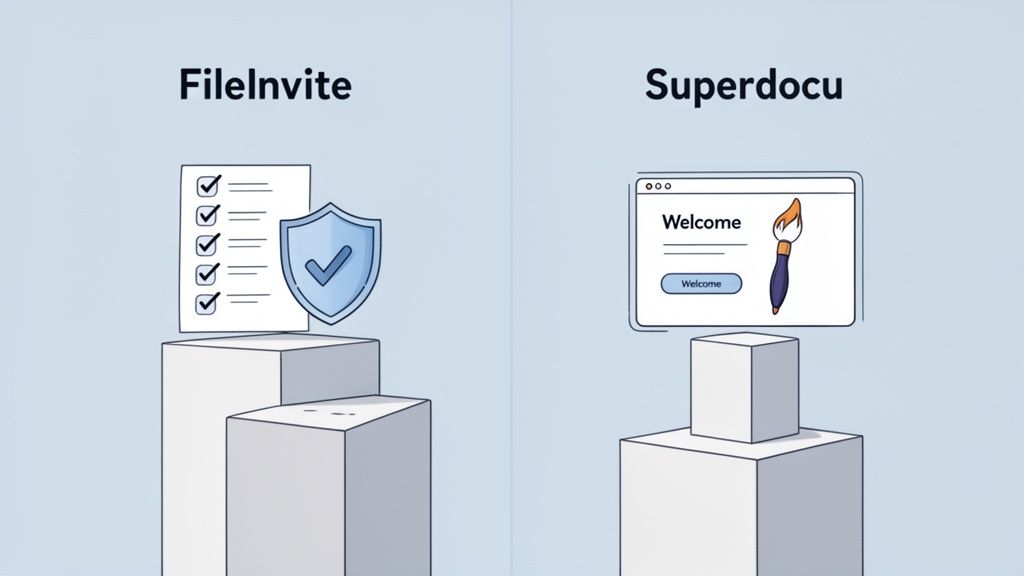
The fundamental difference between FileInvite and Superdocu comes down to their core philosophy. FileInvite is built for structured, high-volume document collection where you have established, repeatable processes. Superdocu, on the other hand, is all about creating a completely branded and customizable client journey with more flexible automation.
So, the choice really hinges on a simple question: do you need a well-oiled machine for efficiency, or a deeply personalized experience for your clients?
Choosing Your Document Collection Platform
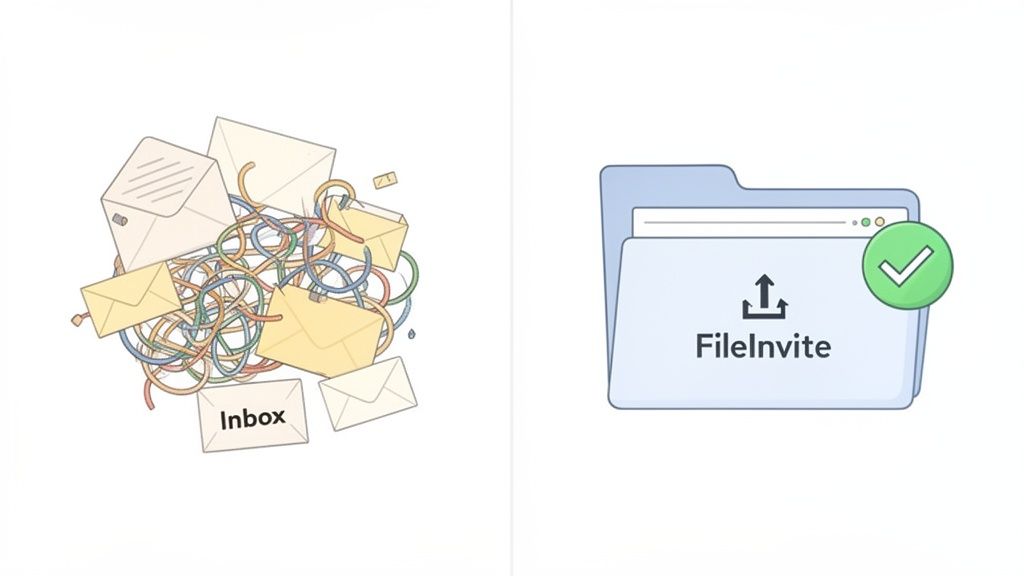
If you're still chasing clients for documents through messy email threads and dealing with insecure attachments, you know the frustration. It’s a huge time-sink, introduces compliance risks, and leaves a poor impression on clients who expect a smooth, digital process.
This guide pits two of the top solutions against each other: FileInvite and Superdocu. We’re going to look past the marketing fluff and give you a straight, side-by-side comparison tailored for businesses in finance, legal, and accounting.
Our aim is to help you see clearly which tool fits your actual needs. We'll dig into the features that matter, from security and automation to the real cost of getting started. By the end, you'll know which platform will truly align with your team’s workflow and your clients' expectations. You might also want to explore different types of document collection software to get a feel for the broader landscape before we dive in.
A Quick Comparison
Both platforms get the job done when it comes to gathering information, but they shine in different areas. Nailing down these key distinctions is the first step to picking the right tool for your firm.
| Feature Area | FileInvite | Superdocu |
|---|---|---|
| Core Strength | Excels at efficient, high-volume requests with a focus on standardizing your process. | Delivers deeply customizable, branded client portals with highly flexible workflows. |
| Ideal User | A great fit for accounting, finance, and mortgage firms with repeatable document checklists. | Perfect for legal, HR, and other client-centric firms that need a tailored user experience. |
| Automation | Offers strong native reminders and follow-ups built into its structured request system. | Provides flexible workflow automation that can connect to thousands of apps via Zapier. |
| Branding | Provides good branding options that give your requests a professional look and feel. | Offers extensive white-labeling for a seamless client journey that feels like your own brand. |
The decision often comes down to this: Do you need a highly efficient, repeatable machine for collecting standard documents, or a flexible, brand-forward platform that adapts to complex client interactions? Your answer will point you toward either FileInvite or Superdocu.
In this guide, we'll break down each platform's features, security, and pricing in detail. This will give you the clarity to invest in a solution that not only solves today's problems but is ready to scale with your business tomorrow.
Understanding Their Core Philosophies
To really get what separates FileInvite from Superdocu, you have to look past the feature lists. Each platform was built with a totally different idea in mind, and that core philosophy shapes how they handle everything. It’s the reason one is a slam dunk for a mortgage broker and the other is a perfect match for a law firm.
FileInvite is all about structured efficiency. It was designed to create a secure, repeatable, and super-smooth process for getting the information you need. The entire platform is built to kill the endless back-and-forth of email and replace it with a simple, checklist-style system that cuts down on administrative headaches.
This approach is a lifesaver in industries where you're asking for the same documents over and over again, like in accounting or financial services. Think of it as an assembly line for paperwork; every step is built for speed and accuracy.
FileInvite: The Efficiency Engine
Launched back in 2015, FileInvite quickly made a name for itself, especially in the Asia-Pacific market. They pull in an estimated $2.1 million in annual revenue with a pretty lean team, which tells you there’s a real hunger for their kind of process-first solution. Clocking over 216,000 monthly visits—with a huge chunk coming from its home base in Australia—it's clear their focus on structured workflows resonates with businesses needing to handle a high volume of requests without a hitch. You can dig deeper into FileInvite's market stats on Semrush.com.
This focus shines through in features that give you total control and consistency, like rigid templates and powerful automated reminders. The whole system is engineered to reduce manual follow-ups and keep everything compliant.
Superdocu: The Experience Architect
Superdocu, on the other hand, is built around creating a branded and welcoming client journey. The top priority here is a seamless, white-labeled experience that makes your client feel like they're interacting directly with your brand, not some random third-party tool. That’s a game-changer for relationship-focused businesses in fields like legal or consulting.
Superdocu is designed for deep customization, letting you fine-tune every single touchpoint your client has with your firm.
The real difference is this: FileInvite optimizes the internal process to make your team more efficient. Superdocu optimizes the external experience to keep your clients happy and engaged.
So, while both platforms get the job done when it comes to securely collecting documents, your choice boils down to what you value most. Is it the operational muscle to process hundreds of standardized loan applications a month? Or is it creating a bespoke, high-touch digital front door for onboarding new clients? Answering that question will point you straight to the right tool for your business.
A Head-to-Head on Core Document Collection Features
When you're picking a document collection platform, it's the core features—the ones that your team and clients use every day—that really make a difference. Both FileInvite and Superdocu are built to make this process easier, but they go about it in very different ways. How they handle the client portal, templates, and follow-up reminders can have a big impact, so understanding these differences is key to choosing the right tool for your business.
Let’s walk through a real-world scenario to see how they stack up: a mortgage broker managing a new loan application. This is a high-stakes process involving dozens of sensitive documents—pay stubs, tax returns, bank statements, you name it. The goal is to collect everything you need while keeping the client calm and the application moving.
The Client Portal Experience
The client portal is your client's first interaction with your request. It's where you make your first impression. A clunky, confusing interface can create friction right from the start.
FileInvite gives clients a clean, no-nonsense portal. When a mortgage applicant logs in, they see a simple checklist. Each document gets its own upload slot with a status indicator and a spot for comments. This straightforward design is fantastic for cutting down on confusion. It’s all about task completion, which is perfect for process-heavy industries where clients just want a clear to-do list.
Superdocu, on the other hand, is all about creating a branded and custom experience. A mortgage broker using Superdocu can design a portal that looks and feels like a natural part of their own website, complete with their logo, brand colors, and a personal welcome message. This approach feels less like a checklist and more like a guided, reassuring journey—something that's incredibly valuable when clients are making stressful financial decisions.
The core difference is clear: FileInvite offers a portal built for efficient task management, while Superdocu provides a portal built for a seamless brand experience. For a high-volume brokerage, FileInvite's clarity might be ideal. For a boutique firm focused on high-touch service, Superdocu’s customization is a powerful advantage.
This image from Superdocu's website shows just how polished a custom portal can look, making it feel like it's part of your business, not some third-party tool.
You can see how the branding and clean layout create a professional and welcoming space for the client to submit their documents.
Core Feature Comparison: FileInvite vs Superdocu
To make things even clearer, let's break down the essential features of each platform side-by-side. This table focuses on the elements that directly shape both the client's experience and your team's day-to-day efficiency.
| Feature | FileInvite | Superdocu |
|---|---|---|
| Client Portal | Structured, checklist-style portal focused on task completion. | Highly customizable, branded portal focused on the client journey. |
| Templates | Robust, standardized templates for process consistency. | Dynamic "smart" templates with conditional logic for personalization. |
| Reminders | Powerful, built-in automated reminder schedules for persistence. | Flexible reminders integrated into broader workflow automation. |
| Signatures | Native e-signature functionality built into the platform. | Integrates with leading e-signature tools like DocuSign. |
| Forms | Simple, secure forms for collecting data alongside documents. | Advanced, logic-based forms that can trigger different requests. |
Looking at this, you can see a pattern emerging. FileInvite is the master of structured, repeatable processes, while Superdocu shines when it comes to creating dynamic, personalized experiences.
Flexibility in Document Request Templates
Templates are the real engine of a good document collection system, saving you countless hours. That mortgage broker, for instance, has a standard set of documents they need for every single loan application.
With FileInvite, templates are solid and built for consistency. A broker can set up a master "New Loan Application" template that includes every document they might need. They send this same request to every new client, ensuring nothing ever gets missed. This rigid structure is actually a major strength for compliance and process control, as it guarantees everyone follows the exact same steps.
Superdocu’s templates are built for flexibility using conditional logic. Our mortgage broker could build a "smart" template that changes based on a client's answers. For example, if an applicant says they're self-employed, the form can automatically ask for extra documents like profit and loss statements. This adaptive approach makes the experience feel more personal and less intimidating for the client, since they only see requests that apply to them.
Effectiveness of Automated Reminders
Let's be honest, chasing clients for documents is one of the biggest time-sinks in any professional service. Automation isn't just a nice-to-have here; it's a must. In fact, financial institutions have found that automating tasks like this can free up over 40% of an employee's time.
FileInvite is a beast when it comes to its built-in reminder system. You can set up a very specific schedule of automated nudges for any documents that are still outstanding. The system will keep sending reminders until every last item on the checklist is submitted and approved. This relentless, automated follow-up is a core part of the FileInvite platform and works incredibly well to get requests completed without you having to lift a finger.
Superdocu also has automated reminders, but it thinks about them as part of a bigger automation workflow. While you can schedule basic follow-ups, its real power is unlocked through integrations, especially with tools like Zapier. This lets our mortgage broker build more sophisticated, multi-step reminder sequences. For instance, a reminder could be sent not just based on a date, but based on an action in another system, like a deal stage changing in their CRM. This offers almost unlimited customization for firms that want to build complex, end-to-end automations.
Evaluating Automation and Integrations
Great document collection software does more than just give your clients a secure place to upload files. It should plug into your workflow and cut out the manual, repetitive tasks that drain your team's time. The real magic happens when a platform can automate the busywork and talk to the other tools you already use.
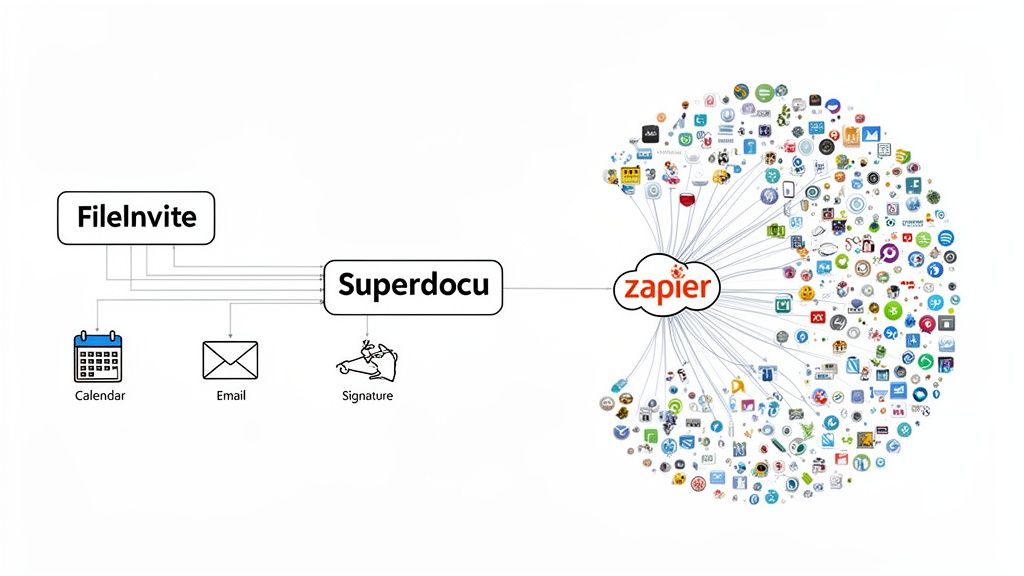
This is where you start to see a real difference between FileInvite and Superdocu. FileInvite packs a punch with its powerful, built-in automation for reminders and follow-ups. Superdocu, on the other hand, plays the long game with a flexible, integration-first strategy. Knowing which approach fits your business is crucial.
Native Automation Capabilities
Let's be honest, the worst part of collecting documents is chasing people down. The core purpose of automation in these platforms is to take that thankless job off your plate. In fact, some studies show that financial firms can automate tasks that eat up over 40% of an employee's day, freeing them up for work that actually matters.
This is where FileInvite truly shines. It has a fantastic native reminder system that you can set up to be as persistent as you need. You can build a multi-stage follow-up sequence that automatically pings clients via email or SMS until every last document is in. It’s a "set it and forget it" machine, perfect for high-volume firms that just need to get the job done without babysitting every request.
Superdocu handles reminders too, but its automation is more about moving a process along. Think of it less as a client-chasing tool and more as a workflow engine. For example, you can set a rule that automatically notifies an account manager for review the moment a client submits their first batch of documents. It’s focused on triggering the next step in your internal process.
FileInvite is built to solve one problem exceptionally well: getting clients to submit their documents with powerful, automated reminders. Superdocu’s automation is more about connecting the dots in a larger workflow, triggering internal actions based on client activity.
If your biggest headache is simply getting clients to follow through, FileInvite’s direct approach is tough to beat. But if you're trying to build more complex, multi-stage workflows, Superdocu gives you a more flexible set of building blocks.
Comparing Integration Ecosystems
A platform is only as good as its ability to connect with the other tools you rely on every day, whether that's your CRM or cloud storage. A staggering 89% of IT leaders say that data getting stuck in separate, incompatible systems is a major problem. This makes a tool’s integration strategy incredibly important.
FileInvite offers a curated list of direct, native integrations with some popular software, including cloud storage providers. This is great if you happen to use the specific tools they support. Native integrations are usually rock-solid and easy to get running. The downside? If your favorite tool isn't on their list, you might be stuck.
Superdocu chose a completely different route, betting big on its Zapier integration. Instead of building a handful of direct connections, this approach unlocks connections to over 3,000 different apps. It gives you incredible power to build custom automations that fit your exact needs.
- For a loan officer: You could build a Zap where moving a deal to the "Application Started" stage in your CRM automatically sends a document request from Superdocu. When the documents are approved in Superdocu, the deal in your CRM is automatically updated.
- For an HR manager: You could connect Superdocu to your HR system. As soon as a new hire is added, a personalized onboarding document request is automatically sent out. No manual effort is needed.
This integration-first mindset makes Superdocu a fantastic choice for businesses that have already built a diverse tech stack and want to create truly end-to-end automated processes. For more ideas on creating efficient systems, check out our guide on how to collect documents easily from your clients.
E-Signature Solutions: A Key Differentiator
Getting documents signed is a standard part of the process for many businesses, and how each platform handles e-signatures really highlights their core philosophies again.
FileInvite comes with its own native, built-in e-signature solution. This is super convenient if you want an all-in-one tool and don't want to pay for or manage a separate subscription. You can add signature fields directly to your document requests and keep everything neatly inside the FileInvite ecosystem.
Superdocu, staying true to its integration-first DNA, connects natively with DocuSign, one of the biggest names in e-signatures. This is a huge plus for businesses that already rely on DocuSign for its advanced features and robust compliance. It lets you slot a best-in-class signing experience right into your Superdocu workflows without making your team or clients learn something new.
Comparing Security and Compliance Standards
When you're handling sensitive client documents—think financial statements, legal contracts, or personal IDs—security isn't just another feature. It's the bedrock of your client relationships. For any business in a regulated field, choosing a platform with the right security is non-negotiable.
Both FileInvite and Superdocu get this, but they approach security and compliance from different angles, which really matters depending on where you and your clients are located. A misstep here can lead to hefty fines and, worse, a loss of trust that’s hard to win back. Let's break down what each platform offers so you can see which one fits your specific needs.
Encryption and Data Protection
On a technical level, both platforms have their encryption locked down. This is table stakes for any modern tool dealing with private information.
- Data in Transit: Both use TLS (Transport Layer Security). This scrambles any information moving between your client's browser and their servers, keeping it safe from prying eyes.
- Data at Rest: They also both use AES-256 bit encryption for files stored on their servers. This is the gold standard—military-grade stuff—meaning even if someone got physical access to the hardware, the data would be useless.
So, when it comes to pure encryption, you're in good hands with either. The real difference isn't in how they encrypt data, but where they store it and which regulations they're built for. If you want to get into the weeds, it's worth learning more about what makes a truly secure document intake platform.
Data Residency and GDPR Compliance
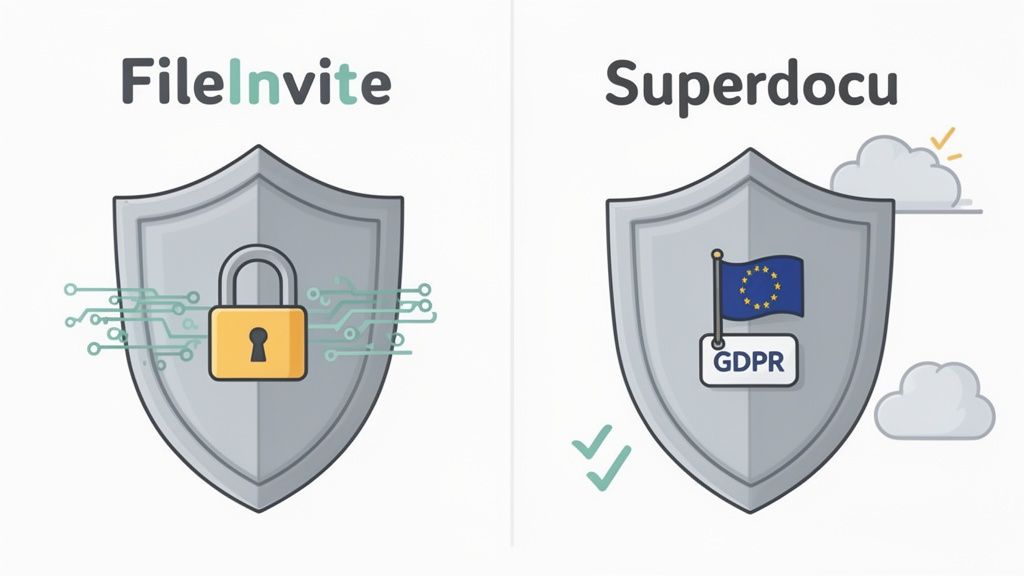
Here's where the two platforms really diverge, and it’s a critical point for anyone working with EU clients. Data residency—the physical country where your data lives—is a huge part of GDPR.
Superdocu was built from the ground up for the European market. Simple as that. All client data is hosted exclusively on servers located within the European Union. This is a massive advantage for anyone who needs to be GDPR-compliant, as it removes any confusion about data sovereignty rules.
FileInvite, on the other hand, is a global player with deep roots in Australia and the United States. Its primary data centers are in those regions. While FileInvite has excellent security protocols, its data hosting location can be a dealbreaker for firms that must strictly adhere to GDPR.
The Deciding Factor on GDPR: If GDPR is a top priority for your business, Superdocu's EU-only data hosting is a clear winner. It makes the compliance conversation straightforward and avoids the legal headaches of international data transfer agreements.
Compliance Certifications and Frameworks
Beyond GDPR, both platforms follow established security standards to show they’re serious about protecting your information.
FileInvite focuses on compliance frameworks relevant to its key markets, particularly finance and accounting in North America and the Asia-Pacific region. Its entire security setup is built to handle the high-volume, process-heavy demands of those industries.
Superdocu’s compliance story is naturally tied to its European focus. It doesn't just check the GDPR box; its entire approach is aligned with the EU's broader privacy landscape. This makes it a perfect fit for legal, HR, and financial firms that need to demonstrate clear, EU-centric data handling.
In the end, it comes down to your regulatory environment. If your business operates mainly under North American or Australian rules, FileInvite offers a robust and secure platform. But if you're under the GDPR umbrella, Superdocu’s dedicated European focus provides a much more direct and defensible solution.
A Look at Pricing and Real-World Value
When you get past the feature lists, the real story of a platform's worth is often told by its price tag. It's easy to get drawn in by a low entry-level price, but those costs can balloon quickly if you're boxed in by user limits or missing features. Let's break down how FileInvite and Superdocu approach this, as they serve very different business models.
FileInvite sticks to a more traditional per-user pricing model. It's a straightforward approach that works well for smaller, stable teams—you know exactly what you're paying for each person. But for a growing business, this can get expensive. If you’re a mortgage brokerage planning to hire five new loan officers, you’ll see your subscription costs climb with every new team member.
Superdocu flips that model. Their tiered plans often come with a generous number of user seats right out of the gate. This is a huge plus for teams on a growth trajectory because you can bring on new staff without immediately bumping up your monthly bill. The focus shifts from how many people are using it to what features and capabilities you're getting.
Figuring Out the True ROI
To really understand the return on investment, you have to connect the price to the features you’ll actually use. A busy mortgage company might find that FileInvite’s powerful, automated reminders save their team dozens of hours a month chasing down documents. In that scenario, the per-user cost is a no-brainer when you see how much faster loans are getting processed.
On the flip side, a law firm that lives and dies by its premium brand image might find Superdocu’s deep white-labeling and customization to be its most valuable asset. The ability to create a completely seamless, branded client portal reinforces the firm’s professional reputation, making a higher-tier plan worthwhile even for a small team.
The real question isn't about which one is cheaper. It’s about which pricing model actually supports your growth plans. A per-user plan is simple, while a multi-user, tiered plan is built for scale.
A Market Perspective on Value
Investing in a tool like FileInvite isn't happening in a vacuum; it’s part of a much bigger shift. The global market for file storage and sharing software was valued at USD 293.3 million in 2024 and is expected to nearly double by 2033. This explosion shows just how many businesses are finally ditching clunky manual processes for smarter, secure solutions.
As companies get more serious about modernizing their operations, the value these platforms deliver—in saved time, lower compliance risks, and happier clients—becomes a clear competitive advantage. You can dig deeper into this growing market and its future projections to see where things are headed.
At the end of the day, a small law firm could easily find that Superdocu’s inclusive user model and branding tools offer better long-term value. A mid-sized accounting department, however, might prefer the structured, process-driven efficiency of FileInvite, seeing the per-user cost as a direct and justifiable investment in their team's productivity.
Frequently Asked Questions
When you're digging into the nitty-gritty of document collection software, a few key questions always pop up. Here are some straight answers to the most common queries we see when people compare FileInvite and Superdocu. Getting these details right can make all the difference.
Which Platform Is Better for GDPR Compliance?
If you work with clients in the European Union, GDPR isn't just a buzzword—it's a critical requirement. This is one area where Superdocu has a clear, built-in edge.
Superdocu was designed from the ground up with EU regulations in mind, hosting all its client data on European servers. This approach takes the headache out of compliance and removes any gray areas about international data transfers.
FileInvite is definitely a secure platform with strong security protocols. However, its primary data centers are in Australia and the United States. For businesses that need to demonstrate strict GDPR adherence, this can mean jumping through extra legal hoops. If you have a significant European client base, Superdocu is the more direct path to compliance.
How Do the Template Systems Differ?
Both tools offer templates to speed things up, but they're chasing different goals.
Think of FileInvite templates as your go-to blueprints for repeatable, high-volume tasks. They are perfect for processes like loan applications or annual tax prep where you need the exact same documents from every client, every single time. The whole point is to create a rock-solid checklist so nothing ever gets missed.
Superdocu’s templates, on the other hand, are all about creating a customized client experience. They use conditional logic, which allows you to build "smart" workflows that adapt on the fly. For example, a template can ask for different documents or follow-up questions based on how a client answers an initial query. This makes the experience feel much more personal, which is ideal for complex onboarding in legal or HR where every client's situation is unique.
It really boils down to this: FileInvite templates are built for process consistency and control. Superdocu templates are built for a personalized, adaptive client journey. Your choice hinges on whether your business prioritizes rigid efficiency or a more flexible, tailored interaction.
Can I Connect My CRM to FileInvite or Superdocu?
You can, but each platform approaches integrations differently.
FileInvite provides a select list of direct, native integrations with some of the most popular software out there. If your CRM or cloud storage provider is on their pre-approved list, you can expect a straightforward and reliable setup.
Superdocu casts a much wider net by connecting through Zapier. This opens the door to thousands of apps, covering just about every modern CRM, project management tool, or communication platform you can think of. If you rely on a diverse set of tools or want to build sophisticated, multi-step automations, Superdocu’s Zapier integration gives you far more power and flexibility.
Ready to transform your document collection with a platform built for customization and a standout client experience? Superdocu offers the flexibility and branding power you need to impress clients and automate your workflows. Start your free 7-day trial of Superdocu today!