
You're trying to get a commercial space over the finish line, and the lease draft is already on your desk. The space looks right, the broker is pushing for speed, and the landlord's template seems close enough, until you start seeing blank fields, vague expense language, and a signature package scattered across email threads. That's usually the moment the deal either gets organized or gets expensive.
Table of Contents
- What a Commercial Lease Template Must Cover
- Choosing the Right Lease Structure for Your Business
- Customizing Every Clause in the Template
- Negotiating the Clauses That Actually Move the Deal
- Collecting Documents and Signing the Lease
- Managing the Lease After Signing
- Onboarding Checklist and Common Questions
What a Commercial Lease Template Must Cover
A workable lease for commercial property template starts with the fields that define the deal. It should identify the parties, describe the premises with enough precision to avoid confusion, state the lease term, set out the rent amount and payment schedule, name the permitted use, and assign the maintenance responsibilities. Those items are the minimum structure a tenant and landlord need before anyone starts marking up details or collecting signatures.
The next layer is the paperwork flow around the lease. A clean draft should sit alongside a real estate transaction checklist so the lease packet stays tied to the rest of the closing materials, from entity documents to insurance certificates. That keeps the signed lease, supporting forms, and move-in records in one place instead of scattered across inboxes and file folders.
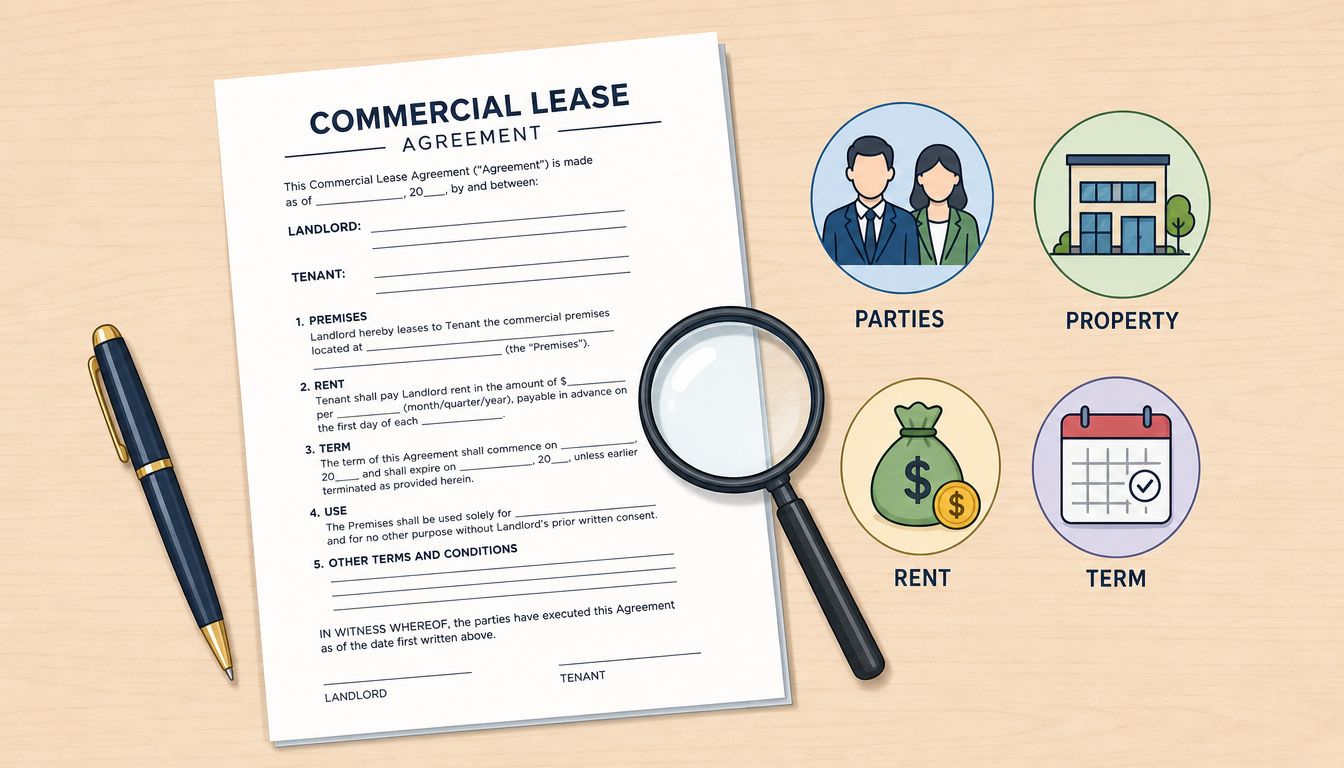
Start with the fields that define the deal
The safest review starts by asking whether each blank tells you who is bound, what space is being leased, for how long, and what use is allowed. If the premises description is vague, the wrong suite or square footage can end up in the final document. If the permitted use is too broad, the lease may authorize an operation that does not match zoning or the tenant's actual business.
The maintenance section deserves close attention because it sets the baseline for day-to-day occupancy. It should say who handles routine upkeep, who repairs what, and where the landlord's responsibility ends. In practice, that is the difference between a lease that is easy to administer and one that turns every small repair into a dispute.
Practical rule: if a template does not say who sends notices, who receives them, and how they are delivered, it is not finished.
Keep the template focused on minimum required terms
A solid template also needs the core administrative terms that make the lease usable after signing. That means the notice addresses, basic insurance requirements, and the language that explains how the document is enforced if a party misses a payment or violates a material term. If you want a plain-language pass on those enforcement sections, browse this lease agreement guide and compare it against the draft before it goes out for signature.
The point here is not to turn the template into a negotiation memo. It is to make sure the lease has enough information to function once both sides sign. A lease packet that leaves out the basic contact details, risk allocation, or the plain language around enforcement is hard to administer later, especially when the lease has to be renewed, documented, or handed off to another manager.
Good templates also leave room for the post-signing workflow. That means the signed lease can be stored with the insurance certificate, rent schedule, and any required notice contacts so renewals and recurring review dates do not get lost after move-in. A lease that supports that file structure is easier to manage, because the paper trail is already set up before the tenancy starts.
Choosing the Right Lease Structure for Your Business
A retail tenant signing for a small storefront does not read a lease the same way an office tenant does, and an industrial user has a different set of risks again. The structure decides whether the tenant is only paying base rent or also absorbing taxes, insurance, utilities, CAM, and repair items that can shift the actual cost of the space over time. A lease that looks affordable on page one can become hard to manage once those pass-throughs start showing up in monthly billing and annual reconciliations. Guidance for commercial lease drafting consistently separates gross, modified gross, net, and triple net structures, and that is where most occupancy surprises begin commercial lease structure guidance.
Compare the structures before you compare the price
A small tenant should never compare leases by rent alone. The structure decides whether taxes, insurance, CAM, utilities, and major repairs stay with the landlord or shift to the tenant. A gross lease is easier to read because more costs stay bundled, while triple net pushes more of the building's expense burden onto the tenant. Modified gross sits in the middle, which can work well when both sides want some cost sharing without fully passing through every charge. Percentage leases appear most often where sales volume and occupancy cost are tied together, usually in retail settings.
| Lease Structure Cost Allocation | Base Rent | Taxes & Insurance | CAM & Utilities | Best Fit |
|---|---|---|---|---|
| Gross | Usually bundled | Mostly landlord-paid | Mostly landlord-paid | Office users who want predictability |
| Modified Gross | Base rent plus some pass-throughs | Shared or partly passed through | Shared depending on draft | Tenants who can absorb limited variable costs |
| Triple Net | Base rent plus pass-throughs | Often tenant-paid | Often tenant-paid | Single-tenant or lower-touch users |
| Percentage | Base rent plus sales-linked payment | Depends on draft | Depends on draft | Retail concepts with revenue tied to foot traffic |
For a 2,000 sq ft office tenant paying $35/sf NNN, a 15% CAM increase adds roughly $1,050 annually. The template needs to say what counts as CAM before anyone signs, or that increase becomes a surprise instead of a known risk.
Match the structure to your risk tolerance
Retail tenants usually care most about expense transparency, because CAM and utility pass-throughs can make a seemingly fair lease drift upward. Office tenants often want stable billing and fewer surprises, especially when staffing and fit-out already stretch the budget. Industrial and mixed-use deals can lean more variable, but only if the template clearly defines what is included and what gets passed through.
Practical takeaway: if the lease doesn't separate what you owe as base rent from what you may owe as operating expenses, you do not yet know your real monthly cost.
The right structure is the one that fits the way the tenant runs the space. A manager can usually live with variable charges when they are defined cleanly, reviewed on a predictable schedule, and supported by a file set that includes the signed lease, the insurance certificate, and the notices needed for renewals and CAM reconciliations.
Customizing Every Clause in the Template
When editing the rent metric, specify whether escalations are fixed percentages or tied to CPI, because vague escalation language creates reconciliation disputes. The same level of precision should carry through the rest of the draft. A lease that says costs are “included” without naming what is included usually creates arguments later, especially around CAM and operating expenses.

Edit the money clauses first
The money section has to do more than name a rent amount. It should state whether the lease is gross, net, or triple net, then identify who pays utilities, insurance, taxes, and CAM. If those costs are shared, the template should say how they are measured and how reconciliations happen. That keeps you from arguing later about whether a charge was meant to be passed through or absorbed by the landlord.
Escalation language should also be explicit. If the rent rises, the lease should show when that happens and how the increase is calculated. Late fees need the same treatment. They are not just penalties, they are workflow rules that determine when the landlord can start enforcing default rights.
Tie use rights to the actual space
Permitted use should be drafted against the property type, address, square footage, and the tenant's intended business activities. That matters because the lease needs to line up with zoning and local use authority, not just with what the tenant hopes to do. A retail use clause that sounds broad can still be too loose if the premises cannot legally support the operation.
A good draft also handles assignment, subletting, and restoration obligations. If the tenant wants flexibility later, the lease should say when a transfer is allowed and whether the landlord has approval rights. If improvements are installed, the template should tell the tenant whether they must remove them at the end or restore the suite to a prior condition.
Useful drafting habit: write the clause as if the tenant will have to prove compliance later, because in practice, that is often exactly what happens.
Signage rules deserve attention too. They are easy to ignore on first read, but they affect visibility, branding, and local approval issues. Once you have handled money, use, transfer rights, restoration, and signage, the template is no longer generic. It is usable.
Negotiating the Clauses That Actually Move the Deal
A retail tenant's first lease draft usually looks tidy until you price the clauses that matter. The landlord wants speed and certainty. The tenant wants room to survive rent pressure, fit-out delays, and early operational mistakes. In one common setup, the first redline battle is not about the headline rent. It's about how much flexibility the tenant gets if the opening takes longer than planned or the sales ramp is slow.
Focus on the few clauses that change economics
The clauses that move the deal are usually the same ones. Base rent, any free rent period, TI allowance and restoration terms, renewal options with notice windows, CAM caps and audit rights, and default cure periods all shape the economics of the lease. If the draft gives the landlord broad discretion on those points, the tenant carries more risk than the cover page suggests.
A tenant should push for clear notice windows on renewals so the option doesn't disappear by accident. That's especially important because one missed deadline can be more costly than a small rent concession. CAM caps and audit rights matter for the same reason. They don't make a bad building cheap, but they do keep cost increases from becoming uncheckable.
Use leverage without overreaching
A landlord's draft often asks for broad default rights and short cure periods. A tenant can usually ask for a fair chance to fix a problem before a remedy kicks in, especially for non-monetary issues that aren't urgent. The tenant can also ask for clearer language on TI work letters, restoration scope, and who owns tenant improvements at the end.
A good negotiation script is direct:
- Ask for clarity first: define the charge or obligation before debating the amount.
- Trade flexibility for certainty: if the landlord wants a quicker signing, ask for a cleaner renewal notice window or a defined cure period.
- Protect the exit: make sure assignment, subletting, and restoration language doesn't trap the tenant in an obsolete layout.
- Push back on vague expense language: if CAM or pass-throughs aren't defined, the tenant is signing a blank check.
The best concessions are the ones that buy something measurable. A tenant can sometimes accept a minor economic compromise if the lease gives better notice rights, tighter expense language, or a realistic renewal path. What usually isn't worth conceding is vague default language that lets the landlord accelerate the dispute without a repair window.
Collecting Documents and Signing the Lease
A signed lease is really a package of documents moving together. If the tenant, guarantor, and landlord are all emailing attachments separately, someone will miss a file, a signature, or an exhibit. That's where a clean portal workflow helps. You want one request path, one review place, and one executed archive so the lease package doesn't drift across inboxes.

Gather every document before you send for signature
The tenant side usually needs a government ID, business registration, tax forms, proof of deposit funds, an insurance certificate naming the landlord where required, and any guarantor paperwork. If those items arrive in different formats and on different days, the signing process slows down and the executed file set becomes incomplete. The better move is to ask for everything in one branded request flow, then validate each submission before the signature step begins.
Automated reminders help more than people expect. They reduce the back-and-forth that usually happens when a tenant forgets a certificate, a bank proof, or a missing exhibit. A validation dashboard is useful here because it lets someone confirm what is still outstanding without hunting through emails.
Execute the lease with the exhibits attached
eSignature works best when it's part of the whole packet, not an afterthought. The lease, its exhibits, and the supporting documents should execute together so the final record set is complete. That's the point where integrations with workflow tools matter, because they let the request, review, and signature steps stay linked instead of becoming three separate tasks.
If you need a clear overview of how eSignature fits into a document workflow, this guide to electronic signature technology is a practical place to start. The key benefit is not the click-to-sign moment. It's the fact that the executed lease gets stored beside the originals, ready for later reference.
Operational rule: don't treat signing as the finish line. Treat it as the handoff from deal-making to recordkeeping.
A clean signing workflow saves time, but it also reduces disputes. When the tenant can upload once, sign once, and store once, the lease file is much easier to defend later.
Managing the Lease After Signing
Most lease templates make it look as if the hard work ends at signature. The operational work starts there. A commercial lease needs active tracking for renewal notice windows, rent escalations, CAM reconciliations, insurance renewals, and every amendment or side letter that changes the original deal. Standard lease administration practice requires the executed lease, exhibits, and reminder dates to live in one controlled record so the team can act before deadlines pass, not after the fact.
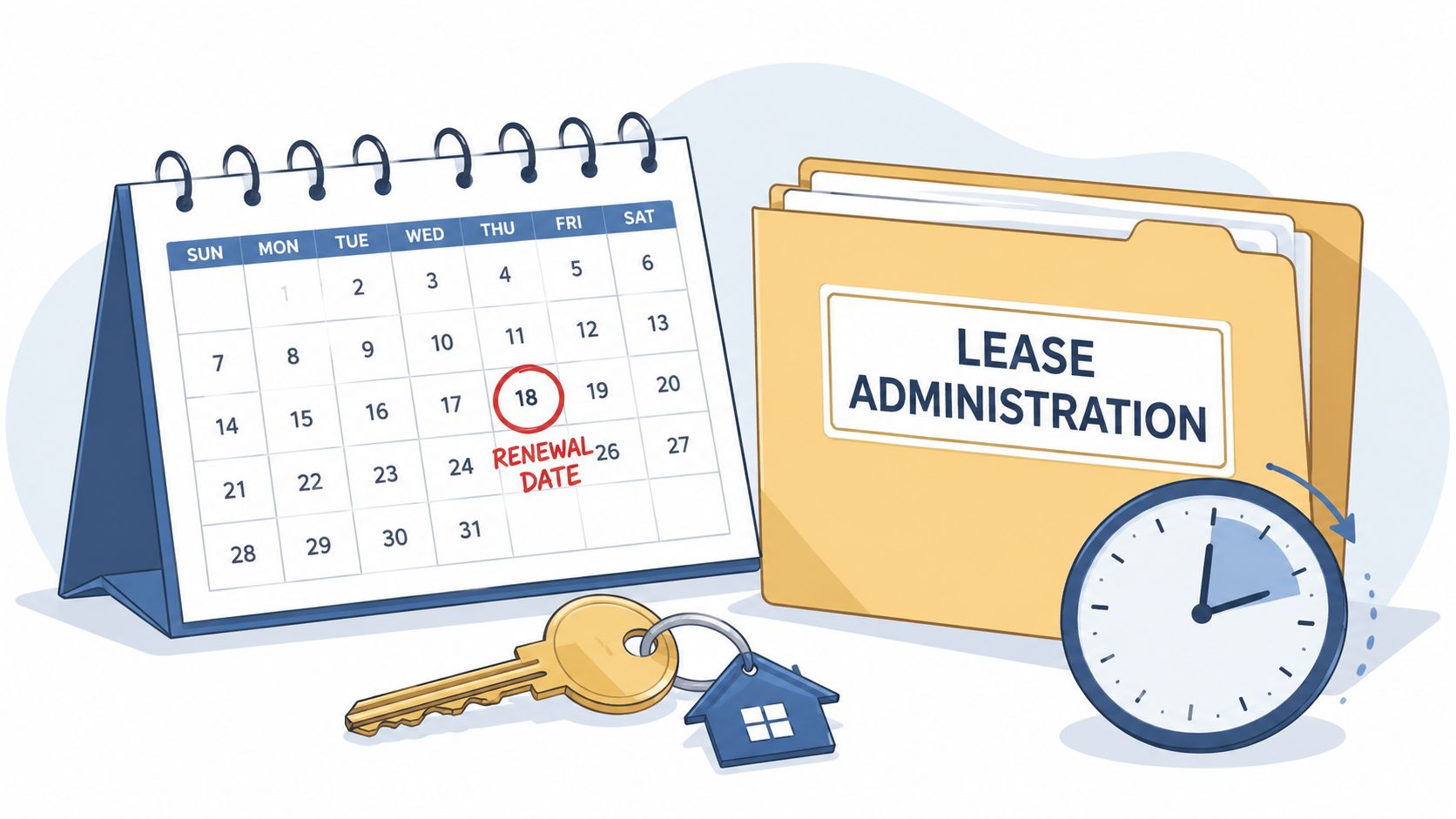
Keep the executed lease and every change together
A lease file should not be a single PDF buried in one folder while amendments sit somewhere else. Later documents can override earlier language, so the full package has to stay together. That includes addenda, riders, side letters, and any amendment that changes payment terms, use rights, or notice deadlines. Lease abstraction guidance makes the same point, later documents can control the original lease, so the reviewer has to read the complete file, not just the base agreement.
The same rule applies to record retention. Keep the executed lease with its exhibits and later changes in one file, and use a retention process that makes it easy to retrieve the full history later, as outlined in document retention policy best practices. If the file is split across inboxes and shared drives, the most important clause is often the one no one can find.
That discipline also protects deadlines. A renewal notice window only helps if someone can see it in advance. A rent escalation clause only works if the reminder is tied to the date it takes effect. An insurance certificate requirement only protects the landlord if the certificate is refreshed before it lapses.
Build the administration rhythm around evidence
Lease administration is document collection over time. The property manager needs proof, not memory, so the workflow should centralize notices, certificates, reconciliations, and amendments in one place. That makes it easier to answer practical questions like whether the tenant sent notice on time, whether CAM reconciliation was delivered, or whether the current policy still names the landlord correctly. A clear lease administration workflow keeps those records tied to the lease instead of scattered across email threads and local folders. See lease administration workflow guidance.
The point is not to create more paperwork. The point is to keep the existing paperwork searchable and current. If a side letter changes a rent term, the record should show it immediately. If insurance expires, the follow-up should happen automatically, not depend on someone remembering to check a spreadsheet.
Best practice: treat the lease like a living file, because that is what it becomes the day the tenant moves in.
That operating rhythm keeps the lease aligned with reality. Without it, even a strong draft slowly becomes the wrong version of the deal.
Onboarding Checklist and Common Questions
Use the same sequence every time. Before signing, confirm the premises description, use rights, rent structure, and expense allocation. At signing, collect ID, entity documents, tax forms, deposit proof, insurance, and guarantor materials. At move-in, store the executed lease with exhibits, log the renewal window, and schedule reminders for rent changes, insurance updates, and CAM reconciliation. Each year, verify that all notices, certificates, and amendments are still current.
For a small tenant facing rising operating costs, the safer structure is usually the one that makes pass-throughs easiest to see in advance. If the lease is vague about what counts as operating expense, the structure is less important than the drafting. If amendments start arriving later, keep the original lease and every change in one file so no one has to guess which language controls. If an insurance certificate expires mid-term, request an updated copy immediately and document the follow-up in the lease record.
The most practical answer to multi-tenant management is consistency. One portal, one naming convention, one document set per lease.
A CTA for Superdocu.