
You're probably dealing with one of two situations right now. Either a client, investor, tenant, borrower, or partner needs to send you identity documents, and you want a clean way to ask for them. Or a regulator, bank, legal adviser, or internal policy has pushed KYC from “something we should sort out soon” into “we need a process this week.”
That's where a KYC form doc becomes useful. Not as more paperwork, but as a way to collect the right information, request the right documents, and keep your records current without creating chaos for your team or your customers. For a small business, the hardest part usually isn't understanding that KYC matters. It's turning a vague compliance obligation into a process people can follow.
Table of Contents
- What Exactly Is a KYC Form Document
- Essential KYC Documents for Individuals
- Corporate KYC Documents for Businesses
- KYC Compliance and Verification Best Practices
- How to Securely Collect and Automate KYC Forms
- Managing Document Renewals to Avoid Common Pitfalls
What Exactly Is a KYC Form Document
A KYC form document is the practical side of “Know Your Customer.” It's the set of information and supporting files you collect so you can confirm who a customer is, where they live, and whether your business should proceed with the relationship.
One source defines it clearly: a KYC document is formal documentation, such as a passport or utility bill, used to verify the identity and address of a customer, and it's a mandatory part of customer due diligence for regulated entities aiming to comply with anti-money laundering regulations (Napier explanation of KYC documents).
Think of it as a digital handshake with evidence. A normal handshake says, “We're doing business together.” A KYC form doc says, “We know who you are, we've checked the basics, and we can show that we did.”

Why businesses need it
For many small businesses, KYC sounds like a bank-only issue. It isn't always that narrow. If you operate in a regulated setting, handle financial flows, onboard business entities, or work in sectors where identity checks matter, KYC can become a core control.
A proper KYC form doc helps you:
- Verify identity: You confirm the person is real and matches the documents provided.
- Verify address: You confirm where that person can be tied geographically.
- Create an audit trail: You can show what was collected, when, and why.
- Reduce fraud exposure: You lower the chance of accepting fake identities or incomplete records.
Practical rule: If your process relies on scattered email attachments and memory, you don't really have a KYC process. You have a document chase.
What a basic KYC form doc usually includes
At the simplest level, you're usually collecting two kinds of evidence for an individual:
- Proof of identity
- Proof of address
The identity document needs to be an original document that includes a photograph of the applicant. The address document needs to be issued in the individual's name. For proof of address, the document generally needs to be recent, typically issued within the last three months, according to the same Napier guidance linked above.
That logic also shows up in adjacent sectors. If you work in investment or fundraising workflows, this overview of real estate syndication compliance is a useful example of how identity and business verification fit into real transaction processes.
Why this matters beyond onboarding
KYC isn't only about collecting documents once. It's about establishing trust in a way your business can defend later. If a customer relationship changes, if risk rises, or if documents expire, your original form and files become the baseline record you'll rely on.
That's why a good KYC form doc should be clear, consistent, and easy to review. If customers don't understand what you need, they'll submit the wrong files. If your team can't check documents quickly, delays pile up.
Essential KYC Documents for Individuals
When you verify an individual, the easiest way to avoid confusion is to separate the request into two buckets: who the person is and where the person lives. Most KYC mistakes happen when those two get mixed together.
A KYC form document for an individual also does more than ask for files. It collects structured information across four areas: basic personal data, identity documentation, employment status, and financial purpose (Tecalis overview of KYC form document requirements).
Proof of identity
This is your POI, or proof of identity. The document should show the customer's legal name and include a photo.
Common examples include:
- Passport: Often the easiest document for cross-border verification.
- Driver's license: Commonly accepted when regulations allow it.
- National ID card: Useful where national identification systems are standard.
- Birth certificate: In some contexts, this can support proof of name, though businesses often need additional documentation for full verification.
What you should ask for in the form itself:
- Full legal name
- Date of birth
- Nationality
- Tax ID or equivalent identifier, where relevant
- A digital copy of the identity document
Proof of address
This is your POA, or proof of address. It confirms the customer's current residence and ties that residence to their name.
Typical examples include:
- Utility bill
- Bank statement
- Tenancy agreement
- Mortgage statement
The detail people often miss is the timing. For proof of address, the document should be recent, typically issued within the last three months. That recency matters because an old address document may be technically real but no longer reliable for current due diligence.
Don't ask for “something with your address on it.” Ask for a recent document, in the person's own name, and make the acceptable document types explicit.
The non-document fields matter too
Businesses sometimes focus only on uploads and forget the rest of the form. That creates blind spots.
A complete individual KYC form doc usually asks for:
- Basic personal data: Name, residence, contact details
- Identity details: Passport or national ID copy, tax ID
- Work information: Whether the person is employed or self-employed, plus employer or business name
- Purpose details: Source of funds and intended activity, such as transfers abroad
Those fields help your team understand whether the documents make sense in context. A customer who lists one country of residence but uploads an address document from another country may need follow-up. A self-employed applicant may need a different review path than a salaried employee.
A simple checklist you can give customers
If you want fewer back-and-forth emails, write the request plainly:
- One photo ID: Passport, driver's license, or national ID
- One recent proof of address: Utility bill, bank statement, tenancy agreement, or mortgage statement
- Matching details: Name on the form should match the name on the documents
- Clear files: No cropped corners, glare, or blurred text
That kind of plain-language request usually solves more problems than a long legal paragraph.
Corporate KYC Documents for Businesses
Verifying a company is different from verifying a person. With an individual, you're asking, “Are you who you say you are?” With a business, you're asking a wider set of questions. Is this entity legally formed? Who controls it? Who benefits from it? Do the submitted documents match the stated structure?
That's why corporate KYC almost always feels heavier. It should.
One reliable summary is that corporate KYC documents go beyond individual IDs and include structural verification such as certificates of incorporation, audited accounts, stock exchange listings, trustee lists, and other documents that establish legal structure (Incode explanation of KYC documents for effective verification).
What you're trying to confirm
For a business customer, your review usually has four layers:
- Legal existence: Does the entity officially exist?
- Operating identity: Does the trading name match the legal records?
- Ownership and control: Who owns or controls the entity?
- Entity type: Is it a sole proprietorship, LLC, corporation, partnership, trust, or listed company?
The more complex the structure, the more documentation you'll usually need.
Common corporate KYC documents
A business KYC form doc often asks for some combination of the following:
- Certificate of incorporation
- Recent audited accounts
- Stock exchange listing details, if applicable
- Trustee list, if the entity is a trust
- Documents showing the legal structure
- Identity documents for relevant individuals connected to the business
If you're a small business onboarding vendors, clients, or investment entities, don't try to solve everything with one generic checklist. A sole proprietor and a multi-owner corporation won't produce the same evidence.
KYC Document Requirements by Business Entity Type
| Entity Type | Required Documents |
|---|---|
| Sole proprietorship | Owner's photo ID, proof of address, and documents showing the business is operating under that individual |
| LLC | Certificate of incorporation or equivalent formation document, records showing legal structure, and identity documents for relevant controlling individuals |
| Corporation | Certificate of incorporation, recent audited accounts where relevant, ownership or control documentation, and any records needed to establish legal structure |
| Partnership | Formation or partnership documents, identity documents for partners or controllers, and records showing how the business is legally organized |
| Trust | Trustee list, documents establishing trust structure, and identity documents for relevant parties |
| Listed company | Corporate formation records and stock exchange listing documentation, along with any supporting structural records needed by your compliance process |
A good corporate checklist doesn't ask every business for every document. It asks for enough to verify the structure that actually exists.
Where small teams get stuck
The usual problem isn't lack of willingness. It's overcollection or undercollection.
If you ask every company for the same bundle, you'll frustrate simple entities and still miss key documents for complex ones. If you ask for too little, your file won't stand up later when someone asks how you verified ownership and control.
A cleaner approach is to branch the form early. Start by asking what kind of entity the customer is. Then request only the records that fit that structure.
KYC Compliance and Verification Best Practices
Collecting documents is only one part of KYC. The stronger process is the one behind the form. Who reviews the file? What happens if details don't match? When do you ask follow-up questions? Which customers need deeper checks?
A standard global framework breaks KYC into three core components: Customer Identification Program (CIP), Customer Due Diligence (CDD), and Enhanced Due Diligence (EDD) for high-risk accounts (Investopedia guide to Know Your Customer).

Start with CIP
Customer Identification Program is the first filter. You collect identifying information and verify it using reliable documents or data sources.
In practical terms, your KYC form doc needs to be tight. If the form is vague, CIP fails early because the customer sends partial or unusable files.
For many businesses, that means collecting:
- Basic identifying details
- A valid identity document
- A separate address document
- Any additional business-specific information needed at intake
Move into CDD
Customer Due Diligence is where you ask whether the customer relationship makes sense. This is broader than “is the passport real?”
CDD often involves looking at:
- Purpose of the relationship
- Type of customer
- Geographic factors
- Expected activity
- Whether the file contains inconsistencies that need explanation
A customer opening a simple low-risk account won't need the same review as a customer with a complex ownership structure or unusual transaction purpose.
Escalate when EDD is needed
Enhanced Due Diligence applies when risk is higher. The same Investopedia source notes that high-risk accounts require additional checks, and that businesses often use a risk-based approach that can include sanctions screening, politically exposed person checks, and ongoing monitoring.
That's the key idea. KYC isn't a one-size-fits-all checklist. It's a controlled process that gets deeper when risk rises.
If every customer goes through the exact same review path, your team will either overwork low-risk files or miss what makes a high-risk file different.
Build a risk-based workflow
A small business doesn't need an oversized compliance department to think clearly about risk. It does need rules.
A workable approach looks like this:
- Define low, medium, and high-risk signals
- Match document requirements to those signals
- Record review decisions
- Escalate exceptions instead of improvising
That means your team should know what to do when:
- A document is blurry
- A proof of address is too old
- A company structure is unclear
- A customer's stated purpose doesn't match the submission
A useful overview of how AML and KYC fit together can help teams align those controls with document collection workflows, especially when compliance starts to outgrow ad hoc processes. See this guide on AML and KYC compliance workflows.
Keep records that can be audited
The same Investopedia guidance also notes the importance of ongoing monitoring and periodic reviews to keep information accurate and auditable. Even if your business is small, you should be able to answer three simple questions later:
- What did we collect?
- Who reviewed it?
- Why did we approve, reject, or escalate it?
That's what turns a stack of files into a compliance record.
How to Securely Collect and Automate KYC Forms
Manual collection creates more problems than initially anticipated. A customer sends an ID by email. Someone else sends a utility bill in a separate thread. The compliance note lives in a spreadsheet. A reminder gets forgotten. Then someone has to search inboxes before a deadline.
That process isn't only messy. It creates security and compliance risk. KYC rules are legally enforced in many jurisdictions, with strict penalties for non-compliance, including substantial fines and legal action under frameworks such as the EU's AMLD and the US Bank Secrecy Act (Fenergo overview of KYC requirements for banks).
What a safer collection process looks like
The goal is simple. Ask for the right documents, through one channel, with clear instructions and traceable follow-up.
That usually means using a secure workflow with:
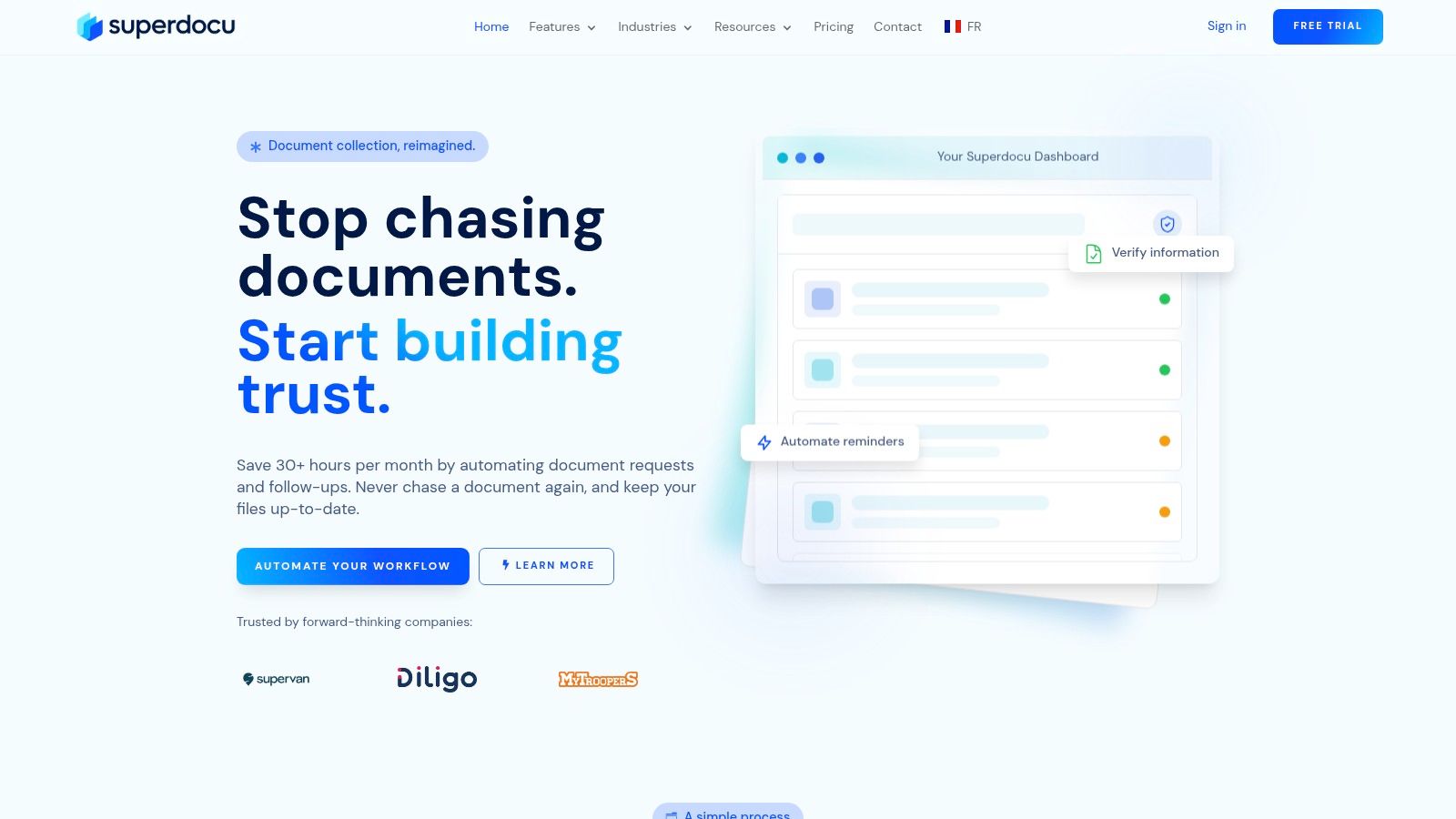
- A branded request page: Customers know the request is legitimate.
- A defined checklist: They see exactly which files to upload.
- Automated reminders: Your team doesn't have to chase every missing document manually.
- A review dashboard: Reviewers can validate submissions in one place.
- Controlled storage: Sensitive files aren't scattered across inboxes.
Here's what that kind of workflow can look like in practice.
A practical automation flow
A small business can set up a repeatable KYC form doc process in a few steps:
Create a request template
Build one version for individuals and another for business entities.List only the required files
Don't force customers to guess. Name the accepted document types inside the request.Use conditional paths
If the customer selects “business,” show company-specific fields. If they select “individual,” show POI and POA requirements.Set reminders before humans need to intervene
Most missing-document delays don't require analysis. They require timing.Review in one queue
Keep submitted files, notes, and status together.
A similar idea shows up in other admin-heavy environments too. If you've seen how organizations standardize requests for IDs, certifications, or forms through volunteer management tools, the lesson is the same. Structured intake reduces confusion and missed follow-ups.
Where one platform can fit
One option is Superdocu, which provides branded portals, pre-built templates, automated reminders, validation dashboards, and expiration tracking for document workflows. For teams that want to see how a document collection system can be adapted to compliance intake, this guide to KYC document collection software shows the structure in more detail.
Security habits that matter
Automation helps, but only if the workflow is designed carefully.
Focus on these habits:
- Limit collection: Ask only for documents you need.
- Standardize naming and review: Make it obvious what has been checked.
- Avoid email attachments where possible: Sensitive identity files shouldn't move through uncontrolled channels.
- Separate intake from approval: The person collecting files doesn't always need to be the final reviewer.
The best KYC intake process often feels boring. That's a good sign. Boring means repeatable, and repeatable means your team is less likely to miss something.
Customer experience matters too
People are more likely to complete KYC quickly when the request is specific and easy to trust. That means fewer legal terms, clearer upload instructions, and no mystery about why a document is being requested.
A good process respects both sides. Your business needs a defensible record. Your customer needs a simple path to provide it.
Managing Document Renewals to Avoid Common Pitfalls
A customer passes onboarding in January. By July, their proof of address is outdated, a director has changed, and nobody on your team has noticed. On paper, the file still looks complete. In practice, it is aging out.
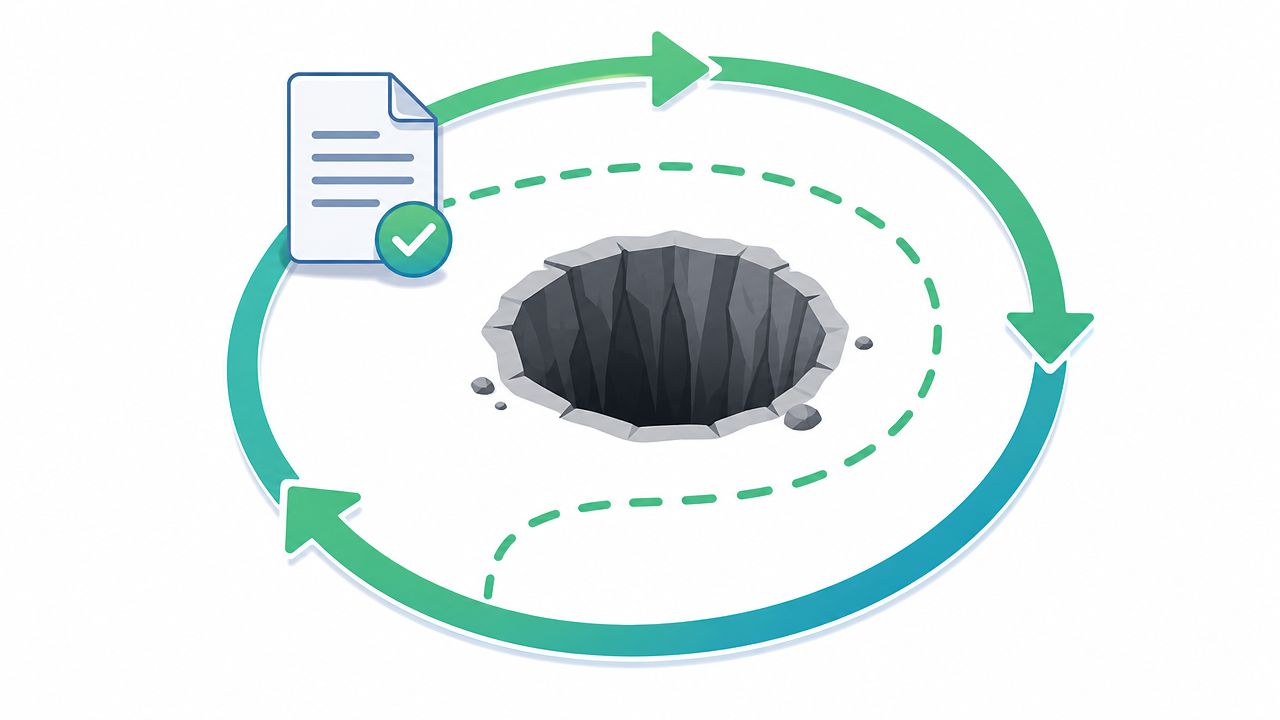
That is the trap with KYC renewals. A file can be approved once and still become unreliable later. IDs expire. Company records change. Ownership shifts. If your KYC form doc process ends at collection, your team is making decisions from a snapshot instead of a current record.
The better way to handle this is to treat KYC like a maintenance schedule. Collection starts the process. Renewal keeps it useful.
Expiration is part of risk control
Small teams often file approved documents away and return only when a reviewer spots a problem. That creates avoidable gaps. Data shows 30% of financial institutions face penalties annually due to failures in periodic due diligence assessments that do not adapt to document expiration timelines, and 65% of regulated entities in the EU use dynamic risk-scoring models that flag documents expiring within 60 days while allowing controlled grace periods for verified renewals, reducing false rejection rates by 22%.
The lesson is practical. Renewal failures usually come from weak follow-up, unclear ownership, or no expiry calendar at all.
Strict rejection is not always the safest policy
An expired document does not always mean the customer has become high risk. Sometimes it means the customer is already renewing it and needs a short, controlled window to submit the replacement.
A useful policy separates silence from cooperation. A customer who ignores reminders for weeks should not be handled the same way as a customer who uploads renewal evidence before the deadline. That distinction protects compliance and avoids unnecessary friction.
A renewal process that a small team can actually run
You do not need a large operations team to improve this. You need a sequence your staff can follow every time.
- Track expiration dates at intake: If a document has an end date, record it immediately.
- Start reminders early: Give customers time to renew before the file becomes stale.
- Set review rules by risk level: Higher-risk accounts may need earlier outreach or stricter escalation.
- Allow limited grace periods where policy supports them: Keep the file under review, not ignored.
- Record every exception: If a pending renewal is accepted temporarily, note who approved it and why.
- Escalate non-response: Missed reminders should trigger follow-up steps, not sit in a queue.
This kind of workflow works like servicing equipment in a shop. Waiting until something breaks creates disruption. Scheduling checks keeps the operation stable.
What to track across the full document lifecycle
A KYC form doc should move through clear stages, not stop at "received."
| Stage | What your team should do |
|---|---|
| Collected | Confirm all required files were submitted |
| Reviewed | Check quality, validity, and consistency |
| Approved | Record decision and review date |
| Monitored | Track risk changes and future review needs |
| Expiring | Send alerts and request refreshed documents |
| Renewed or escalated | Accept updated documents or move the file to follow-up review |
Renewal is the step many businesses skip. That is also the step that keeps a compliant file from turning into an outdated one.
If you want a clearer way to build alerts, ownership rules, and review timing, this guide to document expiration tracking workflows is a useful reference.
Keep the customer experience intact
Renewals go more smoothly when customers know the rules from the start. Tell them which documents expire, when they may be asked for updates, and what counts as acceptable replacement evidence. Clear expectations reduce back-and-forth and make refresh requests feel routine instead of suspicious.
A good renewal system protects both sides. Your business keeps a current, defensible record. Your customer gets a predictable process.
If your team needs a more organized way to request IDs, proof of address, company records, and renewal documents, Superdocu gives you a structured way to collect them through branded portals, automated reminders, review dashboards, and expiration tracking so your KYC process stays manageable as volume grows.