
At its core, a file request is just what it sounds like: asking someone to send you a digital document. It’s the modern-day version of asking for a paper file, but instead of physical folders, we're talking about PDFs, spreadsheets, images, and other digital files.
What Is a File Request and Why Does It Matter

Think of your document collection process as a company mailroom. Relying on email and shared drives is like having packages and letters dumped in a giant, messy pile on the floor. It's pure chaos. Documents get lost, and your team wastes hours just trying to sort through everything.
A dedicated file request system, however, is like a state-of-the-art mailroom with clearly labeled slots, automated sorting, and top-notch security. It’s a structured way to gather information from clients, new hires, or partners.
Instead of a vague email asking for "all the necessary documents," you give them a secure, branded portal with a simple checklist of exactly what you need. This small change solves some of the biggest headaches in business. It kills the endless back-and-forth emails, keeps sensitive data safe, and stops your team from having to manually chase people for missing files.
The Old Way Versus the New Way
The difference between old-school methods and a proper system is night and day. Many businesses just accept the risks and wasted time of traditional methods as a "cost of doing business." But those costs are completely avoidable.
Just think about the common ways we ask for files and how they fall short:
- Email Attachments: They have size limits, get caught in spam filters, and open up huge security holes.
- Shared Drive Links: Clients often find them confusing, leading to files uploaded in the wrong place with the wrong names.
- Consumer File-Sharing Tools: These lack the professional branding, robust security, and audit trails a business really needs.
A dedicated system brings the whole process into one place. It provides a single secure link for a client to upload everything, gives them clear instructions, and even sends out automated reminders so your team doesn't have to. For a deeper look, check out our guide on how to collect documents from clients the right way.
A great file request process does more than just collect files; it builds client trust from the very first interaction. When the process is simple, secure, and professional, it tells your clients that you value their time and their data.
Why This Shift Is Critical for Modern Business
The push for a better file request workflow comes down to three things: rising security threats, higher client expectations, and the sheer cost of manual admin work. Businesses are handling more sensitive data than ever before, and a single breach can be devastating.
At the same time, clients now expect a slick digital experience. A clunky, confusing submission process makes your brand look bad. By switching to a dedicated system, you tackle these issues head-on and turn a potential weakness into a real competitive advantage.
This table really highlights the contrast:
| Feature | Ad-Hoc Methods (Email, Shared Drives) | Dedicated File Request System |
|---|---|---|
| Security | Low; vulnerable to phishing and data leaks. | High; end-to-end encryption and audit trails. |
| Efficiency | Manual; requires constant follow-ups. | Automated; reminders and centralized tracking. |
| Client Experience | Confusing and often frustrating. | Simple, branded, and user-friendly. |
| Organization | Disorganized; files scattered across inboxes. | Centralized; all documents in one secure place. |
The Hidden Drains of Disorganized File Collection

If your team is still chasing down client files through endless email chains and messy shared folders, you're dealing with more than just a minor headache. This unstructured approach is a silent drain on your business, quietly chipping away at your time, money, and security.
Think about a small accounting firm in the middle of tax season. They're drowning in emails, each with a slightly different "final_v2_final" document attached. Hours are lost just trying to confirm if they have everything they need from a client, let alone doing the actual work.
Sound familiar? This constant back-and-forth isn't just frustrating for your team. It creates a confusing and unprofessional experience for your clients, who are left wondering what you need and when. This ad-hoc method doesn't just feel messy—it has real, tangible costs that hit your bottom line.
The True Cost of Inefficiency
When you rely on a patchwork of emails and shared drives, you’re essentially creating a system that works against itself. Every step is manual, repetitive, and wide open to human error. A disorganized file request workflow is a thief, and its target is your team's most valuable resource: their time.
Just think about the little tasks that add up every single week:
- Manual Follow-ups: An employee has to stop what they're doing, dig up an old email thread, and craft another polite reminder about that one missing document.
- Searching for Documents: A project manager needs to find a signed contract, but it could be in one of three different inboxes or buried in a folder named "Misc."
- Version Control Chaos: Two people edit the same file and email their versions back, leading to confusion, wasted work, and sometimes, costly mistakes.
These small time sinks accumulate faster than you'd think. In fact, research shows that knowledge workers can spend nearly 20% of their workweek just searching for information or tracking down colleagues who can help. That’s an entire day lost, every single week, for every employee.
A disorganized file collection process is like a leaky faucet. Each drip of wasted time seems insignificant on its own, but over a month or a year, the accumulated loss is staggering.
Sorting out your file request process plugs that leak and gives that time back to your team.
Navigating the Security and Compliance Minefield
Beyond the obvious productivity drain lies a much bigger risk: security and compliance failures. Using email for a sensitive file request is like mailing confidential documents in an unsealed envelope. It's just not secure. Email is a prime target for phishing attacks, and one compromised account can expose a huge amount of client data.
On top of that, many industries have to follow strict data privacy rules like GDPR and HIPAA. A messy system makes it nearly impossible to prove you're compliant. Without a clear audit trail showing who touched a file and when, you're left exposed during an audit or, even worse, after a data breach.
The risks are serious and can come from anywhere:
- Data Breaches: An employee accidentally sends sensitive files to the wrong email address—a simple, common, and potentially devastating mistake.
- Phishing Attacks: A convincing fake email tricks a client into uploading their documents to a hacker's website, destroying trust and your reputation.
- Compliance Penalties: Failing to protect client data can lead to fines big enough to cripple a small business.
A structured file collection system isn't just about staying organized; it's a critical part of a modern security strategy. It swaps the vulnerabilities of email for a secure, encrypted, and traceable environment that protects both you and your clients.
Comparing File Collection Methods
It's clear that the method you choose for collecting files has a major impact. Let's break down the differences between a dedicated system and the old-school approach.
| Feature | Dedicated File Request System | Email & Shared Drives |
|---|---|---|
| Security | Encrypted, access-controlled, and secure portals | Prone to phishing, data leaks, and unauthorized access |
| Efficiency | Automated reminders, centralized dashboard, status tracking | Manual follow-ups, fragmented communication, no oversight |
| Client Experience | Simple, branded, and guided upload process | Confusing, unprofessional, requires multiple steps |
| Compliance | Provides clear audit trails and helps meet regulations | Difficult to track access, lacks formal audit capabilities |
| Version Control | Manages versions automatically, single source of truth | Creates duplicates, leads to "final_v3.docx" chaos |
| Integration | Connects to other business tools for seamless workflows | Isolated systems that require manual data transfer |
As the table shows, sticking with traditional methods means accepting major trade-offs in nearly every area that matters—from security to the experience you provide your clients. A dedicated system is built from the ground up to solve these problems.
What You Gain With a Modern File Request System
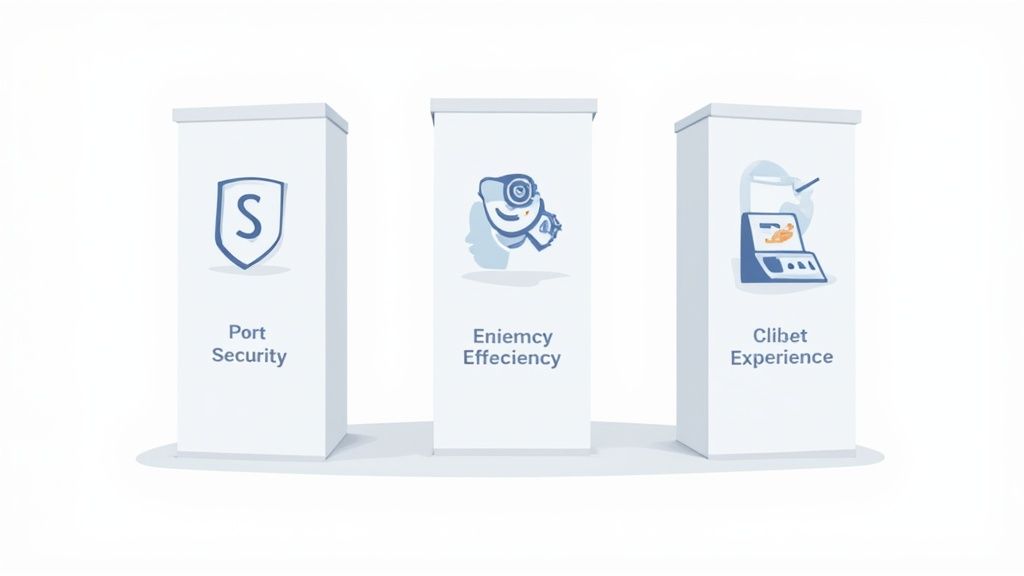
Moving away from the chaos of email attachments and messy shared drives isn't just about getting organized. It’s a strategic shift that brings real, tangible benefits across your entire business—stronger security, sharper efficiency, and a much better client experience.
These advantages aren't just buzzwords; they’re built on three core pillars that directly address the weak spots of older, ad-hoc methods. Let's break down how switching to a dedicated system can turn a painful administrative chore into a genuine business asset.
Fortify Your Security and Compliance
In a world where data breaches are a constant threat, using a proper file request system is no longer optional—it's a fundamental security measure. Email was never built to be a secure vault for sensitive files. A dedicated platform, on the other hand, is built from the ground up with security at its core.
It's like the difference between leaving a sensitive package on your public doorstep versus placing it in a bank's vault. Features like end-to-end encryption wrap your files in a protective layer, making them unreadable to anyone without the right key, both in transit and at rest.
Security isn't just a feature; it's the foundation of trust. A secure file request process shows your clients you're serious about protecting their data, which strengthens that relationship right from the start.
Beyond encryption, these systems give you detailed audit trails. This means you have a complete, unchangeable log of every single action: who requested a file, who uploaded it, and when it was accessed. This kind of granular oversight isn't just nice to have; it's essential for meeting compliance standards like GDPR or HIPAA and proving you're handling data responsibly.
Reclaim Your Team's Time with Smarter Workflows
The first thing your team will notice is just how much time they get back. Chasing down documents, sending manual follow-ups, and digging through disorganized inboxes are massive productivity killers. A modern file request system automates the grunt work, freeing up your people to focus on what they do best.
Customizable templates are a huge part of this. Instead of rewriting the same email for every new client or project, you can build a standard request in minutes. This not only saves a ton of time but also ensures every request is professional and consistent.
The system also takes over the tedious job of nagging for missing files. You can set up automated reminders to gently nudge clients who are running behind, which means your staff can stop playing collections agent and focus on more valuable work.
The efficiency gains are clear and immediate:
- A Centralized Dashboard: See the status of every single file request in one spot. No more hunting through email threads to figure out what's still missing.
- Automatic Naming and Organizing: Files are automatically named and sorted as they come in, putting an end to the chaos of documents called “Final_Scan_v2_updated.pdf.”
- Fewer Errors: By giving clients a clear checklist and simple instructions, you cut down on receiving the wrong or incomplete documents, which means less back-and-forth for everyone.
This reclaimed time adds up fast. Tasks that used to eat up hours every week can be handled in just a few minutes, making your entire team more productive and proactive.
Elevate Your Client Experience
Think about it: your document collection process is often one of the very first interactions a new client has with your business. A clunky, confusing experience can sour the relationship before it even starts. A smooth, professional one, however, builds confidence and satisfaction from day one.
A dedicated file request portal gives your clients a simple, branded, and easy-to-use experience. They get a single, secure link that takes them to a clean page where they see exactly what you need and can upload their files from any device.
There’s no software to install and no complicated login to figure out. The goal is to make it as frictionless as possible. Not only does this make your clients happier, but it also means you get the documents you need much faster. This polished, user-friendly approach reflects well on your brand, showing clients that you're organized, professional, and respect their time.
Real-World File Request Workflows in Action
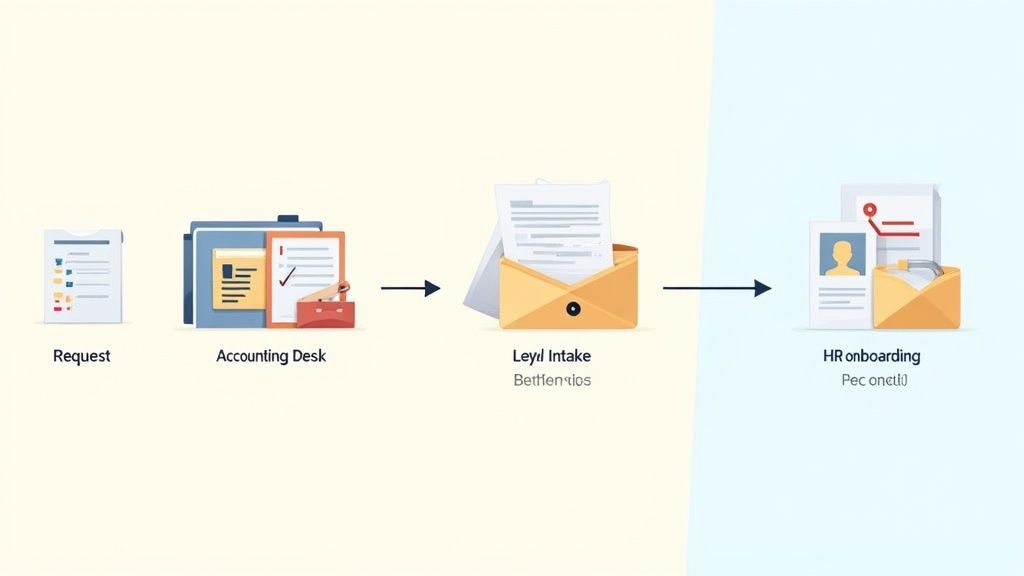
It’s one thing to talk about the benefits of a modern file request system, but it's another to see it untangle a real-world mess. The true "aha!" moment comes when you watch a chaotic, manual workflow transform into something smooth and professional.
Let’s move past the theory and look at how different businesses are tackling their unique document collection headaches. Each scenario paints a clear picture of a frustrating problem and the elegant solution a structured system can provide.
Accounting Firms During Tax Season
For any accountant, tax season is a frantic sprint. Your success hinges entirely on getting the right documents from clients—on time. The old-school method usually means sending a monster email with a laundry list of every possible document, which just leads to confused clients, disorganized files, and endless follow-up calls.
A modern file request system completely changes the game.
- The Pain Point: Constantly chasing clients for W-2s, 1099s, and investment statements, causing delays and opening the door for costly errors.
- The Smart Solution: The firm builds a "Tax Prep Checklist" template. With a single click, they can send each client a secure, branded portal with a personalized list of exactly what they need to provide.
- The Result: Clients can easily drag-and-drop files or upload them straight from their phones. The system automatically checks off each item as it arrives and sends polite, automated reminders for anything that's missing. This frees up the accounting team to do actual tax prep, not administrative busywork.
This approach doesn't just speed things up; it makes the firm look more professional and dramatically reduces the chance of mistakes.
By swapping out a messy email chain for a single, secure portal, an accounting firm can slash its document collection time by over 50%. This simple shift turns a huge bottleneck into a real competitive advantage during their busiest season.
Legal Teams Managing Client Intake
When a law firm brings on a new client, the intake process is absolutely critical. You're gathering highly sensitive documents like contracts, personal identification, and case evidence, all of which demand top-notch security and organization. Let's be honest—email just isn't cut out for that level of confidentiality.
This is where a dedicated platform becomes a necessity for both compliance and pure efficiency.
- The Pain Point: Securely collecting confidential client files while maintaining a perfect, auditable trail to meet strict compliance standards.
- The Smart Solution: The firm implements a secure file request workflow for all new client onboarding. The request includes a clear checklist for things like the signed retainer agreement, ID verification, and initial case documents.
- The Result: Clients get a link to an encrypted portal, which immediately gives them confidence that their private information is safe. Internally, the firm has a central dashboard to track the status of all incoming files, complete with a detailed audit log showing who accessed what and when.
This process ensures every document is collected securely and by the book, building crucial client trust right from the start.
HR Departments Streamlining New Hire Onboarding
Onboarding a new employee means collecting a mountain of paperwork. You need signed offer letters, tax forms, I-9 verification, direct deposit info… the list goes on. A disorganized process not only creates a poor first impression but can also lead to serious compliance headaches later.
An automated file request workflow ensures every new hire gets a smooth, professional welcome.
- The Pain Point: Manually chasing dozens of forms for each new employee, resulting in a clunky, inconsistent, and slow onboarding experience.
- The Smart Solution: The HR team creates a new hire onboarding template. As soon as a candidate accepts their offer, the system automatically sends a file request with everything they need to fill out. You can learn more about how an automated document request tool can handle these workflows.
- The Result: New hires receive a simple, welcoming checklist they can complete online before their first day. The HR team can see at a glance who has submitted what, guaranteeing every employee file is 100% complete and compliant from day one.
See How Superdocu Turns File Requests into a Smooth, Automated Process
It’s one thing to understand why a dedicated file request system is a good idea, but it’s another thing entirely to see it transform your daily work. The real magic happens when you replace a messy, insecure back-and-forth with a professional, automated workflow that just works. Superdocu was designed from the ground up to do exactly that, tackling the security headaches and wasted time of old-school methods head-on.
Forget about digging through endless email chains. Superdocu provides a single, central place to manage everything. You can spin up a secure request in just a few minutes using pre-built templates, protect your client's sensitive information with bank-level security, and let automated reminders handle all the nagging for you. It's a system built to be powerful for your team and incredibly simple for your clients.
Build and Send Secure Requests in Minutes
Getting up and running with Superdocu is a breeze. The platform is designed to be intuitive, so you can create and send a professional file request without needing an IT degree. You can also customize the look and feel to match your company's branding, giving your clients a polished and consistent experience right from the start.
This straightforward approach means your team can easily create standardized collection processes, ensuring every client interaction is secure and professional.
Take a look at how simple it is to build a new, organized checklist for a file request right inside the Superdocu dashboard.
With a clean layout like this, you can spell out exactly what you need, add clear instructions for each item, and set firm deadlines—all from one screen.
Bank-Level Security for Every Single File
Trust is the foundation of any professional relationship, and security is how you build it. Superdocu takes your data security as seriously as you do, leaving the well-known risks of email far behind. From the moment a file is uploaded to the moment you download it, it's protected by serious security measures.
Here’s how we keep your data locked down:
- End-to-End Encryption: Your files are encrypted while they're being uploaded and while they're stored on our servers. This scrambles the data, making it unreadable to anyone without authorization.
- Secure, Branded Portals: Instead of attaching sensitive documents to an email, your clients upload them to a private, controlled space that belongs to you.
- Detailed Audit Trails: You get a complete history of every action. See who requested what, when it was uploaded, and who downloaded it—perfect for staying compliant.
When you use a system built for security from the start, you can handle sensitive information with complete confidence. You can dive deeper into creating a safe environment for your clients in our guide to a secure document intake platform.
Automate Your Follow-Ups and Get Hours Back
Let's be honest: one of the biggest time-sinks in collecting documents is the constant follow-up. Chasing clients for missing files is tedious and drains hours from your week. Superdocu takes this entire task off your plate.
You can set up a simple schedule of polite, automated reminders that give clients a gentle nudge when deadlines are near or if you're still waiting on a few documents. This not only helps you get what you need on time but also keeps the conversation professional and friendly, all without you lifting a finger.
"Before Superdocu, we were drowning in email follow-ups. Now, the system handles the reminders for us, and we can see the status of every client file on a single dashboard. It has easily saved our team 10+ hours a week."
This kind of automation has become essential, especially as more teams work remotely. The technology that powers a secure file request is part of the global Remote File Access market, which has boomed with this shift. It was valued at USD 341 million in 2024 and is projected to hit USD 675 million by 2032, all because professionals need to get to their files securely, no matter where they are. You can find more details on the Remote File Access Market on intelmarketresearch.com. Superdocu puts that same power right at your fingertips, making your entire workflow more modern and efficient.
Got Questions About File Requests? We’ve Got Answers.
Jumping into any new system, no matter how great it seems, naturally comes with a few questions. It’s smart to kick the tires and think through the practical side of things before you change up your team's routine. This section tackles the most common questions and hesitations we hear about switching to a dedicated file request platform.
We're here to give you direct, no-fluff answers to clear up any lingering doubts. Let's dig into the big ones: security, client experience, and how this all fits into the way you already work.
Is a File Request System Really More Secure?
This is probably the number one question we get. Is a dedicated system genuinely more secure than, say, sending a password-protected Dropbox link? The answer is a resounding yes, and the difference is night and day.
Think of it this way: a password-protected link is like a simple padlock on a garden shed. It’s a single layer of security, which is better than nothing, but it’s not exactly Fort Knox. A true file request system, on the other hand, is like a bank vault—a complete security environment built from the ground up to protect what’s inside.
These platforms have multiple layers of defense that a simple link just can’t replicate:
- End-to-End Encryption: Your client's data is scrambled the second it leaves their device and stays that way until it’s safely in your hands.
- Secure User Authentication: You know exactly who is uploading files, so there’s no guesswork about whether the right person is sending the information.
- Detailed Audit Trails: Every single action is tracked and logged, from the moment you send the request to the final download. This isn't just nice to have; it's often essential for compliance with regulations like GDPR or HIPAA.
- Role-Based Access Controls: You decide which members of your team can see or touch sensitive documents, dramatically reducing internal risks.
A simple shareable link can be accidentally forwarded, the password can be guessed, or the email it’s in can be intercepted. A secure portal creates a private, controlled, and traceable space that’s absolutely critical for handling the kind of sensitive information businesses run on today.
Will This Be Too Complicated for My Clients?
A totally fair question. The last thing anyone wants is to introduce a new tool that just confuses and frustrates the very people you need information from. That's exactly why modern file request platforms are designed to be almost ridiculously simple for the end-user.
From your client's perspective, the process couldn't be easier. They get an email with a single, clear link. They click it. They land on a clean, professional-looking page with your branding, a simple checklist of what you need, and a big, friendly "upload" button.
The best systems are invisible to the user. A great file request portal feels less like using software and more like following simple instructions on a webpage. The technology does the heavy lifting in the background, so your client doesn't have to.
There is absolutely no software to install and no complicated account to create. Honestly, it’s often much easier and faster for them than digging through their files and attaching multiple large documents to an email, especially if they're on a phone. This smooth, user-friendly design means less friction for them and faster document collection for you. Win-win.
How Does This Fit Into My Current Workflow?
The thought of ripping out an established process and starting over is enough to give anyone a headache. But good tools aren't about disruption; they're about enhancement. You can ease into it, not flip a switch overnight.
For example, you could start small. Just replace the part of your process where you manually email clients for documents. Instead of your team typing the same message for the tenth time this week, they'll just send a secure link from a template. The time you save on follow-ups and automated reminders alone will make the value obvious almost immediately.
Once you see it working, you can go deeper. Many platforms connect directly with the tools you already use, like Google Drive, Dropbox, or your CRM. This means files can be automatically sent to the right folder, renamed, and organized without anyone on your team lifting a finger. The transition is smooth, and the efficiency gains pop up right away, letting your team adapt at their own pace.
Ready to stop chasing documents and start streamlining your workflow? Superdocu provides a secure, automated, and professional way to handle every file request. Try it free for 7 days and see the difference.