
A driver qualification file (DQF) is more than just a folder of paperwork; it's the legal backbone of your transportation operation, proving your commitment to safety and compliance with Federal Motor Carrier Safety Administration (FMCSA) regulations. With audits becoming more stringent and penalties for non-compliance growing, maintaining a complete and accurate DQF for every driver is non-negotiable. A single missing or outdated document can lead to significant fines, operational shutdowns, and even increased insurance premiums.
This guide provides a comprehensive driver qualification file checklist, breaking down the 8 absolutely essential documents you must collect, verify, and maintain to build an audit-proof system. We move beyond a simple list to give you the actionable details needed for flawless execution.
Inside, you will find:
- Specific FMCSA regulatory references for each required document.
- Clear retention periods and renewal schedules to prevent compliance lapses.
- Common audit pitfalls and how to avoid them with proactive management.
- Practical workflows for automating collection and verification.
We will dive into the specifics of each required item, from the initial Application for Employment to ongoing Medical Examination Certificates and Motor Vehicle Reports. Consider this your roadmap to not just meeting, but exceeding, compliance standards in 2025. By implementing the strategies outlined here, you can transform your DQF management from a reactive, stressful task into a streamlined, defensible asset for your business. Let's get started.
1. Application for Employment
The Application for Employment is the cornerstone of your entire driver qualification file checklist. Mandated by the Federal Motor Carrier Safety Administration (FMCSA) under 49 CFR § 391.21, this document is the first official record you'll have for a prospective driver. It collects essential personal details, contact information, and a comprehensive employment history that forms the basis for all subsequent background checks and verifications. It must be completed, signed, and dated by the applicant.
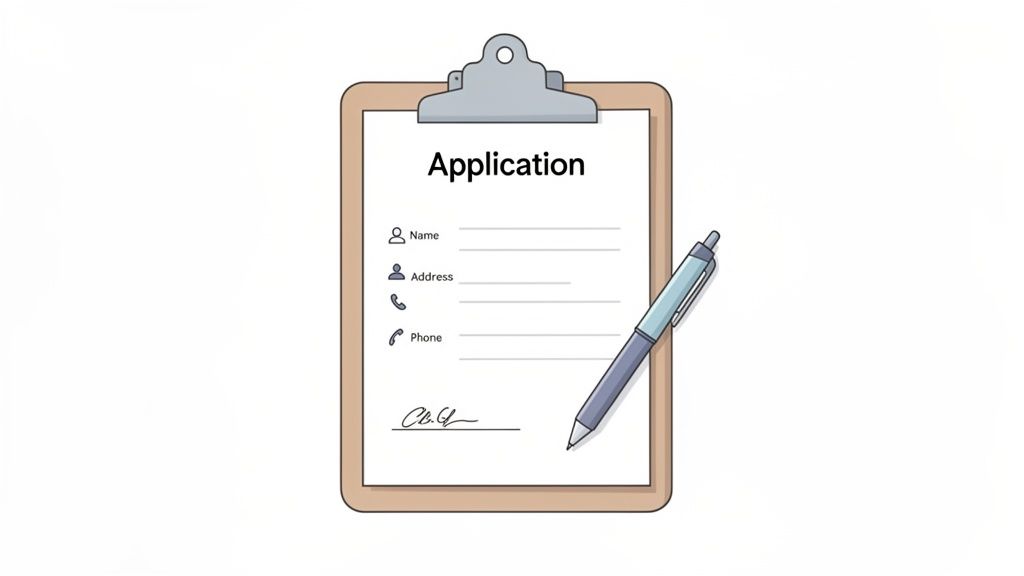
This form isn't just a formality; it's a critical compliance tool. The information provided, especially the 10-year employment history for interstate drivers, is what you will use to conduct mandatory safety performance history investigations. An incomplete or inaccurate application can lead to a failed audit and significant compliance risks down the road.
Why It's a Foundational Document
Think of the application as the blueprint for the DQF. Every subsequent document, from the motor vehicle report (MVR) to employment verifications, cross-references the data supplied here. Major carriers like J.B. Hunt and Schneider National utilize detailed, FMCSA-compliant digital applications as the first gate in their rigorous qualification process. Accuracy at this initial stage prevents delays and ensures you are building a compliant file from day one.
Actionable Tips for Implementation
- Go Digital and Automate: Manual paper applications are prone to errors and get lost easily. Use a platform to create branded, digital application templates with e-signature capabilities. This simplifies the process for drivers and ensures you receive a complete, legible record.
- Set Up Smart Reminders: Reduce follow-up time by setting automated reminders for applicants who have started but not finished their forms. This simple step can significantly improve your first-pass completion rates.
- Validate and Cross-Reference: As you collect other documents, make it a standard practice to cross-reference employment dates and other details against the original application. Discrepancies should be addressed and documented immediately.
- Ensure Secure Storage: The signed application contains sensitive personal information and must be stored securely. Using a system with encrypted cloud storage ensures the document is protected yet easily accessible for audits.
By standardizing your application process, you establish a solid, compliant foundation for every driver's file. Transitioning to a digital workflow with a dedicated platform can streamline this critical first step. For more on this, explore our insights on driver qualification file software.
2. Previous Employment Verification (Motor Carrier Record)
The Previous Employment Verification, also known as the Safety Performance History (SPH) investigation, is a critical step in your driver qualification file checklist. Mandated by the FMCSA under 49 CFR § 391.23, this process involves contacting all previous DOT-regulated employers from the past three years to gather specific information on the driver’s safety record, including accident history and drug and alcohol testing results. This verification confirms the driver's experience and uncovers potential safety risks.
This is not a simple reference check; it is a legally required investigation. You must document every good-faith effort made to contact previous employers, even if they do not respond. Failing to properly conduct and document these inquiries is a common and severe violation found during safety audits, as it indicates a gap in due diligence.
Why It’s a Critical Safety Step
Think of this verification as your due diligence report on a driver's professional past. It’s your best tool for understanding how a driver has performed in similar safety-sensitive roles. Transportation giants often use third-party services like HireRight or Sterling to automate and certify these background checks, ensuring compliance and speed. A thorough verification process protects your company by demonstrating a commitment to hiring only the safest, most qualified drivers.
Actionable Tips for Implementation
- Create a Secure Request Link: Instead of relying on insecure email or fax, create a secure, shareable request link for previous employers to upload verification forms directly. This simplifies the process for them and creates a secure, auditable trail for you.
- Automate Follow-Ups: Previous employers are busy and often forget to respond. Set up automated email or SMS reminders that trigger if a verification request hasn't been completed within a set timeframe, such as 5 or 10 business days.
- Use a Validation Dashboard: A central dashboard can help you track the status of all outstanding requests. Use it to quickly flag incomplete or unsigned verifications, ensuring no driver file is finalized without this crucial documentation.
- Maintain a "Good Faith Effort" Log: If a previous employer is unresponsive, document every attempt you made to contact them (dates, times, methods). This documentation is essential to prove your compliance during an audit.
By systemizing your verification process, you build a robust and defensible DQF. A streamlined workflow not only ensures compliance but also accelerates your hiring timeline. For a deeper look at refining these steps, check out our guide to improving your courier onboarding process.
3. Commercial Driver's License (CDL) Verification
The official verification of a Commercial Driver's License (CDL) is a non-negotiable component of any driver qualification file checklist. This record confirms that the driver holds a current, valid license and details its class, endorsements, and any restrictions. As outlined in 49 CFR § 391.23, carriers must obtain a Motor Vehicle Record (MVR) from every state where the driver held a license in the preceding three years. This verification is the legal foundation proving a driver is authorized to operate your commercial motor vehicles.

Simply making a copy of the physical license is not enough for compliance; you must obtain an official record from the state licensing agency. This process verifies the license's status and uncovers any violations, suspensions, or disqualifications that would make the driver ineligible to operate a CMV. Neglecting this step exposes your company to immense liability and severe penalties during a DOT audit.
Why It's a Foundational Document
The CDL verification and associated MVR serve as the primary source of truth for a driver's legal operating authority. Large-scale logistics operations like Uber Freight and Amazon Logistics integrate real-time CDL verification into their platforms to ensure every driver is qualified before they can accept a load. This document directly cross-references with the application for employment and is essential for assessing the driver's safety risk profile. A clean, valid CDL is the first and most important green light in the hiring process.
Actionable Tips for Implementation
- Integrate Real-Time Verification: Use certified third-party services or direct access to the FMCSA's SAFER (Safety and Fitness Electronic Records) database for instant verification. This eliminates delays and provides immediate confirmation of license status.
- Automate Expiration Tracking: Manually tracking CDL, medical card, and endorsement expiration dates is a common point of failure. Set up automated alerts 90, 60, and 30 days before expiration to give drivers ample time to renew without any service interruptions.
- Cross-Reference with Job Requirements: Before finalizing a hire, ensure the driver’s CDL class and endorsements match the specific requirements of the job. For example, a driver hauling liquid chemicals must have both a tanker (N) and a hazardous materials (H) endorsement.
- Secure Proper Authorization: Before pulling an MVR, you must obtain a signed release from the driver that complies with the Driver's Privacy Protection Act (DPPA). Use digital forms with e-signatures to capture and store this consent securely within the driver's file.
By building a robust CDL verification workflow, you ensure your drivers are legally qualified from day one. Using modern DOT compliance software can automate these checks and reminders, drastically reducing your administrative burden and compliance risk.
4. Medical Examination Certificate (FMCSA Form MCSA-5875)
The Medical Examination Certificate is the official document confirming a driver's physical fitness to safely operate a commercial motor vehicle (CMV). As required by the FMCSA under 49 CFR § 391.43, this certificate must be completed and signed by a medical examiner listed on the National Registry of Certified Medical Examiners. It serves as proof that the driver meets the stringent physical qualification standards, which is a critical component of your driver qualification file checklist.
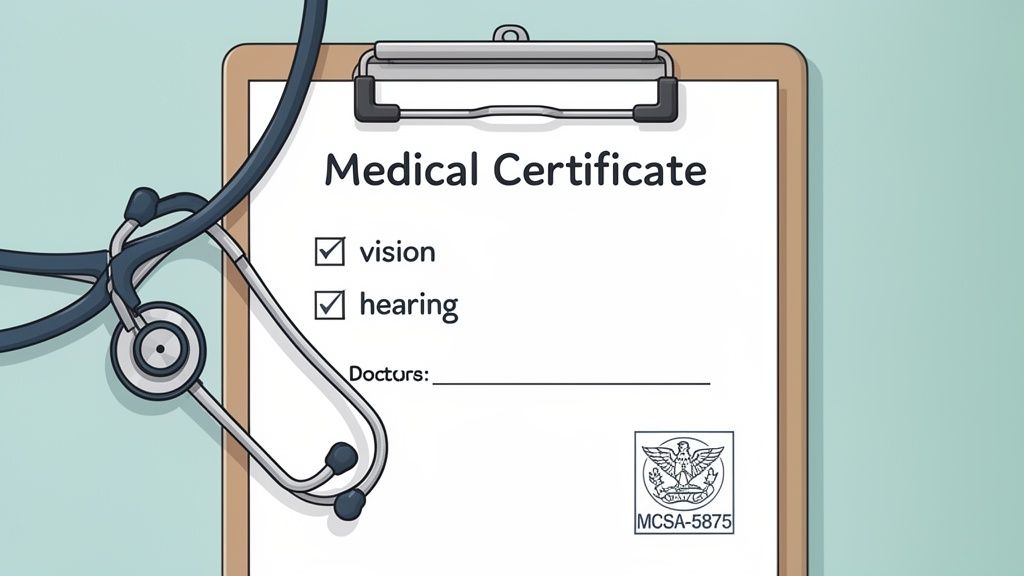
This certificate, often referred to as a "med card," is valid for up to 24 months, though a shorter period may be assigned if the examiner notes a condition that requires monitoring. Failing to maintain a valid medical certificate in the DQF for every driver is a serious violation that can lead to immediate out-of-service orders during roadside inspections and significant fines during a compliance audit.
Why It's a Foundational Document
Think of the Medical Examination Certificate as the green light for a driver's physical ability to be on the road. It directly addresses public safety by ensuring drivers do not have medical conditions that could impair their ability to operate a large vehicle. Major fleets like Werner Enterprises and travel center chains like Love's Travel Stops often provide on-site access to certified examiners, highlighting the industry's focus on simplifying this mandatory compliance step for drivers. Keeping this document current is non-negotiable for maintaining a compliant and safe operation.
Actionable Tips for Implementation
- Track Expirations Proactively: Use an expiration tracking dashboard to automatically alert both your team and the driver 90, 60, and 30 days before their medical certificate expires. This prevents last-minute scrambles and potential lapses in qualification.
- Automate Renewal Reminders: Create an automated workflow that not only reminds drivers of the upcoming expiration but also provides them with a list of approved, nearby certified medical examiners and instructions for submitting the new certificate.
- Store It for Easy Access: Keep a high-quality digital copy of the MCSA-5875 form in encrypted cloud storage. This ensures the document is protected from loss and can be easily accessed and presented during a roadside inspection or an audit.
- Validate Examiner Certification: Before accepting a medical certificate, always verify that the medical examiner is listed on the FMCSA National Registry. Submitting a certificate from a non-certified examiner will render the driver disqualified.
5. Driving Record Abstract (Motor Vehicle Report)
The Driving Record Abstract, commonly known as the Motor Vehicle Report (MVR), is a critical component of any driver qualification file checklist. Mandated by 49 CFR § 391.23, this document provides an official record of a driver's traffic violations, license status, and accident history directly from the state licensing agency. This report, covering the preceding 3 years, must be obtained for every state where the driver held a commercial motor vehicle license or permit.
The MVR is your primary tool for verifying a driver's safety history and ensuring they meet both regulatory and company standards. An MVR revealing serious violations like a DUI, reckless driving, or a suspended license can immediately disqualify a candidate, protecting your company from significant liability and safety risks. This report must be placed in the DQF within 30 days of the driver's start date.
Why It's a Foundational Document
The MVR provides an objective, third-party look into a driver's on-road behavior, moving beyond what the applicant self-reports on their application. Leading insurance underwriters rely heavily on MVR analysis to determine premium rates, as the data directly correlates with accident risk. Similarly, third-party services like Checkr and MVR.com provide carriers with instant access to these records, making it an indispensable part of the screening process.
Actionable Tips for Implementation
- Establish Clear Hiring Thresholds: Define and document your company's hiring policy regarding MVRs. For example, you might set a rule of "no more than two moving violations in the past three years" or an immediate disqualification for any alcohol-related offenses.
- Order MVRs in Batches: Reduce administrative time and per-report costs by ordering MVRs in bulk. Integrating your system with a verification service allows you to process multiple candidates at once, streamlining the hiring workflow.
- Set Up Annual Review Reminders: FMCSA requires an annual review of each driver's record. Set up automated reminders to pull a new MVR for every driver in your fleet at least once every 12 months, ensuring continuous compliance.
- Review Violations Carefully: Not all violations are equal. Train your staff to differentiate between minor infractions and serious, disqualifying offenses as defined by FMCSA regulations. This prevents mistakenly rejecting qualified candidates or hiring high-risk drivers.
6. Road Test Certificate or Behind-the-Wheel Evaluation
The Road Test Certificate is the practical, hands-on proof that a driver possesses the skills necessary to safely operate your specific commercial motor vehicles. Mandated under 49 CFR § 391.31, this evaluation goes beyond a license, confirming a driver can handle the vehicle type they will be assigned under real-world conditions. A qualified person must administer the test and certify, in writing, that the driver passed.
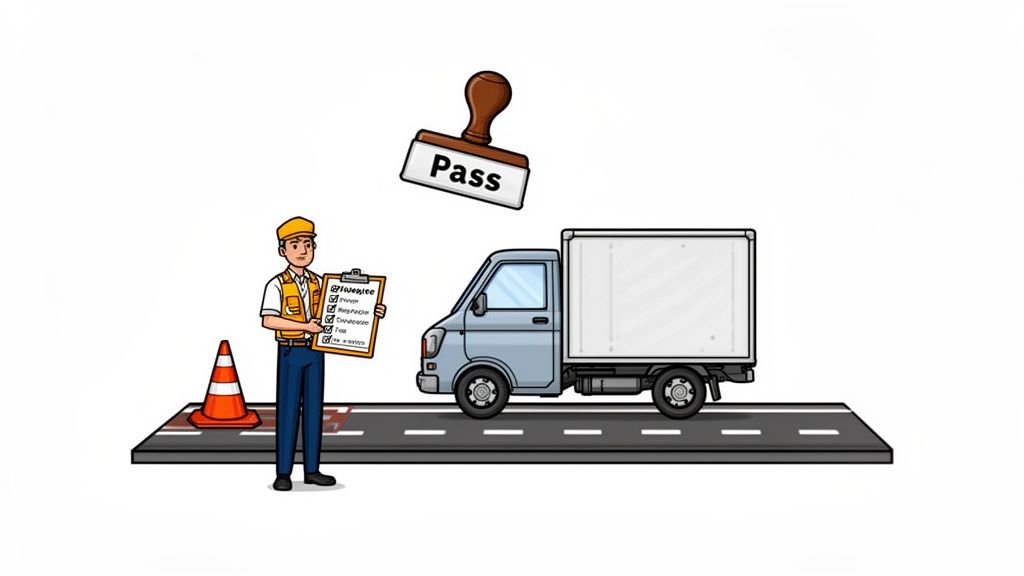
This certificate is a critical liability and safety document. It demonstrates your due diligence in verifying a driver's competence before entrusting them with valuable assets and public road safety. Failing to properly document a road test is a common and easily avoidable violation found during FMCSA safety audits.
Why It's a Foundational Document
Think of the road test as the final exam before a driver gets the keys. It validates all other qualifications, proving theoretical knowledge translates into safe, practical application. Major carriers like Schneider National operate dedicated driving schools with standardized road test protocols to ensure every new hire meets their stringent safety benchmarks. Similarly, third-party companies like Roadmaster Drivers School provide certified road tests nationally, offering a consistent evaluation standard. The certificate confirms a driver can manage pre-trip inspections, couple and uncouple units, and navigate traffic safely.
Actionable Tips for Implementation
- Standardize Your Evaluation: Develop a standardized road test checklist customized to your specific operations, vehicle types, and common routes. This ensures every driver is evaluated against the same objective criteria.
- Train Multiple Examiners: Avoid scheduling bottlenecks by training and qualifying several individuals within your company to conduct road tests. Ensure they understand the FMCSA requirements for examiners and document their qualifications.
- Digitize the Certificate: Use a platform to collect the signed road test certificate electronically. Create a digital form that includes the examiner’s name and signature, the date, the vehicle details, and the driver's signed acknowledgment, storing it securely in the DQF.
- Use Results for Training: The road test is not just a pass-or-fail event. Use the results to identify specific areas where a driver may need remedial training or mentorship before they begin independent operation.
- Schedule Early: Conduct the road test early in the onboarding process, before making a significant investment in further training. This helps you identify and address any skill gaps from the outset.
7. HazMat Endorsement Verification (if applicable)
For carriers transporting hazardous materials, this verification is a non-negotiable component of the driver qualification file checklist. Mandated by both the FMCSA and the Transportation Security Administration (TSA), you must confirm that a driver possesses a valid Commercial Driver’s License (CDL) with the necessary Hazardous Materials (HazMat) endorsement. This involves more than just looking at the license; it requires proof of a passed HazMat knowledge test and clearance from a TSA security threat assessment.
This verification is a critical safety and security measure. The process ensures that drivers entrusted with sensitive materials are properly trained, knowledgeable, and have been vetted against national security databases. An oversight here can lead to catastrophic safety failures and severe penalties from multiple federal agencies, making it a high-priority compliance item.
Why It's a Critical Compliance Layer
Think of the HazMat endorsement as a specialized security clearance for drivers. It confirms the driver's capability and trustworthiness to handle materials that pose a risk to public safety. Leading tanker carriers like Groendyke Transport and USA Compression make HazMat verification a fundamental step in their hiring process, integrating it directly into their initial qualification workflow. The documentation for this must be meticulously maintained and readily available for audit.
Actionable Tips for Implementation
- Create a Dedicated Workflow: Use a platform to build a separate onboarding workflow specifically for HazMat-qualified positions. This ensures the additional verification steps, like TSA clearance checks, are never missed.
- Set Advanced Expiration Alerts: HazMat endorsements and the underlying TSA threat assessments have separate expiration dates. Set automated reminders at least 90 days in advance to give the driver ample time to complete the complex renewal process without any lapse in qualification.
- Verify TSA Status Directly: Do not rely solely on the CDL. Before finalizing an offer, verify the applicant's TSA approval status through the official HazMat Endorsement Threat Assessment Program database to confirm their clearance is active and valid.
- Enhance Document Security: The TSA clearance letter contains sensitive personal information. Archive this document separately from the main DQF with enhanced security controls and restricted access to protect the driver’s privacy and maintain compliance with data security regulations.
8. Substance Abuse Prevention Program (SAPP) Acknowledgment and Baseline Testing
A critical component of the driver qualification file checklist is the documentation related to your company's drug and alcohol program. Mandated under 49 CFR Part 382, this includes two key pieces: the driver’s signed acknowledgment of your substance abuse policy and the negative result of a pre-employment drug test. This establishes a clear, compliant baseline before a driver ever operates a commercial motor vehicle (CMV).
This isn't just about passing an audit; it’s about public safety. The policy acknowledgment confirms the driver understands their responsibilities and the consequences of violations, while the pre-employment test verifies they are fit for duty from day one. Failing to maintain these records can result in severe penalties and liability.
Why It's a Non-Negotiable Safety Standard
Think of the SAPP documentation as your company's commitment to a drug-free workplace, formalized and filed. Every subsequent test, whether random, post-accident, or based on reasonable suspicion, builds upon this initial baseline. Major carriers like Knight-Swift and J.B. Hunt partner with third-party administrators such as Concentra and LabCorp to manage their comprehensive, DOT-compliant testing programs, ensuring every new hire meets federal safety standards before getting behind the wheel. A clear, documented process protects your company and the public.
Actionable Tips for Implementation
- Partner with Certified Labs: Ensure all drug and alcohol testing is conducted by a SAMHSA-certified facility. This guarantees the procedures and results are compliant with DOT regulations.
- Automate Acknowledgment Forms: Use a digital platform to distribute your SAPP policy and collect e-signatures. This creates an immediate, time-stamped record proving the driver received and understood the materials.
- Integrate Testing Workflows: Create conditional offer letters stating employment is contingent upon passing a pre-employment drug screen. Once an offer is accepted, you can trigger an automated workflow that sends the lab requisition to the candidate and the testing facility simultaneously.
- Securely Store Sensitive Results: Test results are protected health information. Use an encrypted, access-controlled system to store MRO-verified results, ensuring they are secure from unauthorized access but available for audits.
- Train Your Team: Ensure hiring managers understand the strict DOT protocols for handling test results, including the role of the Medical Review Officer (MRO) and the proper procedures following a non-negative result.
8-Point Driver Qualification File Checklist Comparison
| Item | 🔄 Implementation complexity | ⚡ Resource requirements | 📊 Expected outcomes | 💡 Ideal use cases | ⭐ Key advantages |
|---|---|---|---|---|---|
| Application for Employment | Low — standardized form, manual or e-sign | Low — admin time, storage, e-sign tools | Baseline identity/employment data; audit trail | All hires; initial qualification & compliance | Legal attestation; simple standardized record |
| Previous Employment Verification (Motor Carrier Record) | Moderate — requires third-party responses and certification | Moderate — days–weeks turnaround; verification service fees | Confirmed employment dates, reasons for separation, safety flags | Hiring experienced drivers; due diligence & risk checks | Independent validation of history; reveals safety issues |
| Commercial Driver's License (CDL) Verification | Moderate — driver authorization + DMV/service integration | Low–Moderate — per-check fees; API/integration possible | Confirm valid class/endorsements; suspensions flagged | Ensuring legal authority for vehicle classes | Authoritative source; reduces negligent-hiring risk |
| Medical Examination Certificate (MCSA-5875) | Moderate — scheduling examiners; renew every 24 months | Moderate — exam fees; certified examiner availability | Certified medical fitness; documented restrictions | All commercial drivers; fitness compliance checks | Federally standardized; reduces health-related liability |
| Driving Record Abstract (Motor Vehicle Report) | Moderate — DPPA authorization; state variability | Low–Moderate — per-report costs; possible batch services | Objective violation/accident history for risk scoring | Risk-based hiring, insurance underwriting, annual review | Comprehensive safety history; supports policy thresholds |
| Road Test Certificate / Behind-the-Wheel Evaluation | High — qualified examiners, standardized rubric required | High — examiner labor, vehicle use, scheduling, recording | Demonstrated operational competency; training gaps identified | Final qualification before independent duty; specialty vehicle ops | Direct skills validation; lowers on-road incident risk |
| HazMat Endorsement Verification (if applicable) | High — TSA clearance, fingerprinting, exam proof | High — TSA processing (weeks), training & renewal costs | Confirmed HazMat endorsement and security clearance | HazMat, tanker, chemical transport roles | Mandatory compliance for HazMat; improves security & safety |
| SAPP Acknowledgment & Baseline Testing | Moderate — testing logistics, MRO handling, privacy controls | Moderate — drug/alcohol test costs, lab turnaround, admin | Baseline drug/alcohol status; signed policy acknowledgment | All DOT-regulated hires; safety-sensitive positions | Federally required; reduces substance-related risk and liability |
From Checklist to Automated Compliance: Your Next Steps
You've just walked through the essential components of a compliant driver qualification file. From the initial Application for Employment to the verification of a Commercial Driver's License and the critical Medical Examiner's Certificate, each document plays a vital role in ensuring safety and regulatory adherence. Understanding this driver qualification file checklist isn't just about ticking boxes; it's about building a foundational safety culture within your organization.
Remember, the Federal Motor Carrier Safety Administration (FMCSA) doesn't see these files as mere paperwork. They are the definitive proof that you, as a motor carrier, have performed the necessary due diligence to put a safe, qualified, and professional driver behind the wheel. The common pitfalls we discussed, like missing dates on previous employment verifications or failing to pull a new MVR annually, are exactly what auditors are trained to find.
The True Cost of Manual DQF Management
Let's be direct: managing DQFs manually with paper folders or disorganized spreadsheets is a high-risk gamble. A single misplaced document or a missed expiration date for a medical card can cascade into serious violations, hefty fines, and a damaged Compliance, Safety, Accountability (CSA) score. This reactive approach keeps your team in a constant state of administrative catch-up, pulling resources away from core business activities like dispatching, driver training, and fleet maintenance.
The real challenge isn't knowing what goes into the file; it's maintaining the integrity of that file over the entire lifecycle of a driver's employment. This is where a strategic shift from a passive checklist to a proactive, automated system becomes a game-changer.
Actionable Takeaways: Building a Bulletproof System
Your goal should be to create a DQF system that is not only compliant but also efficient and error-proof. Here are the most important takeaways to implement immediately:
- Centralize Everything: Ditch the filing cabinets and scattered digital folders. A single, secure, cloud-based platform for all driver files is the only way to guarantee consistency and immediate access during an audit.
- Automate Expiration Alerts: Manually tracking CDL, medical card, and MVR renewal dates is a recipe for human error. Implement a system that automatically sends reminders to both your administrative staff and the drivers themselves well in advance of any deadline.
- Standardize Document Collection: Use digital templates and standardized workflows for every new hire. This ensures you collect the exact same compliant information, in the correct format, from every single driver, every single time.
- Create an Audit-Ready Dashboard: Imagine an auditor walking in and you being able to pull up a complete, organized, and up-to-date file for any driver in under 30 seconds. This level of preparedness demonstrates a serious commitment to compliance and can significantly streamline the audit process.
Mastering your driver qualification file checklist is the first, most crucial step. The next is to leverage technology to transform that knowledge into a seamless, automated process. By doing so, you move beyond simple compliance and cultivate a system that actively protects your business, enhances your safety reputation, and frees up your team to focus on what they do best. The peace of mind that comes from knowing you are perpetually audit-ready is invaluable.
Ready to transform your driver qualification file checklist from a static list into a dynamic, automated compliance engine? See how Superdocu can centralize your records, automate reminders, and make you audit-ready 24/7. Explore Superdocu's solutions for transportation and compliance today.