
Think of data security compliance as the set of rules you have to follow to keep digital information safe. It’s all about mixing smart policies with the right technology to stop data breaches before they happen and show your clients you can be trusted. If you handle customer information, this isn't just a nice-to-have—it's essential.
What Is Data Security Compliance and Why It Matters Now
Let's use an analogy. Picture your business as a bank vault, and all the sensitive client data you hold—names, financials, personal documents—is the treasure locked inside. Data security compliance is your entire security system for that vault. It’s not just the heavy steel door (your technology), but also the strict rules about who gets the key and when they can open it (your policies).
Put simply, it's the formal process of proving you meet specific requirements for how you handle and protect data. These rules can come from laws, industry standards, or even client contracts. Being compliant means you can actually show that your security practices are up to snuff.
Beyond a Simple Checklist
It's easy to fall into the trap of treating compliance like a boring checklist, but that's a huge mistake. True compliance is an ongoing commitment to protecting information. The real goal isn't just to dodge fines; it's to build a secure foundation that protects both your clients and your business from constant threats.
A solid compliance strategy really comes down to two things working hand-in-hand:
- Data Security: These are the technical, hands-on measures you put in place. Think encryption, firewalls, and access controls—the digital walls you build around your data.
- Data Compliance: This is the administrative side of the house. It’s the official policies, employee training, and regular audits that make sure your security measures are actually working and meeting legal standards.
You can't have one without the other. Strong security without a compliance framework is like a ship without a rudder, and compliance policies without solid security are just empty words.
Data security compliance isn’t only about fending off hackers. It’s also about creating internal systems that prevent accidental leaks and make sure everyone in your organization is accountable for protecting data.
Why Is Compliance Suddenly Such a Big Deal?
The conversation around data security has gotten a lot louder lately, and for good reason. As our world becomes more digital, the sheer amount of sensitive data being shared has skyrocketed, making businesses of every size a juicy target for cybercriminals.
In response, governments have put their foot down, passing strict data protection laws like GDPR in Europe and a growing number of state laws in the US. These rules put the responsibility for protecting consumer data squarely on your shoulders, and the penalties for dropping the ball are severe. Today, ignoring compliance is a direct risk to your bottom line and your reputation. It’s a core business function, not just a problem for the IT department.
Navigating the Most Common Compliance Frameworks
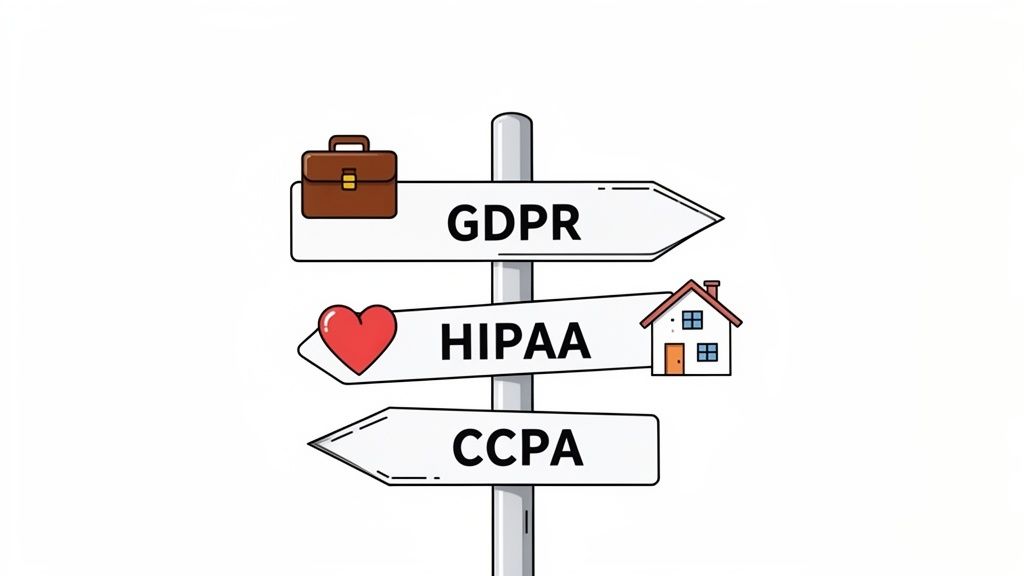
The world of data security can feel like an alphabet soup of acronyms. GDPR, HIPAA, CCPA—it's easy to feel overwhelmed. But these aren't just bureaucratic hurdles. Think of them as blueprints for building trust. Each regulation is simply a set of rules designed to protect specific types of information for specific groups of people.
The good news? You don't need to be an expert on every single regulation out there. Your goal is to figure out which specific rules apply to your business. It all comes down to where you operate, who your clients are, and the kind of data you handle. Focusing on what matters to you makes the path to compliance a lot less intimidating.
Matching Regulations to Your Business
So, where do you start? It all begins with a simple question: "What kind of data do I collect, and from whom?" The answer is your compass, pointing you toward the right compliance frameworks. A small health clinic and a real estate agency, for instance, handle wildly different sensitive information, so they’ll naturally fall under different rules.
Let’s walk through a few common scenarios for small and medium-sized businesses:
- You Handle Health Information: If your business—whether it's a small clinic, a health-tech app, or an HR team managing employee health plans—deals with Protected Health Information (PHI) in the United States, then the Health Insurance Portability and Accountability Act (HIPAA) is your primary concern.
- You Process Data from EU Residents: Do you have clients, customers, or even just website visitors from the European Union? If the answer is yes, the General Data Protection Regulation (GDPR) applies to you, no matter where your office is located. This is a big one for any company with a global footprint.
- You Do Business in California: If your company serves California residents and meets certain revenue or data-processing thresholds, you need to follow the California Consumer Privacy Act (CCPA). This law gives consumers powerful rights over their personal data.
This isn’t just a regional trend; it’s a global movement. Data protection laws now cover an incredible 6.3 billion people, which is about 79% of the global population. With 144 countries having data privacy laws on the books and 21 states in the U.S. having passed their own, knowing your obligations is no longer optional.
A Quick Guide to Key Frameworks
To make this even clearer, let’s map some common business sectors to the regulations they’re most likely to face. This table is a handy reference to pinpoint your potential compliance needs at a glance.
Key Compliance Frameworks for Common SMB Sectors
| Business Sector | Primary Regulation(s) | Key Data Handled |
|---|---|---|
| Legal & Immigration | GDPR, CCPA, Local Bar Rules | Client case files, personal identification, immigration status, financial records. |
| Human Resources (HR) | GDPR, CCPA, HIPAA (for health plans) | Employee PII, payroll data, health benefits information, performance reviews. |
| Real Estate & Finance | GLBA, CCPA, State-Specific Laws | Social Security numbers, bank account details, credit histories, loan applications. |
| Healthcare & Wellness | HIPAA, GDPR (for EU patients) | Medical records, insurance information, patient diagnoses, biometric data. |
| Transportation & Logistics | GDPR, CCPA, DOT Regulations | Driver's license information, vehicle data, shipping manifests with personal details. |
As you can see, your industry directly shapes your compliance journey. A transportation company will be focused on protecting driver data, while a law firm has a completely different set of rules to follow for confidential client information.
At the end of the day, all these frameworks share the same core principle: treat personal data with respect, keep it safe from prying eyes, and be upfront with people about how you’re using it.
For any business with a European presence or customer base, GDPR is often seen as the gold standard. Its concepts—like collecting only what you need and giving individuals control over their data—are shaping privacy laws across the globe.
If you need to get into the nitty-gritty, you can explore our detailed GDPR compliance checklist for a practical, step-by-step guide. By first identifying the right framework for your business, you can turn a confusing legal landscape into a clear and actionable roadmap.
The Two Pillars of Your Compliance Strategy
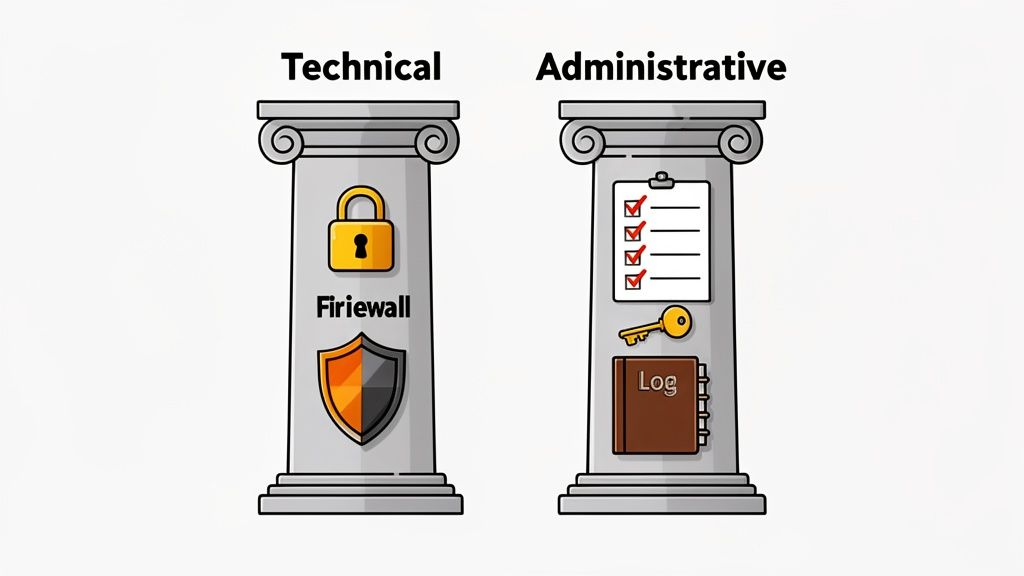
A solid data security compliance strategy isn’t just one big wall you build. It’s more like a structure resting on two separate but equally important pillars: technical controls and administrative controls. Nailing the balance between these two is the secret to building a defense that’s not only strong but also practical enough to maintain over the long haul.
Think of it like protecting a treasure chest. The chest itself—the reinforced steel, the complex lock, the tamper-proof hinges—is your set of technical controls. But what about the rules for who gets a key? Or the logbook tracking every time it's opened? That's where your administrative controls come in. One is pretty useless without the other. A strongbox with no rules is a sitting duck, and a bunch of rules with no strongbox is just wishful thinking.
Pillar One: Technical Controls
Technical controls are the actual hardware and software you put in place to guard your data and systems. These are the digital locks, alarms, and firewalls that form your first line of defense against anyone trying to get in who shouldn't be. They are the tangible, system-based tools that work automatically to enforce your security policies day in and day out.
For a small or medium-sized business, this doesn't have to mean a server room full of blinking lights and a six-figure budget. The goal is to create smart layers of protection that make it too difficult and time-consuming for threats to break through.
Here are some of the most critical technical controls to have in place:
- Encryption: This is the process of scrambling your data so it’s completely unreadable without the right key. You need to protect data "at rest" (sitting on a hard drive) and data "in transit" (zipping across the internet).
- Access Control: This is all about making sure people can only see and touch the specific information they absolutely need for their jobs. It’s based on the "principle of least privilege," which dramatically limits the potential damage if one person's account ever gets compromised.
- Firewalls and Network Security: A firewall is like a digital bouncer for your network. It inspects all the traffic coming in and going out, blocking anything that looks suspicious based on the rules you’ve set.
- Intrusion Detection Systems (IDS): Think of these as a silent alarm. They constantly monitor your network for shady activity or policy violations and immediately alert you when they spot something wrong.
These controls are the "what" of your security plan—the real tools doing the heavy lifting to protect your digital assets 24/7.
A classic mistake is to pour money into fancy technology while forgetting about the people using it. The world's best firewall can't stop an employee who clicks on a phishing link. That's why the second pillar is so crucial.
Pillar Two: Administrative Controls
If technical controls are about technology, administrative controls are all about people and process. These are the policies, procedures, and training programs that guide how your team behaves and ensure your security tools are actually used correctly. They answer the "how" and "why" behind your data security efforts.
Some people call these "soft controls," but don't let the name fool you—their impact is massive. A data breach is far more likely to stem from simple human error than a catastrophic failure of technology, which arguably makes these controls the most important part of your entire strategy.
Essential administrative controls include:
- Security Awareness Training: You have to regularly train your employees to spot threats like phishing emails, use strong passwords, and understand the critical role they play in protecting company data.
- Data Handling Policies: These are clear, written rules that spell out exactly how sensitive information should be collected, stored, shared, and eventually destroyed. No guesswork allowed.
- Incident Response Plan: When a breach happens, you can't be figuring things out on the fly. This is a detailed, step-by-step playbook that tells your team exactly what to do to contain the threat and minimize the damage.
- Vendor Management: You need a solid process for checking the security practices of any third-party vendor or partner who has access to your data. Their weakness can easily become your breach.
- Regular Audits and Risk Assessments: You can't just set it and forget it. Periodically reviewing your security measures helps you find weaknesses before attackers do and ensures you stay compliant.
When you bring these two pillars together, you create a security posture that is both tough and resilient. Your technology is the shield, but it’s your people and your policies that make sure that shield is held up correctly and pointed in the right direction.
What Non-Compliance Really Costs Your Business
Think of data security compliance like insurance for your most valuable asset: your data and your reputation. Skipping it might feel like you're saving a few bucks now, but you're leaving your business completely exposed to a disaster that could wipe you out. The fallout from a compliance failure isn't just a hypothetical risk; it's a real, painful, and often business-ending event.
The most obvious hit comes from the eye-watering fines. These aren't just minor penalties. Regulators have the power to issue fines specifically designed to be so costly that ignoring compliance simply isn't an option.
The Staggering Financial Penalties
The numbers speak for themselves. The average cost of a data breach globally has now hit an all-time high of $4.88 million. For big breaches—the kind involving over 50 million records—that number skyrockets to an average of $375 million. Under GDPR alone, regulators have already handed out around €5.65 billion in fines.
But here's the good news: having strong security controls in place makes a massive difference. Companies that get this right save an average of $1.9 million per breach. You can dig into more compliance statistics to see just how stark the contrast is between being prepared and being caught off guard.
And those huge fines are just the beginning. The secondary costs start piling up almost immediately:
- Legal Fees: You'll be paying lawyers to defend you against regulatory actions and potential lawsuits from clients whose data was exposed. This gets expensive, fast.
- Remediation Costs: You have to hire forensic experts to figure out what went wrong, then pay to notify every single person affected, and often provide them with credit monitoring services for years.
- Operational Downtime: While you’re in crisis mode, your business grinds to a halt. Every minute you spend dealing with a breach is a minute you're not helping clients or making money.
The question isn't if a breach will happen, but when. Smart, proactive investment in data security is the best way to soften the financial blow when that day comes.
The Hidden Costs That Linger for Years
As painful as the immediate financial hit is, the long-term damage is often worse. This is where the real threat lies for small and medium-sized businesses, as these "hidden" costs can quietly dismantle everything you've built.
The biggest casualty is customer trust. Trust is everything. When you fail to protect your clients' sensitive information, you shatter that trust. Winning it back is an uphill battle, and many customers will simply walk away and never come back. They just won't feel safe with you anymore.
This erosion of trust inevitably leads to long-term damage to your brand and reputation. Your name becomes linked with carelessness and insecurity, a stain that's incredibly difficult to wash away. You can bet your competitors will use it against you, making it tougher to attract new clients, partners, or even talent. It all creates a vicious cycle of operational chaos—panicked employees, derailed projects, and constant fire-fighting—that can be nearly impossible to escape.
How the Right Tools Simplify Your Compliance Journey
Let's be honest: trying to manage data security compliance can feel like a massive undertaking, especially if you don't have a dedicated expert on your team. Juggling documents, manually checking IDs, and trying to keep a record of every single action isn't just a drain on your time—it's practically asking for a mistake to happen.
The right tools, however, can completely change the game. They automate the tedious, critical tasks and weave strong security right into your everyday work.
Instead of fighting with messy spreadsheets and endless email chains, a dedicated platform can turn compliance from a constant headache into something that just… happens in the background. It’s like having a digital compliance officer on duty 24/7, enforcing your rules, keeping data organized, and generating the proof you need to show you’re doing things right. This frees you up to focus on what you do best: serving your clients.
This shift is more important than ever. Cybersecurity and data protection are now the top compliance priorities for businesses everywhere, with 51% of companies listing them as major concerns. When you consider that over 30,000 new security vulnerabilities were found in a single year and that personal information shows up in 44% of data breaches, it's clear that automated defenses are no longer a luxury. You can dig deeper into these compliance statistics and trends on Vanta.com.
Automating Technical Controls with Encryption
One of the most effective technical tools you can use is encryption. Think of it as putting every sensitive file you handle into an unbreakable digital safe. Platforms like Superdocu automatically apply end-to-end encryption, which scrambles the data from the moment your client uploads it to the second you receive it.
This one feature alone knocks out a huge compliance requirement. It means that even if someone managed to intercept the data while it was being sent, it would be completely unreadable. By making this process automatic, your team never has to remember to encrypt an attachment or worry about sending something over an unsecured channel. A major risk is simply eliminated.
Having a single, clear dashboard like this gives you a central command center for your entire data collection workflow—a fundamental principle of solid data security.
Meeting Regional Requirements with Smart Hosting
You've probably heard of "data sovereignty." It’s a core concept in rules like GDPR, and it just means that data is subject to the laws of the country where it's physically stored. If you work with European clients, this is a big deal. You have to know exactly where their personal information is kept.
A classic compliance mistake for small businesses is using generic cloud tools that store data in who-knows-what country. This can easily put you in violation of GDPR's strict data residency rules without you even realizing it.
Purpose-built platforms solve this by offering geographically specific hosting. Superdocu, for instance, hosts all its data on servers located within Europe. This isn't some setting you have to find and turn on; it’s built into the service from the ground up, giving you automatic GDPR compliance and one less thing to worry about.
Proving Compliance with Detailed Audit Trails
If an auditor ever comes knocking, saying "we take security seriously" isn't going to cut it. You have to prove it. This is where a detailed audit trail becomes your best friend. An audit trail is simply an unchangeable log that records every action taken on a document.
- Who accessed the file? The log shows the exact user.
- When did they look at it? The log gives you a precise timestamp.
- What did they do? The log tracks every single view, download, or change.
This creates an airtight record of how you handle data. If there’s ever a security incident, this log is the first thing you'll turn to, showing exactly what happened, who did it, and when. Trying to create this kind of record manually would be impossible, but a dedicated platform does it for you automatically. Our guide on choosing a secure document intake platform gets into why features like this are so crucial.
Building Compliance into Your Workflow
At the end of the day, you've truly nailed compliance when the most secure way of doing things is also the easiest way. This is where tools like pre-built, secure templates come in. Whether you’re in legal, HR, or real estate, using a template ensures you're only asking for the information you truly need—a key GDPR principle called data minimization.
By standardizing how you collect documents, you dramatically lower the risk of an employee accidentally asking for too much sensitive information or saving it in the wrong place. It makes doing the right thing the path of least resistance. When your workflow is secure from the very first step, you're not just ticking a compliance box; you're building a real culture of security that protects your business from the ground up.
Your Actionable Roadmap to Data Security Compliance
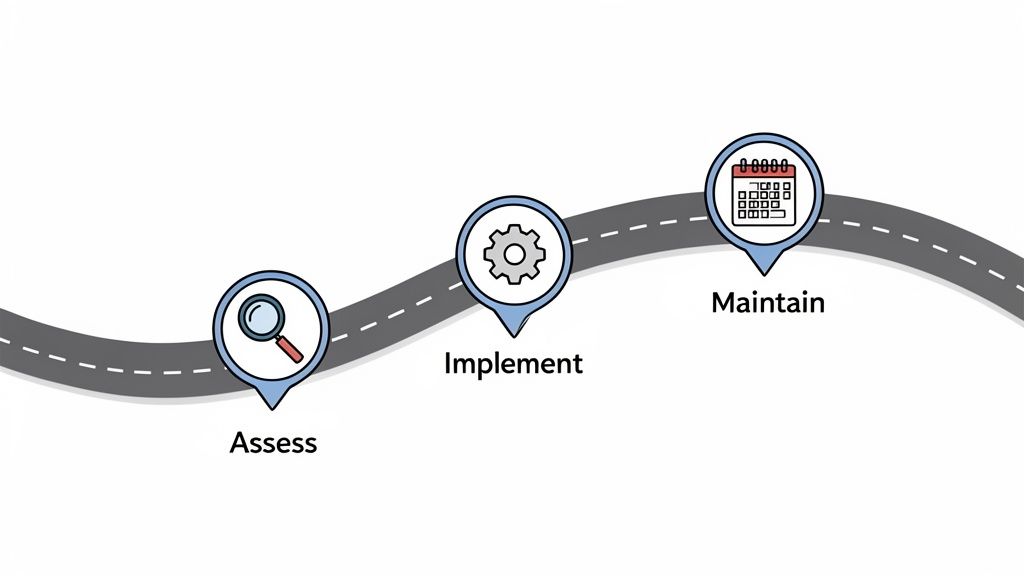
Jumping into data security compliance can feel like a massive undertaking, but it doesn't have to be. The secret is to break the journey down into manageable stages. You can build a solid foundation without feeling completely overwhelmed.
Think of it as building a house. You wouldn't just show up and start hammering nails without a blueprint. The "Assess" phase is that blueprint. "Implement" is the actual construction, and "Maintain" is the essential upkeep that keeps your house standing strong for years. This simple framework turns a vague goal into clear, doable steps.
Phase 1: Assess Your Current Position
Before you can chart a course forward, you have to know exactly where you are right now. This first phase is all about discovery—understanding what data you have, where it lives, and which rules apply to it. Rushing this step is a classic mistake that will only create more work for you later.
Here’s what you need to focus on:
- Map Your Data: Start by creating a simple inventory of all the sensitive information you handle. Ask the basic questions: What kind of data is it? Where is it stored? Who has access? And how long do we really need to keep it?
- Identify Applicable Regulations: Look at your data map and where your clients are located to figure out which regulations apply. Are you dealing with data from EU citizens? That’s GDPR. Working in healthcare? You'll need to look at HIPAA.
- Run a Gap Analysis: Now, compare your current security practices to the requirements of the regulations you just identified. This analysis will shine a light on your biggest vulnerabilities and show you exactly where to focus your efforts first.
Phase 2: Implement Your Security Controls
Okay, you've done your homework and have a clear action plan. Now it’s time to roll up your sleeves and put the necessary technical and administrative controls in place to fix the gaps you found. This is where you actively build your defenses and write down your rules.
Key steps for implementation include:
- Adopt Secure Tools: Bring in solutions that handle the heavy lifting. Look for tools that provide end-to-end encryption, secure ways to collect files, and automatic audit trails to prove you’re doing the right thing.
- Draft Your Policies: It’s time to get your internal rules on paper. This means creating your official data handling procedures, an incident response plan (what to do when things go wrong), and a clear policy for remote work.
- Train Your Team: The best security tech in the world can be defeated by a simple human mistake. Make security awareness training mandatory for everyone. Teach your team how to spot phishing emails, use strong passwords, and handle sensitive data with care.
Phase 3: Maintain and Monitor Continuously
Here’s the thing about compliance: it’s not a one-and-done project. It’s an ongoing commitment. Threats change, and regulations evolve, so your security program has to be ready to adapt. This final phase is all about making sure your defenses stay strong for the long haul.
Compliance isn't a destination you arrive at—it's a continuous process of adaptation and improvement. Regular reviews are essential to staying ahead of new threats and evolving legal standards.
Ongoing maintenance boils down to a few key activities:
- Regular Audits: Periodically check in on your controls and procedures to make sure they're still working as intended. Using a detailed compliance audit checklist can give you a structured way to run these internal reviews.
- Stay Informed: Keep an eye on changes in data protection laws that might affect your business. You could subscribe to a few security newsletters or make it someone's job to monitor regulatory news.
- Update and Evolve: Use what you learn from your audits and any security incidents to make things better. Refine your policies, update your training materials, and improve your technical controls.
Got Questions About Data Security Compliance? We've Got Answers.
Jumping into the world of data security compliance can bring up a lot of questions. Let's clear up some of the most common ones business owners ask.
Is This Just a Big Company Problem?
Not at all. It’s a common misconception that compliance is only for massive corporations with dedicated legal teams. The truth is, these laws apply to any business that handles sensitive information, no matter its size.
In fact, small businesses are often seen as easier targets by cybercriminals, who assume they have fewer defenses. This makes having a solid compliance strategy even more important for protecting your business and your clients.
What’s the Real Difference Between Security and Compliance?
Here’s a simple way to think about it: Security is the strong fence you build to protect your property. Compliance is having the paperwork to prove to an inspector that your fence is built to code.
Security is about the tools and actions you take—like using encryption and strong passwords. Compliance is the process of documenting that your security measures meet the specific rules required by laws like GDPR or HIPAA.
A great security setup makes proving compliance a whole lot simpler. When your defenses are already strong, you’re just checking the boxes, not starting from scratch.
Do I Really Need to Hire a Full-Time Compliance Officer?
For most small to medium-sized businesses, the answer is no. You don't need to hire a dedicated person for this role.
Responsibility can usually fall to a business owner, an office manager, or another trusted team member. The important thing is to have one person who officially "owns" it—someone who makes sure policies are up-to-date, training happens, and the business keeps up with any new regulations.
How Often Should My Team Be Trained on Security?
Think of security training as an ongoing conversation, not a one-and-done lecture. Every new employee should go through formal training as part of their onboarding.
For the rest of the team, you’ll want to hold a required refresher course at least once a year. To keep everyone sharp, it’s also a great idea to run continuous mini-trainings, like sending out test phishing emails to see who spots them. It keeps security top-of-mind all year round.
Ready to stop chasing documents and start building a secure, automated workflow? See how Superdocu makes it easier to achieve and demonstrate data security compliance. Get started with your free trial today.