
Your business is ready to ship orders, onboard clients, or open a new market, and then a simple question lands in your inbox, where will this document data live? That question can slow down a launch faster than any technical bug, because the answer is tied to data residency requirements, vendor contracts, cloud settings, and the laws of the places where your customers are based. For small businesses that handle a lot of files, forms, IDs, invoices, and signed paperwork, this is no longer a legal side note. It's part of everyday operations.
Table of Contents
- Why Data Residency Matters Now More Than Ever
- Untangling the Terminology
- A Tour of Global Data Residency Laws
- The Real Business Risks of Getting It Wrong
- Your Practical Data Residency Compliance Checklist
- How to Choose a Compliant Document Platform
- Making Compliance Your Competitive Advantage
Why Data Residency Matters Now More Than Ever
A small accounting firm opens its first client portal for overseas customers. A recruitment agency starts collecting passports and contracts from applicants in another region. A mortgage broker moves paperwork into the cloud so staff can work from anywhere. In each case, the team thinks first about speed and convenience, then someone asks the question that changes the project plan: where is the data stored and processed?
That question matters because data residency is about the actual location of digital information, not just the country listed in a dashboard. If your files are uploaded in one market, backed up in another, and reviewed by a processor elsewhere, you're dealing with more than a simple storage choice. You're dealing with legal and operational boundaries that can affect how you serve customers.

The scale of the issue has grown quickly. The number of jurisdictions with some form of data localization requirement rose from 35 in 2017 to 62 in 2026, according to an industry synthesis citing the Information Technology and Innovation Foundation. That's a clear sign that residency is no longer a niche concern for giant multinational companies.
Practical rule: if your business collects documents from people in more than one country, assume data location will matter before you sign a vendor contract.
The good news is that not every rule means “keep everything inside one country forever.” Many regimes are built around controlled transfer, not total lockdown. That's why small businesses need a working understanding of the topic, not a law degree. The firms that handle this well don't wait for a regulator to ask questions. They map their data early, choose vendors carefully, and make sure the paperwork matches the way the business really runs.
Untangling the Terminology
The easiest way to understand this subject is with mail. Data residency is like choosing which country your mail is routed through and where the mailbox sits. Data localization is stricter, like a rule that says the mailbox must stay inside one country and the mail can't leave. Data sovereignty is the legal system that decides which country's laws control the mail once it's there.
That distinction matters because people often use the terms as if they mean the same thing. They don't. A company may be allowed to store personal data outside the EU or EEA if it uses a valid transfer mechanism, which means residency is about location plus legal safeguards, not just physical storage. Under GDPR, data residency is not the same as localization, and EU personal data can be stored outside the EU/EEA if the transfer uses an adequacy decision, Standard Contractual Clauses, or similar safeguards supported by a transfer impact assessment, as explained by Secure Privacy's EU and US residency overview.
Why the difference changes day-to-day decisions
If you think residency and localization are identical, you can make the wrong vendor choice. A platform might keep its primary servers in one region, but still rely on approved transfer safeguards for backups, support access, or document processing. That can be perfectly workable under some laws, but it won't satisfy a strict localization rule that requires in-country storage.
For a document-heavy business, the practical lesson is simple. Don't ask only, “Where is the main server?” Ask where the files are stored, where backups go, where support staff can access them, and what legal mechanism covers every transfer. That's the mailbox analogy in action. One postal address is not the whole story if the letter gets forwarded across borders.
A useful compliance habit is to treat every file as if it could take multiple routes, storage, backup, review, and support. If any one of those routes crosses a border, you need a legal basis for it.
Data sovereignty adds another layer. It's about which nation's laws apply to the data, not just where the data sits. For business owners, the safest mindset is to separate the three terms before you sign anything. Once those labels are clear, the next step is to understand how the major laws work in practice.
A Tour of Global Data Residency Laws
The GDPR, which took effect on 25 May 2018, is a useful starting point because it changed how businesses think about data location. It did not create a blanket EU-local-storage rule. Instead, it focused on regulating transfers outside the EEA through legal safeguards, and that framework has shaped how multinational businesses design cloud architectures, according to Teradata's overview of data residency. That is why many companies now think in terms of controlled transfers rather than simple “keep it all here” rules.
A simple comparison of the most common patterns
| Regulation (Region) | Core Principle | Allows Cross-Border Transfer? | Example Requirement |
|---|---|---|---|
| GDPR (EU) | Transfer control with legal safeguards | Yes | Use adequacy decisions, SCCs, or BCRs for certain transfers |
| India DPDP framework | Applies to processing of digital personal data of people in India, regardless of company location | Yes, subject to compliance requirements | Foreign companies serving Indian customers still need to comply |
| National localization-style regimes | Keep certain data within borders | Sometimes limited or conditional | Use in-country storage, approved transfers, or government approval |
That table shows the pattern small businesses need to recognize. Some laws are permissive if you document your transfers correctly. Others are more demanding and make cross-border movement harder. If your business serves people in more than one country, you don't just need a privacy policy. You need a data flow map that shows where files start, where they move, and who can touch them.
For a practical model of how teams put those controls into a working process, PledgeBox's GDPR approach is a useful reference point for thinking about operational discipline rather than abstract legal theory. The value is not the label on the law. It's the habit of documenting transfers, processor relationships, and safeguards before anything goes live. A broader GDPR compliance checklist can also help teams see how legal requirements turn into daily tasks.
The Real Business Risks of Getting It Wrong
The most immediate risk of ignoring residency rules is not always a fine. For many small businesses, the bigger problem is operational disruption. A launch gets paused while legal reviews catch up. A document workflow gets blocked because the vendor can't prove where data is processed. A sales team loses momentum because a promising market suddenly comes with a data handling question nobody can answer quickly.
In India's Digital Personal Data Protection Act framework, organizations processing digital personal data of people in India must comply regardless of where the organization is based, and the cited source says full compliance is due by May 2027, as summarized by Signzy's regional residency guide. That matters because deadlines change how business leaders prioritize work. A rule that feels distant on paper can become a real blocker in procurement, onboarding, or market entry.

What breaks first in a document-heavy business
The first casualty is usually process clarity. If your staff don't know which documents can move across borders, they start improvising. That leads to inconsistent handling, extra review cycles, and avoidable mistakes. The second casualty is trust. Clients, applicants, and partners rarely care about the legal nuance. They care whether you can explain where their information goes and why.
Compliance trouble often shows up as a workflow problem before it shows up as a legal one.
The third risk is strategic. If you can't answer residency questions during vendor review, an enterprise customer may choose another provider. If your archive, intake forms, or approval trails aren't designed with residency in mind, international growth can become expensive and slow. This is why treating the topic as a box-ticking exercise is such a mistake. It's not only about avoiding penalties. It's about keeping the business operational when the rules get more specific.
Your Practical Data Residency Compliance Checklist
Start with the data, not the law books. Make a list of the documents your business collects, passports, signed contracts, payroll files, medical forms, financial records, tax documents, and support attachments. Then note where each file is created, stored, backed up, reviewed, and deleted. A simple spreadsheet is enough to begin.
The first four actions that matter most
Map every data flow. Trace the path from intake to archive. Include backups and support access, not just the main storage region. That is where many businesses miss hidden transfers.
Review each vendor contract. Look for clauses about storage region, subprocessors, breach notice, support access, and transfer safeguards. If a contract is vague about location, treat that as a risk, not a detail.
Write a short internal policy. Staff need clear rules for what they can collect, where they can send it, and what happens when a customer asks for deletion or export. Short is fine. Clear is better than long and ignored.
Train the people who touch documents. The person who uploads files, chases signatures, or exports reports can create a residency issue without realizing it. Training should focus on real tasks, not abstract legal terms.
Then tighten the routine
Once the basics are in place, add an ongoing review cadence. New vendors, new regions, and new document types can all change your risk profile. That's why compliance isn't a one-time project. It's part of how the business stays organized.
A practical way to keep the checklist from drifting is to connect it to your broader security habits, including access control, retention, and incident response. The data security compliance guide is useful if you want to see how those pieces fit together in a document workflow. The goal is simple. Make the compliant path the default path, so staff don't need to make judgment calls every time they handle a file.
Operational habit: if a document can reveal identity, finances, or regulated details, assume it needs a named owner and a documented route.
That shift matters for SMBs because compliance work often fails when it stays in one person's head. Put the rules in writing, assign responsibility, and review them when vendors or markets change. That's how a messy intake process turns into a repeatable system.
How to Choose a Compliant Document Platform
A good document platform should make residency easier, not harder. Start by asking where data is hosted, how backups are handled, and whether the provider can explain transfer safeguards in plain language. If the answer is vague, that is already a warning sign. A compliance-friendly platform should be able to tell you what happens to files at rest, in transit, and in support workflows.
Vendor criteria that actually matter
- Transparent hosting policy: You should know the region or regions used for storage and processing, not just a marketing promise.
- Clear transfer safeguards: If data can cross borders, the provider should be able to explain the legal and technical controls behind that movement.
- Strong encryption and access controls: Sensitive documents need protection both in storage and during transfer, along with role-based access that limits who can view what.
- Auditability: You need logs or records that show who accessed documents and when, especially if you handle regulated paperwork.
- Retention and deletion controls: Residency decisions get messy if old files linger without a policy.
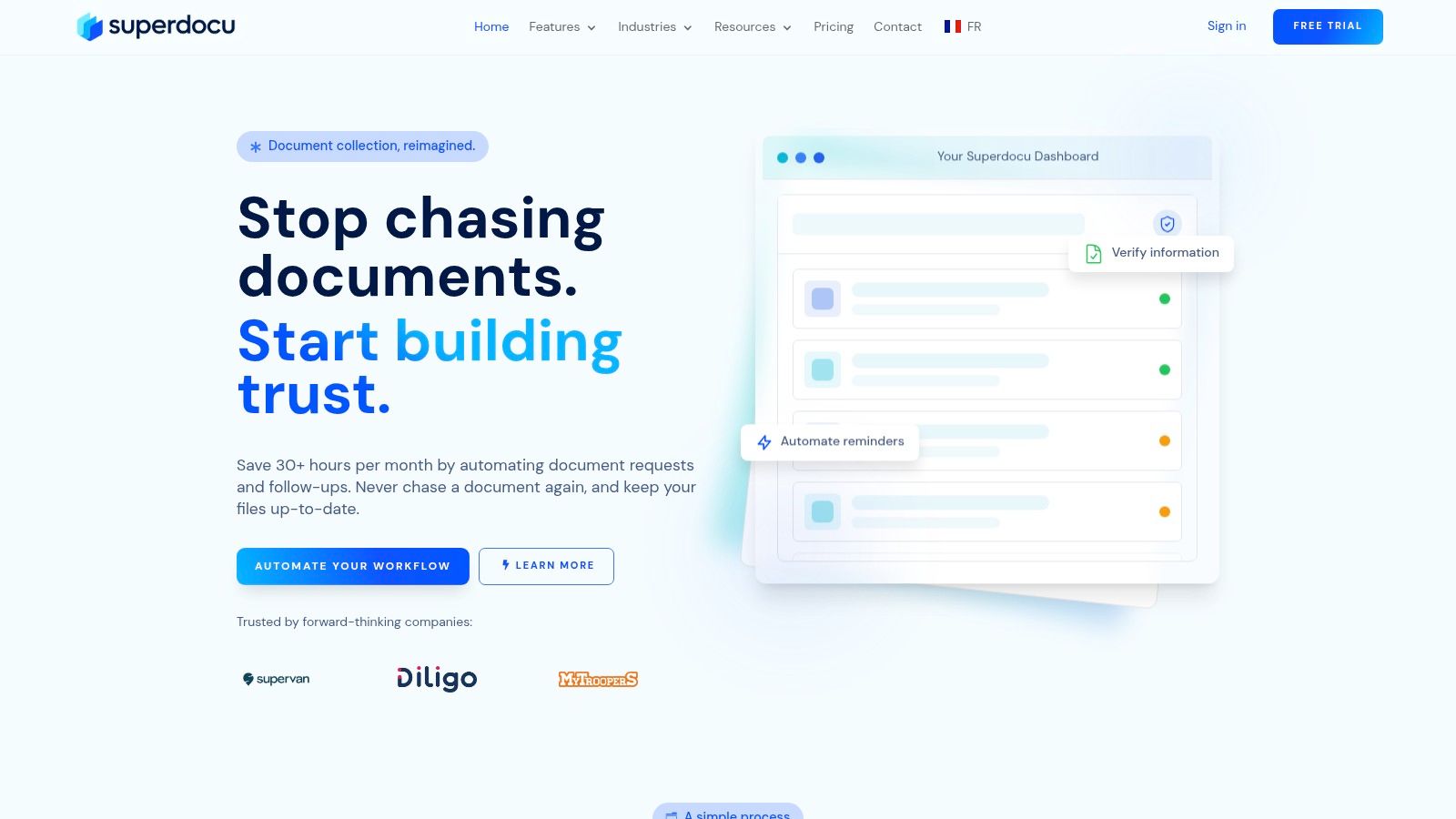
The screenshot below shows a platform interface designed around document automation, which is relevant because the compliance burden often sits inside the workflow itself, not just the storage layer.
For teams that want a deeper look at cloud risk, the security of cloud storage matters because residency and security are connected. A platform can't help you if it stores data carelessly, exposes access paths, or leaves your staff guessing about where documents sit. A compliant setup should reduce manual work, preserve visibility, and keep the legal basis for storage clear.
That is why a provider with European hosting, GDPR-ready controls, and document workflows built for controlled sharing can be a strong fit for businesses that need operational simplicity and legal discipline at the same time. For a small business, the test is not whether a vendor says “secure.” The test is whether the vendor can support your actual document flow without forcing you to rebuild it every time a new country or customer segment comes along.
Making Compliance Your Competitive Advantage
A lot of businesses treat residency rules like friction. That mindset misses the bigger opportunity. When you can explain where data lives, how it moves, and why your controls are in place, customers trust you faster. If you want a broader perspective on choosing a provider with jurisdiction-aware hosting, choosing a sovereign provider is a useful lens for thinking about control and accountability.
Compliance also makes expansion less chaotic. Instead of scrambling every time a customer or regulator asks a location question, you already have the map, the contracts, and the workflow. That calm, repeatable setup becomes part of your brand.
If you want to make data residency easier to manage in everyday document work, Superdocu helps businesses collect, organize, and track files with secure workflows that support compliance-minded operations. Visit Superdocu to see how a structured document process can help your team stay organized, reduce manual follow-up, and handle residency questions with more confidence.