
In an era of constant data breaches and strict privacy laws like GDPR and HIPAA, how you move a file from point A to point B is as critical as the information it contains. Standard email attachments and basic cloud storage no longer suffice. For small and medium-sized businesses, from solo legal practitioners to bustling real estate firms, the need for robust, reliable, and compliant ways to handle sensitive documents is non-negotiable. This is especially true during large-scale operations; for instance, ensuring comprehensive SharePoint migration security is paramount to prevent data leaks during a platform transition.
This guide moves beyond buzzwords to give you actionable insights into the top secure file transfer methods available today. We will break down how each one works, its specific security strengths and weaknesses, and its suitability for compliance. You'll learn which methods are best for different industries and how they can be integrated with document collection platforms to streamline your workflows.
You will leave with a clear understanding of:
- The core technology behind methods like SFTP, end-to-end encryption, and APIs.
- Practical implementation tips for your business.
- Real-world use cases in sectors such as legal, HR, and finance.
Let’s dive into the essential strategies that keep your data safe, your clients confident, and your business compliant.
1. End-to-End Encryption (E2EE)
End-to-end encryption (E2EE) is the gold standard among secure file transfer methods. This approach ensures your data is unreadable from the moment it leaves your device until it reaches the intended recipient. The file is encrypted on your end, travels securely across servers, and can only be decrypted by the recipient who holds the corresponding key.
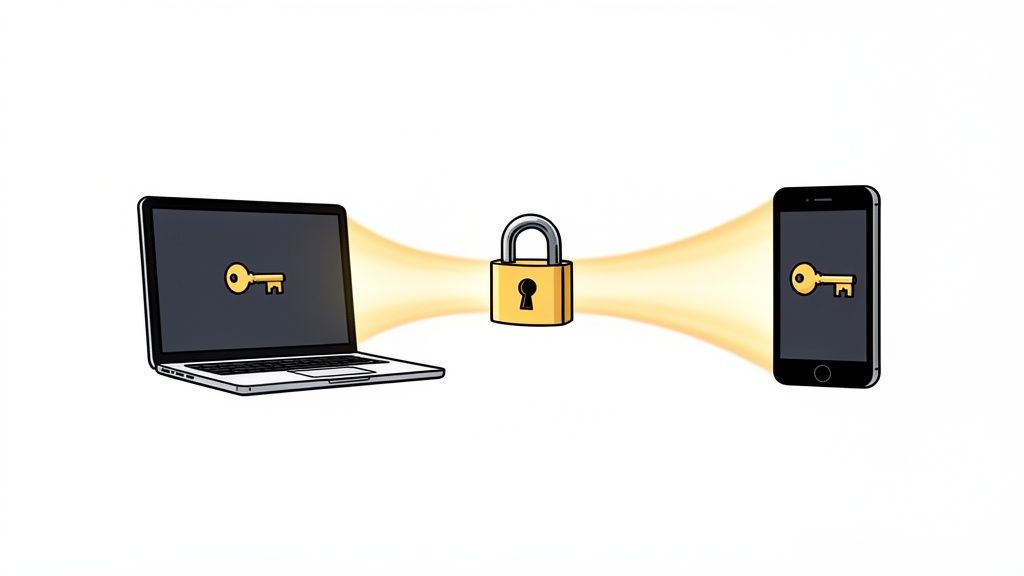
Unlike standard encryption, where a service provider might hold the keys and could theoretically access your files, E2EE makes the data completely private. Even the service facilitating the transfer cannot access the content. For a deeper dive into the cryptographic principles behind these secure transfers, consider reading about the Role of Encryption in Information Security.
Why It's a Top Method
E2EE is critical for industries handling highly sensitive information. For legal firms exchanging privileged client documents or HR departments processing employee PII, it offers the highest level of assurance. This method is a cornerstone of compliance with stringent data privacy regulations. Adhering to these standards is essential; you can use our GDPR compliance checklist to ensure your processes are up to par.
Platforms like Superdocu leverage E2EE to protect documents throughout the entire collection workflow, from upload to storage, making it a powerful tool for secure data management.
Implementation Tips for SMBs
- Prioritize Sensitive Data: Apply E2EE for all documents containing PII, financial details, intellectual property, or legal information.
- Secure Key Management: Implement robust practices for managing encryption keys, including secure storage and providing key recovery options for business continuity.
- User Education: Train your team on what E2EE protects against and the importance of safeguarding their decryption keys or passwords.
- Test Performance: Before a full rollout, test the performance of your E2EE solution during peak hours to ensure file transfers remain efficient and don't create bottlenecks.
2. TLS/SSL Protocol (HTTPS)
Transport Layer Security (TLS) and its predecessor, SSL, are cryptographic protocols that provide foundational security for data in transit. When you see "HTTPS" in your browser's address bar, it signifies that TLS is active, creating an encrypted tunnel between your device and the server. This method protects files during upload or download, making it one of the most fundamental secure file transfer methods.
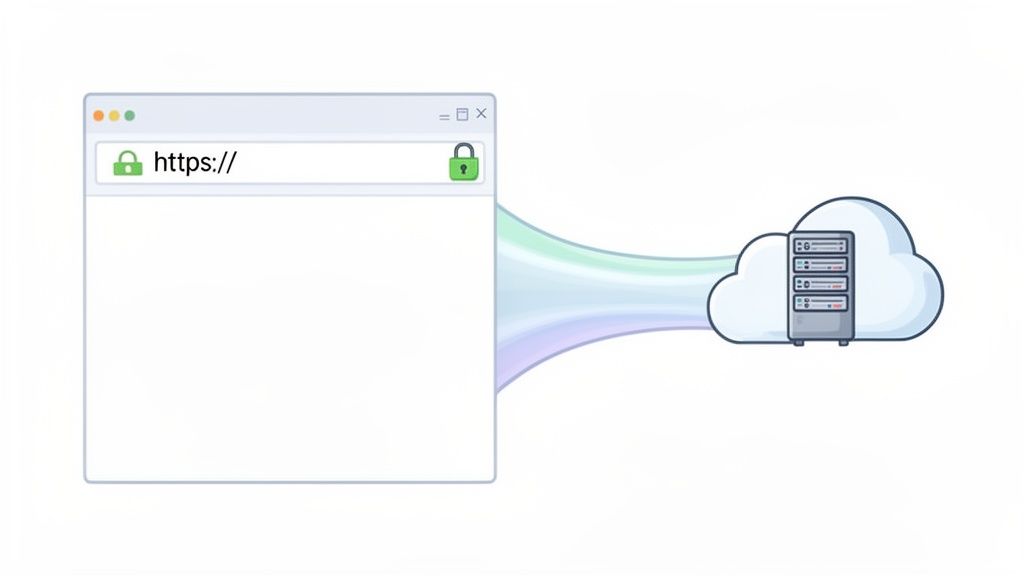
While E2EE encrypts the data itself, TLS encrypts the connection or the pipe through which data travels. This prevents eavesdropping and man-in-the-middle attacks, ensuring that files sent via a web portal, for instance, are unreadable to anyone intercepting the traffic. It is the baseline for nearly all secure online interactions, from online banking to patient portals.
Why It's a Top Method
HTTPS is a non-negotiable standard for any business operating online. It builds user trust and is essential for compliance with regulations like GDPR and HIPAA, which mandate the protection of personal data during transmission. For industries like finance, healthcare, and government, where clients submit sensitive documents through online portals, TLS provides the necessary layer of in-transit security to protect that information.
Platforms like Superdocu use HTTPS across their entire service to secure all client interactions. Every document you request or receive through a Superdocu portal is protected by this robust encryption from the moment it leaves the user's browser until it reaches our secure servers.
Implementation Tips for SMBs
- Mandate Modern Protocols: Configure your web servers to use only TLS 1.2 or TLS 1.3. Disable all older, vulnerable versions like SSLv3 and early TLS.
- Implement HSTS: Use HTTP Strict Transport Security (HSTS) headers to force browsers to always connect to your site using HTTPS, preventing downgrade attacks.
- Automate Certificate Management: Monitor SSL/TLS certificate expiration dates closely and automate the renewal process to avoid service interruptions and security warnings.
- Regularly Audit Configurations: Use tools like SSL Labs to periodically test your server's configuration and ensure it meets current security best practices.
3. Zero-Knowledge Cloud Storage
Zero-knowledge cloud storage takes data privacy to a new level by ensuring that even the service provider cannot access your files. In this model, all encryption and decryption happen on your device (client-side) before the data is uploaded. The provider only stores unintelligible encrypted blobs of data and has "zero knowledge" of the decryption keys, which remain solely with you.

This architecture effectively eliminates the risk of data breaches on the server-side exposing sensitive content, as the files would be useless without the user's key. Services like Tresorit, Sync.com, and Internxt are built on this principle, offering a highly secure alternative to conventional cloud storage. Choosing the right architecture is a key part of implementing a cloud-based document management system.
Why It's a Top Method
Zero-knowledge architecture provides an unparalleled level of privacy and security, making it one of the most trustworthy secure file transfer methods for long-term storage. It is ideal for industries handling confidential client data, such as legal firms retaining case files or financial services managing client portfolios. By making data inaccessible to the provider, it also simplifies compliance with regulations like GDPR and HIPAA, as the risk of unauthorized third-party access is fundamentally removed.
Platforms like Superdocu use this principle to secure documents in features like its validation dashboard and long-term retention archives, ensuring maximum security and client confidentiality.
Implementation Tips for SMBs
- Use Strong Key Derivation: Implement robust key derivation functions like Argon2 to protect user passwords, which often serve as the basis for encryption keys.
- Provide Secure Recovery Options: Since the provider cannot reset passwords, offer users secure recovery codes or mechanisms to regain access if they forget their credentials.
- Prioritize a Smooth User Experience: Use client-side libraries that handle encryption and decryption transparently to minimize user friction and technical complexity.
- Plan for Version Control: Implement a system for versioning and recovering previous file versions, a feature that can be complex to manage within a zero-knowledge framework.
4. SFTP (SSH File Transfer Protocol)
SFTP (SSH File Transfer Protocol) is a network protocol that provides secure file access, transfer, and management over a reliable data stream. It runs over the Secure Shell (SSH) protocol, leveraging its robust encryption and authentication features to protect data in transit. Unlike its outdated predecessor, FTP, SFTP encrypts both the commands and the data, preventing passwords and sensitive information from being exposed.
This method establishes a single, secure connection for all operations, making it an efficient and trusted choice for secure file transfer methods. It authenticates the client and server and ensures the integrity of the data being transferred, making it a staple for automated and programmatic file exchanges in corporate environments.
Why It's a Top Method
SFTP is indispensable for businesses that require automated, high-volume, or scheduled file transfers. For instance, mortgage companies use it to exchange loan documents with lenders and title companies, while insurance firms rely on it to transfer claim files between offices securely. Its reliability and strong security controls make it ideal for system-to-system workflows where direct human interaction is minimal.
The protocol’s ability to provide detailed logs and audit trails also makes it highly suitable for industries needing to demonstrate compliance with data security standards. It offers a powerful way to manage document workflows programmatically, ensuring both security and efficiency.
Implementation Tips for SMBs
- Use SSH Key Pairs: Prioritize strong SSH key pairs (minimum 2048-bit RSA or modern Ed25519) for authentication instead of less secure passwords.
- Implement IP Whitelisting: Restrict access to your SFTP server by only allowing connections from trusted IP addresses.
- Enable Detailed Logging: Configure your server to log all SFTP activity and monitor these logs regularly for any suspicious patterns or unauthorized access attempts.
- Restrict User Access: Use "chroot jails" to confine SFTP users to their designated home directories, preventing them from navigating the entire server filesystem.
5. PGP / GPG Encryption
Pretty Good Privacy (PGP) and its open-source alternative, GNU Privacy Guard (GPG), represent a trusted and established method for securing files and communications. This approach uses asymmetric cryptography, where each user has a pair of keys: a public key for encrypting files and a private key for decrypting them. Senders use the recipient's public key to encrypt a file, ensuring only the recipient with the corresponding private key can unlock it.
This method stands out among secure file transfer methods because it places control directly in the hands of the users. Instead of relying on a central service, PGP/GPG enables individuals to manage their own security keys, providing verifiable authentication and data integrity. This makes it ideal for direct, point-to-point secure exchanges where individual responsibility is paramount.
Why It's a Top Method
PGP/GPG is particularly valuable in fields where confidentiality and non-repudiation are non-negotiable. For journalists protecting sources, lawyers handling sensitive client communications, or government agencies exchanging classified documents, it offers a robust layer of security. This user-centric model is also favored by financial institutions for securing email-based document transfers and by whistleblower platforms that need to guarantee submitter anonymity.
Because PGP/GPG authenticates the sender and encrypts the content, it helps organizations meet strict compliance requirements related to data integrity and privacy. It provides a strong, auditable trail proving that a file was sent by a specific individual and remained unaltered in transit.
Implementation Tips for SMBs
- Establish Key Management Policies: Define clear procedures for key rotation, revocation, and recovery to maintain security over time.
- Use Strong Passphrases: Protect private keys with complex passphrases and store them securely, for example, in a hardware security module (HSM) or an encrypted password manager.
- Build a Web of Trust: Organize internal key-signing events where team members can verify each other's identities and sign their public keys, strengthening trust within your organization.
- Automate Where Possible: Integrate PGP/GPG into workflows using automation libraries to reduce the risk of human error associated with manual encryption and decryption processes.
6. Secure File Sharing Links and Encrypted Archives
Combining secure, time-limited links with password-protected archives offers a practical balance between strong security and user convenience. This two-part approach involves first encrypting files locally into a compressed archive (like a ZIP or 7Z file), then sharing them via a unique, expiring URL. This method is one of the most accessible secure file transfer methods for non-technical recipients, as they only need to click a link and enter a password.
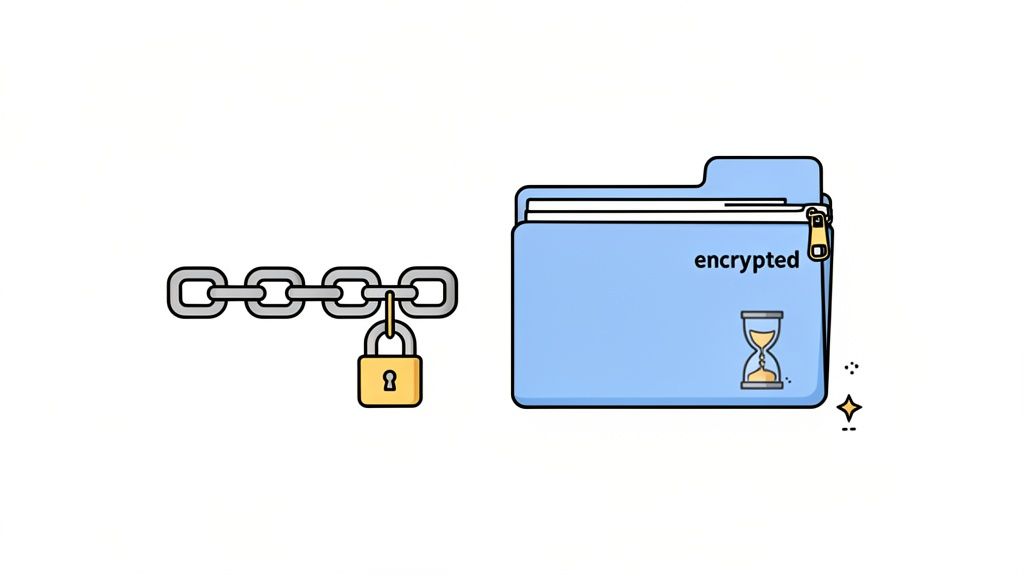
The link itself acts as a temporary key, granting access for a limited time, while the archive’s password provides a separate, crucial layer of security. This dual-control mechanism ensures that even if the link is intercepted, the file's contents remain unreadable without the password, which should always be shared through a different channel.
Why It's a Top Method
This method excels in scenarios where you need to collect or send sensitive information to external parties without forcing them to create an account. For instance, HR departments can send onboarding document requests to new hires, or a small consulting firm can share project deliverables with a client. The recipient experience is simple and direct, which reduces friction and speeds up document exchange.
Platforms like Superdocu build on this model by generating secure request links for clients to upload documents directly. This streamlines collection workflows in industries like real estate for rental applications or legal services for client evidence gathering, ensuring simplicity does not compromise security.
Implementation Tips for SMBs
- Set Aggressive Expiration Times: Configure links to expire quickly, typically within 24 to 72 hours, to minimize the window of exposure.
- Separate Password Communication: Never send the archive password in the same email as the file link. Use a different channel, like a text message or a phone call.
- Use Strong Encryption: When creating archives, always use AES-256 encryption. The 7Z format often provides stronger encryption defaults than standard ZIP files.
- Implement Access Alerts: Use a system that provides download receipt notifications. This confirms the intended recipient has accessed the files and can alert you to unauthorized access attempts.
7. API-Based Secure File Transfer with OAuth 2.0
API-based file transfers use Application Programming Interfaces (APIs) to programmatically move data between systems, and OAuth 2.0 is the industry-standard protocol for authorizing these connections. Instead of sharing usernames and passwords, applications are granted secure, temporary access tokens with specific permissions. This method is fundamental for integrating different software platforms securely.
This approach minimizes credential exposure by preventing your core passwords from ever being shared with a third-party application. Modern integrations, such as connecting Superdocu to over 3,000 apps via Zapier or Slack’s third-party app integrations, rely on OAuth 2.0. It allows seamless, automated workflows across multiple platforms while upholding robust security standards for data in transit.
Why It's a Top Method
API-based transfers are essential for businesses that rely on interconnected software ecosystems. For a mortgage broker, this could mean automatically transferring a client's verified documents from a secure collection portal like Superdocu directly into their Customer Relationship Management (CRM) system. It eliminates manual downloads and uploads, which are both time-consuming and prone to human error, making it one of the most efficient secure file transfer methods available.
By using OAuth 2.0, you maintain granular control, granting only the necessary permissions (scopes) for an application to perform its function. This "least privilege" principle is a cornerstone of modern cybersecurity and a key requirement for many compliance frameworks.
Implementation Tips for SMBs
- Implement Granular Scopes: When configuring an API integration, never grant broader permissions than absolutely necessary. If an app only needs to read files, do not grant it write or delete access.
- Use Short-Lived Access Tokens: Configure access tokens to expire quickly (e.g., within 15-60 minutes) and use refresh tokens for longer-term access. This limits the window of opportunity for an attacker if a token is compromised.
- Monitor API Activity: Implement rate limiting to prevent abuse and actively monitor API logs for unusual patterns, such as a high volume of failed authentication attempts or access from suspicious IP addresses.
- Validate Tokens Server-Side: Before granting access to any resource, your server should always validate the OAuth token to ensure it is authentic, has not expired, and possesses the required scopes.
8. Blockchain-Based Document Verification and Transfer
Blockchain technology introduces a revolutionary approach to secure file transfer methods by creating an immutable, timestamped record of every document interaction. Instead of storing the entire file on the blockchain, which can be costly, this method typically stores a cryptographic "fingerprint" or hash of the document. Each transfer or modification is recorded as a transaction on a distributed ledger, sealed cryptographically, and linked to the previous one, forming a secure chain.
This process ensures that any attempt to alter a document or its history is immediately detectable, providing unparalleled auditability and non-repudiation. The actual document remains encrypted and stored off-chain, but its integrity is continuously verifiable against the public or private ledger. This hybrid model offers a powerful combination of privacy and verifiable proof. For those interested in the foundational technology, exploring resources on blockchain for enterprise can provide valuable context.
Why It's a Top Method
Blockchain-based verification is ideal for scenarios requiring an indisputable audit trail. For industries like real estate processing title deeds, immigration authorities verifying credentials, or supply chains tracking high-value assets, it provides a "single source of truth." This method guarantees that a document has not been tampered with since it was last recorded, which is critical for legal evidence, regulatory compliance, and high-stakes transactions where authenticity is paramount.
Platforms can integrate this verification layer to offer clients absolute confidence in the integrity of collected documents, enhancing trust and reducing the risk of fraud in critical workflows.
Implementation Tips for SMBs
- Use Hashing, Not Full Storage: To manage costs and complexity, store only document hashes (e.g., SHA-256) on the blockchain, keeping the encrypted files in separate, secure storage.
- Choose the Right Blockchain: For sensitive business documents, opt for a private or consortium blockchain over a public one to control who can participate and view transaction data.
- Combine with Encryption: Implement blockchain verification as an additional layer of security on top of strong, end-to-end encryption for the off-chain file storage.
- Evaluate Necessity: Before investing, assess whether a traditional, cryptographically signed audit log would suffice for your needs, as blockchain implementation can be more complex.
9. Secure File Transfer Service Platforms (SFTS)
Secure File Transfer Service (SFTS) platforms are specialized solutions built from the ground up to handle sensitive data with robust security and compliance features. Unlike general-purpose cloud storage, these dedicated services combine strong encryption, granular access controls, detailed audit trails, and user-friendly interfaces into a single, cohesive platform. They are optimized specifically for secure document sharing and management.
Leading SFTS solutions like Citrix ShareFile, Egnyte, and Kiteworks offer advanced features such as remote file deletion, link expiration, and download tracking. This gives businesses complete control over their data even after it has been sent. These platforms are designed to address the complex needs of regulated industries, making them one of the most reliable secure file transfer methods available.
Why It's a Top Method
SFTS platforms are ideal for organizations that need more than just encryption. They provide a comprehensive governance framework for managing the entire lifecycle of a document. For a financial services firm managing client portfolios or a healthcare provider sharing patient records, an SFTS ensures that every transfer is logged, auditable, and compliant with regulations like HIPAA or GDPR.
These platforms often function as a centralized hub for all external data exchanges, streamlining workflows and reducing the risk associated with shadow IT. Many businesses use them as a core component of their data governance strategy, similar to how they might use a secure document intake platform to manage incoming information safely.
Implementation Tips for SMBs
- Assess Compliance Needs: Evaluate platforms based on their certifications and ability to meet your specific regulatory requirements (e.g., HIPAA, GDPR, CCPA).
- Test Integrations: Before committing, test the platform's ability to integrate with your existing systems, such as your CRM or document management software.
- Establish Clear Policies: Create and enforce company-wide policies for using features like access expiration and remote file deletion to maintain consistent security.
- Pilot the Solution: Roll out the platform to a small, specific team or department first to gather feedback and refine your processes before a full-scale implementation.
10. Hardware Security Keys (U2F / WebAuthn) for Access Control
Hardware security keys represent the pinnacle of user authentication, directly strengthening secure file transfer methods by preventing unauthorized access. These physical devices, such as a YubiKey or Google Titan Key, use standards like FIDO2 and WebAuthn to provide phishing-resistant multi-factor authentication. When a user tries to access a secure portal, they must physically interact with the key to verify their identity.
The key contains cryptographic material that never leaves the device, making it impossible for attackers to intercept credentials through traditional phishing or malware attacks. This approach ensures that even if a user's password is stolen, their account and the files within it remain secure. It adds a powerful, hardware-based layer of protection to any file access or transfer system.
Why It's a Top Method
Hardware keys provide an unparalleled defense against account takeover, a primary vector for data breaches. They are highly recommended by government agencies like NIST for securing sensitive systems. For businesses in finance, law, or compliance, requiring hardware keys for administrative or high-risk accounts drastically reduces the threat of sophisticated cyberattacks. This makes them an essential component of a robust security posture for document collection.
Platforms that integrate with identity management systems can leverage hardware keys to ensure that only authenticated individuals access sensitive document workflows, protecting data from upload to final storage.
Implementation Tips for SMBs
- Provide Backups: Issue at least two hardware keys to each user. One serves as the primary, and the other as a secure backup to prevent lockouts.
- Establish Recovery Procedures: Implement an account recovery process that is independent of the hardware key, such as in-person identity verification for resetting access.
- Support Multiple Form Factors: Offer both USB (USB-A, USB-C) and NFC-enabled keys to ensure compatibility across desktops, laptops, and mobile devices.
- Prioritize Privileged Accounts: Start your rollout by requiring hardware keys for all administrative and other high-privilege accounts before extending the policy to all users.
10-Point Comparison: Secure File Transfer Methods
| Solution | Implementation Complexity 🔄 | Resource Requirements ⚡ | Expected Outcomes 📊 | Ideal Use Cases 💡 | Key Advantages ⭐ |
|---|---|---|---|---|---|
| End-to-End Encryption (E2EE) | High — endpoint key management, PFS required 🔄 | Moderate–High — CPU on clients, key storage/UX effort ⚡ | Maximum confidentiality; server cannot read content 📊 | Highly sensitive PII, legal & financial document exchange 💡 | Strongest privacy and regulatory alignment ⭐ |
| TLS/SSL Protocol (HTTPS) | Low–Moderate — certificate lifecycle and config 🔄 | Low — minimal performance overhead on servers ⚡ | Protects data in transit; prevents MITM eavesdropping 📊 | Web portals and general document submissions 💡 | Universal browser support and low overhead ⭐ |
| Zero-Knowledge Cloud Storage | High — client-side crypto and recovery complexity 🔄 | High — client CPU, UX work, key-recovery systems ⚡ | Provider has zero access; strong long-term privacy 📊 | Long-term retention, GDPR-sensitive storage 💡 | Absolute provider-side privacy and reduced insider risk ⭐ |
| SFTP (SSH File Transfer Protocol) | Moderate–High — server administration and SSH key ops 🔄 | Moderate — server infra, key management, audit logging ⚡ | Secure automated batch transfers with full audit trails 📊 | Enterprise integrations (banks, mortgage, insurers) 💡 | Robust automation, authentication, and compliance logs ⭐ |
| PGP / GPG Encryption | High — user key lifecycle and trust management 🔄 | Low–Moderate — client tooling, key storage, training ⚡ | Confidential files with digital signatures (non‑repudiation) 📊 | Legal, government, journalists, secure email workflows 💡 | Encryption + signatures; decentralized trust model ⭐ |
| Secure File Sharing Links & Encrypted Archives | Low — simple link/expiry and archive password setup 🔄 | Low — minimal infra; relies on secure token generation ⚡ | Fast, time-limited access but risk of link forwarding 📊 | Client-facing collection for non‑technical users, ad‑hoc sharing 💡 | Very user-friendly; quick adoption and flexible controls ⭐ |
| API-Based Secure File Transfer (OAuth 2.0) | Moderate–High — OAuth infra, scopes, token flows 🔄 | Moderate — token management, monitoring, rate limits ⚡ | Granular, auditable programmatic transfers; revocable access 📊 | Integrations/automation (Zapier, CRMs, workflows) 💡 | Scoped permissions and scalable automation with audit trails ⭐ |
| Blockchain-Based Verification & Transfer | Very High — ledger integration, smart contracts 🔄 | High — compute, transaction fees, specialized expertise ⚡ | Immutable timestamps and verifiable hashes; strong provenance 📊 | Multi‑party closings, legal provenance, high-assurance audits 💡 | Tamper‑proof audit trails and non‑repudiation for records ⭐ |
| Secure File Transfer Service Platforms (SFTS) | Low–Moderate — vendor integration and policy setup 🔄 | Variable — licensing and enterprise deployment costs ⚡ | Turnkey secure sharing with compliance controls and logs 📊 | Organizations needing managed, compliant file delivery 💡 | Purpose-built UX, certifications, remote deletion & expiry ⭐ |
| Hardware Security Keys (U2F / WebAuthn) | Moderate — device provisioning and recovery policies 🔄 | Low–Moderate — per-user hardware cost and distribution ⚡ | Phishing‑resistant strong auth; significantly reduced account takeover 📊 | Admins, auditors, high‑privilege portal access and sensitive accounts 💡 | Highest assurance authentication; phishing-resistant credential proof ⭐ |
Choosing the Right Method for Your Workflow
Navigating the landscape of secure file transfer methods can feel overwhelming, but the journey ends with a powerful realization: there is no single "best" method. Instead, the most secure and effective strategy is a tailored combination of the tools we've explored, one that aligns perfectly with your specific business processes, compliance requirements, and user needs. The goal is not just to transfer files but to build a resilient, trustworthy, and efficient document management ecosystem.
From the robust, system-to-system reliability of SFTP to the user-friendly accessibility of secure file-sharing links protected by TLS, each method serves a distinct purpose. The key is to move beyond thinking of these as isolated technologies and start viewing them as interconnected layers of a comprehensive security posture.
From Theory to Action: Building Your Secure Workflow
The true value of understanding these secure file transfer methods lies in their practical application. Your next step is to map these technologies directly onto your operational realities. This involves asking critical questions about your daily workflows and identifying the points where data is most vulnerable or where processes become inefficient.
Consider these actionable steps to translate knowledge into a concrete strategy:
- Audit Your Current Processes: Where are you currently collecting documents? Are you relying on insecure methods like standard email attachments? Identify the highest-risk data transfer points in your business, whether it's client onboarding, vendor communication, or internal collaboration.
- Segment by Use Case: Your needs will vary dramatically by context.
- Client-Facing Collection: For gathering documents from clients, simplicity and ease of use are paramount. A secure portal or a platform that generates unique, expiring file-sharing links (like Superdocu) is often ideal. It removes technical barriers for your clients while enforcing strong security standards like HTTPS.
- System-to-System Automation: When connecting your internal systems (like a CRM to a document storage platform), a more technical solution like an API with OAuth 2.0 or a dedicated SFTP server provides the necessary reliability and automation capabilities.
- High-Stakes Verification: For industries where document authenticity is non-negotiable, exploring advanced methods like blockchain verification or enforcing multi-factor authentication with hardware security keys can provide an unparalleled level of assurance.
- Prioritize the User Experience: Security should not come at the cost of usability. A complex, confusing process will lead to user frustration, workarounds, and ultimately, a breakdown in your security protocol. The most successful implementations are those that make the secure path the easiest path for everyone involved.
The True ROI of Secure File Transfer
Mastering these concepts is more than a technical exercise; it's a fundamental business imperative. A well-designed secure file transfer strategy directly impacts your bottom line and brand reputation. It builds client trust, ensures you meet critical compliance obligations like GDPR and HIPAA, and protects you from the devastating financial and reputational costs of a data breach.
By thoughtfully selecting and integrating the right combination of secure file transfer methods, you transform document management from a potential liability into a strategic advantage. You create a system that is not only secure but also streamlined, professional, and efficient. This empowers your team to focus on their core responsibilities, confident that the sensitive data they handle is protected at every step.
Ready to replace insecure email attachments with a streamlined, secure, and professional client document collection process? Superdocu combines the power of secure file-sharing links, TLS encryption, and automated workflows into one easy-to-use platform designed for businesses like yours. Start simplifying your document collection today with Superdocu.