
Picture this: you send a critical client contract, but before it ever reaches them, it’s intercepted. It's a business owner's worst nightmare. Shared file encryption is the modern-day fix for this problem. It works by scrambling your files into an unreadable code, making sure only the people you authorize can ever see what's inside.
Think of it like sending a valuable item in a locked box. Only the person with the correct key can open it.
Why Unsecured Shared Files Are a Major Business Risk
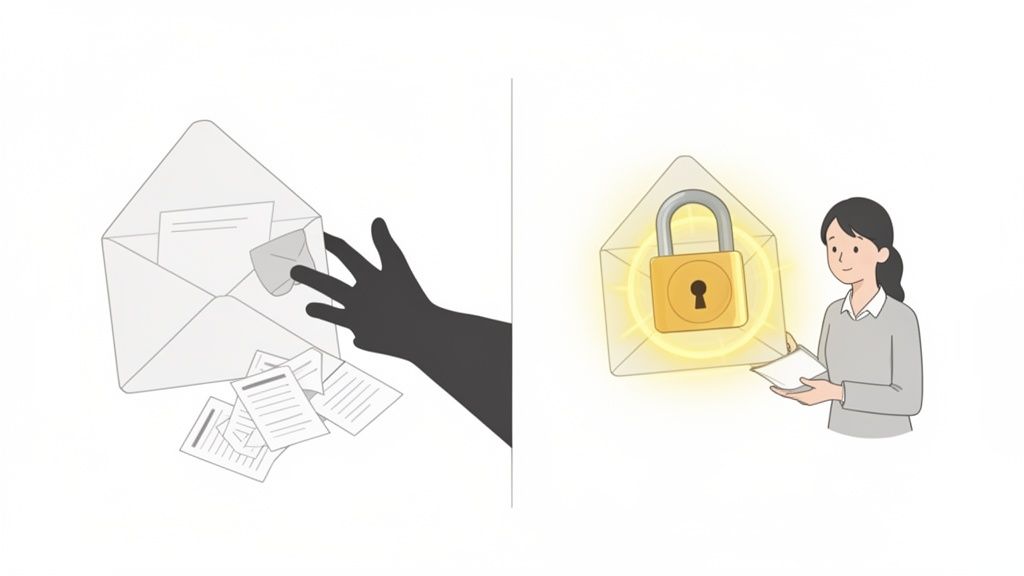
Sharing files—from client invoices to employee records—is just part of doing business today. But too many companies still rely on outdated methods like password-protected ZIP files or regular email attachments, which leaves sensitive data dangerously exposed. These old habits just don't stand a chance against modern cyber threats.
The fallout from a data breach can be devastating, hitting you with financial losses, a damaged reputation, and hefty legal penalties. It's impossible to ignore the broader cloud computing security challenges that put your data at risk every day. When you share files without proper protection, you're creating a weak link in your security chain, practically inviting trouble.
Moving Beyond Basic Passwords
Relying on a simple password is like putting a flimsy screen door lock on a bank vault. It might stop someone who wanders by, but it won’t hold up against a determined intruder. Today's sophisticated threats demand a much stronger defense.
That’s where shared file encryption comes in. It makes your data completely unreadable to anyone without the right credentials, even if they somehow manage to get their hands on the file.
Shared file encryption is not a technical burden; it is a fundamental necessity for protecting client data, maintaining trust, and meeting legal requirements.
This proactive approach to security is a must for any business that takes data protection seriously. The market numbers tell the story. The global encryption software market was valued at USD 10.9 billion in 2021 and is expected to double to USD 22.1 billion by 2026, according to research from MarketsandMarkets. This growth is fueled by rising concerns over data breaches and stricter compliance rules.
Adopting a secure method isn’t just about playing defense; it’s about building a smarter, more efficient workflow. The experience needs to be smooth for you and your clients. For a closer look at how to blend security with convenience, check out our guide on how to securely request files from customers. It’s a great resource for seeing how security and efficiency can go hand-in-hand.
How Shared File Encryption Actually Works
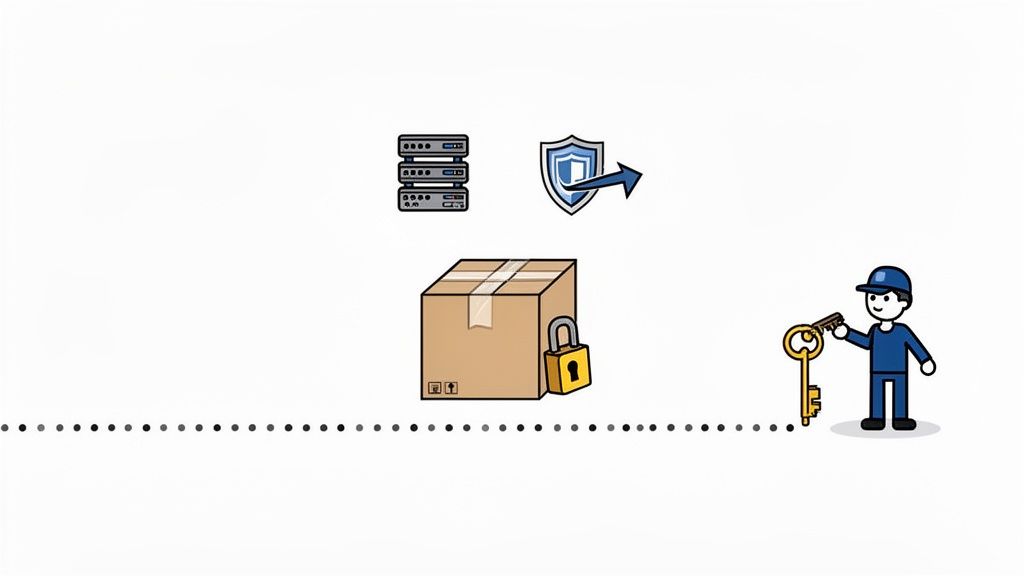
Let's break down shared file encryption with a simple analogy. Imagine you need to send a valuable item across town. You wouldn't just hand it to a courier; you'd put it in a locked box first. Only the person with the right key can open it, no matter who handles the box along the way. That's the basic idea behind how modern platforms protect your sensitive documents.
When you encrypt a file, you're essentially putting it in that digital "locked box." The system transforms your readable document—like a PDF or spreadsheet—into a jumble of unreadable code called ciphertext. This happens seamlessly in the background. The only way to turn it back into a readable file is with the correct digital "key."
Protecting Data Everywhere It Goes
For a file to be truly secure, it needs protection at two critical stages: when it's just sitting there and when it's on the move. Good encryption covers both.
Encryption at Rest: This is for files saved on a server or in cloud storage. Think of it as a locked safe inside a secure warehouse. Even if someone manages to break into the warehouse, the contents of the safe are still protected.
Encryption in Transit: This secures files as they travel across the internet from your computer to the recipient's. This is the armored truck that transports your locked box, preventing anyone from intercepting it en route.
This two-pronged strategy creates a complete security shield around your data, closing any potential gaps.
The best shared file encryption systems apply these protections automatically. From the moment a document is uploaded until it's safely with the recipient, it's shielded. This end-to-end approach leaves no weak points for an attacker to exploit.
This kind of built-in security is a huge reason why businesses are flocking to cloud solutions. In fact, the "solution component" of the cloud encryption market captured over 69% market share in 2024. With remote work becoming the norm, the need for secure file sharing has skyrocketed.
The market is projected to grow at a massive CAGR of 30.2% from 2025 to 2030. This growth is largely driven by small and mid-sized businesses adopting third-party tools for everything from HR paperwork to client onboarding.
The Technology Behind the Lock
You don't need to be a cryptographer to appreciate how this works. Most of the heavy lifting happens behind the scenes, but knowing the basics can give you peace of mind. There are a couple of core methods that modern platforms combine for maximum security and ease of use. For a deeper look, check out this excellent guide to file share encryption.
To help clarify, this table breaks down the key approaches.
Comparing Encryption Methods for Shared Files
This table compares the two fundamental types of encryption—at rest and in transit—and the two main cryptographic approaches, symmetric and asymmetric, to help businesses understand how their data is protected.
| Encryption Type | What It Protects | Analogy | Best For |
|---|---|---|---|
| Symmetric Encryption | Uses a single, shared key to both lock (encrypt) and unlock (decrypt) a file. | A single house key that both you and a trusted friend have a copy of. | Securing large files quickly, as it's computationally faster. |
| Asymmetric Encryption | Uses a pair of keys: a public key to lock the file and a private key to unlock it. | A public mailbox where anyone can drop off mail, but only you have the private key to open it. | Securely exchanging the "single key" used in symmetric encryption to start a session. |
Today's best platforms handle this complexity for you. They typically use the slower but more secure asymmetric encryption to establish a safe connection, then switch to the faster symmetric encryption to protect the file itself. This hybrid approach delivers the best of both worlds: unshakeable security that’s also incredibly efficient.
Why Managing Encryption Keys Is So Important
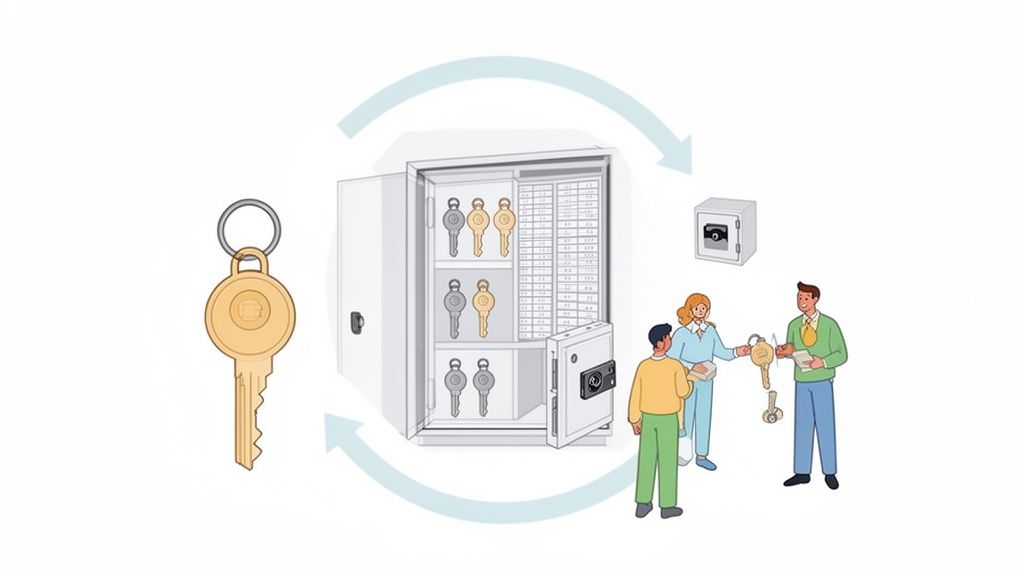
If encryption is the digital lock on your files, then the cryptographic key is the actual key that opens it. Think about it like the master key system for a big office building. You wouldn't just hand out copies of that master key to anyone, and you definitely wouldn't leave one sitting on a reception desk.
That’s the core idea behind shared file encryption. The key is a special string of data that scrambles and unscrambles your information. Without it, an encrypted file is just a jumble of useless code. This is why managing who has access to the keys, where they are stored, and what to do if one goes missing is so incredibly important.
The Problem with Manual Key Management
Now, imagine trying to manage all the keys for that office building on your own. You’d need a safe to store them, a detailed logbook to track who has which key, and a solid plan for rekeying every lock if a key ever gets lost or stolen. It quickly becomes a huge, risky headache.
Trying to manage your own encryption keys creates the exact same set of problems. You suddenly become responsible for a lot of moving parts:
- Secure Generation: Creating keys that are genuinely random and complex enough to fend off brute-force attacks.
- Safe Storage: Keeping keys protected from theft or accidental deletion.
- Controlled Distribution: Making sure only the right people get the right keys.
- Key Rotation: Routinely changing out old keys for new ones to minimize the damage if one is ever compromised.
For most small and medium-sized businesses, this is a massive undertaking that’s just not practical. It also introduces the risk of human error. A single slip-up, like emailing a key or saving it in a public folder, can completely unravel your security.
The biggest weakness in any encryption system isn't usually the lock itself—it's how the keys are handled. If you lose the key, you lose your data forever. There’s no getting it back.
How Modern Platforms Solve the Key Problem
This is exactly why smart businesses rely on secure platforms that manage keys automatically. Modern services that provide shared file encryption take this entire complex process off your plate. When you upload a file, the system handles the entire key lifecycle behind the scenes.
It generates a strong, unique key for each session, stores it in a secure, isolated environment, and manages the entire exchange without you ever seeing it. This ensures only the people you’ve authorized can ever access the documents.
This "managed" approach gives you the best of both worlds. You get the powerful security of enterprise-level encryption without the headache and risk of doing it all yourself. Access is tied to a user’s secure login, not a separate key file they could easily lose. This keeps your data from being permanently locked away or falling into the wrong hands, letting you focus on your business instead of becoming a part-time cryptographer.
Keeping Up with Compliance Demands
If you're in a regulated field like finance, healthcare, or law, you know that strong data security isn't just a "nice-to-have"—it's a legal must. Regulations like GDPR in Europe and HIPAA in the US come with serious teeth, and they don't mess around when it comes to mishandling sensitive information. This is where shared file encryption becomes one of your most important tools.
These rules aren't just legal jargon; they have a real impact on how you work every day. Take GDPR's principle of "data protection by design and by default." It basically means security can't be a Band-Aid you slap on later. It has to be baked into your systems from the start. Using a platform that encrypts files automatically is a perfect, practical example of putting that principle to work.
Turning Rules into Reality
Let's get specific. Imagine a law firm that handles confidential client documents. If one of those files gets out, it could shatter attorney-client privilege and create a legal nightmare. Or think about an HR agency collecting IDs and bank details from job candidates—they have a legal responsibility to lock that data down tight.
Shared file encryption solves these problems head-on. It puts a secure, digital lockbox around every document you receive. So even if a file somehow ended up in the wrong hands, it would be nothing but a meaningless scramble of code without the right key.
An encrypted platform is more than a tool; it's a statement of due diligence. It shifts your company's mindset from simply hoping a breach won't happen to being fully prepared if one is attempted.
What's at Stake: Money and Trust
Ignoring data protection laws can cost you big time. We're talking about fines that can be a percentage of your total revenue, not to mention the kind of reputational damage that can take years to repair. A data breach can instantly erase the trust you've painstakingly built with your clients.
Using shared file encryption is one of the clearest and most direct ways to sidestep these risks.
The market shows everyone is getting the message. The global data encryption market is expected to hit USD 17.47 billion by 2032, a huge jump from USD 8.64 billion in 2024. Why the surge? More cloud-based work and tougher privacy laws are pushing businesses to accept that protecting digital files is no longer optional.
Choosing a platform with encryption and compliance built-in, like the framework we cover in our GDPR compliance checklist, gives you the foundation to work without constantly looking over your shoulder. You're not just buying software; you're investing in your company's reputation and its future.
Putting Shared File Encryption into Practice
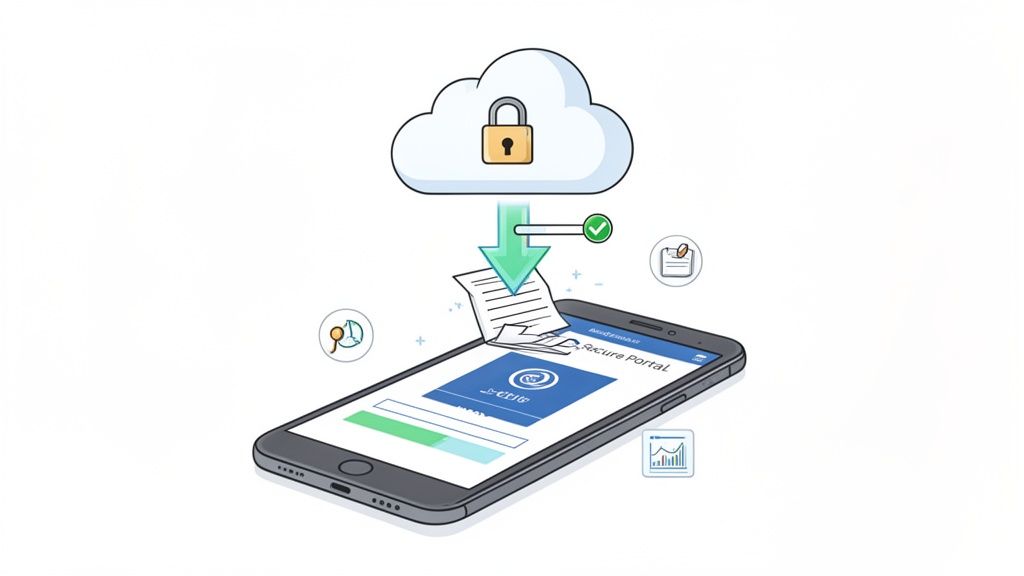
It’s one thing to talk about security concepts, but what does shared file encryption actually look like during a busy workday? The good news is, you don't need a degree in cryptography to use it. The best modern platforms bake powerful encryption right into their systems so seamlessly that you get top-tier security without adding extra steps to your workflow.
Let's walk through a real-world scenario. Imagine a mortgage broker who needs to collect a pile of sensitive financial documents from a new client—think bank statements, tax returns, and pay stubs. All of that is exactly what cybercriminals love to find. In the past, this probably would have been a messy and risky chain of emails.
A Modern Document Collection Workflow
With a proper platform, that same broker can set up a secure, efficient process in just a few minutes. It's a completely different experience for both sides, with security built in from the very start.
- Create a Secure Request: The broker uses a simple interface to build a checklist of the exact documents they need. They can even customize it with their company logo, so the whole thing feels professional and trustworthy.
- Send a Secure Link: Instead of attaching a PDF to an email, the broker sends the client a single, unique link that leads directly to a secure portal.
- Client Uploads from Any Device: The client just clicks the link. They can drag and drop files from their computer or even snap photos of documents with their phone. No special software, no complicated instructions.
- Automatic Encryption Happens Instantly: The second a file hits the upload button, it gets encrypted. This shared file encryption protects the data on its way to the server (in transit) and keeps it locked down once it’s stored (at rest).
The entire exchange happens inside a protected bubble, neatly sidestepping all the risks that come with unsecured email. The broker gets what they need, and the client can relax, knowing their financial history is safe.
The goal of a modern platform isn't just to add a layer of security; it's to make the entire process of collecting documents faster, easier, and more reliable for everyone involved. Security becomes a benefit, not a burden.
Enhancing the Process with Automation
A great system does more than just encrypt files. It adds smart features that cut down on the manual follow-up that eats up so much time.
For instance, the broker can set up automated reminders to gently nudge the client if they haven't submitted everything by a certain date. This keeps things moving without anyone having to pick up the phone or send yet another email.
On top of that, a progress dashboard gives both the broker and the client a clear, at-a-glance view of what's been submitted and what's still missing. This kind of transparency helps manage expectations and keeps everyone on the same page. If you want to dive deeper into this, our article on building a secure document intake platform has a lot more detail.
By combining powerful, automated shared file encryption with these kinds of user-friendly features, businesses can turn document collection from a tedious chore into a smooth, professional, and safe experience.
Common Questions About Shared File Encryption
Even when you see the benefits, bringing in any new security measure is going to spark a few questions. When it comes to shared file encryption, we tend to hear the same concerns from businesses about performance, security, and just how it fits into the daily grind. Getting straight answers is the only way to feel confident you're making the right move.
Let’s tackle the most common questions we get from businesses just like yours. We'll give you direct, no-fluff answers to show how this technology can easily become a part of your workflow.
Does Encryption Slow Down File Access for My Clients?
This is a great question and a perfectly valid concern—nobody wants to trade security for a clunky user experience. The short answer? No, not with modern platforms. Today's tools are built for speed, and the encryption process itself is incredibly efficient.
Encryption and decryption happen automatically in the background, almost instantly. Your clients and your team will just see a smooth, fast process. They won't even notice the heavy-duty security working behind the scenes. That tiny, unnoticeable bit of processing time is a tiny price to pay for the massive security boost you get.
Is Cloud Storage Really Secure Enough for Sensitive Files?
The security of your cloud storage all comes down to the layers you put around it. Just dropping a file into a standard cloud drive isn't going to cut it. But when you use a platform built with end-to-end encryption, the game changes entirely.
This method scrambles your data before it leaves your device (that’s "in-transit" security) and keeps it scrambled while it’s stored on the server ("at-rest" security).
Think of it this way: even if a hacker managed to break into the cloud provider's servers, all they would find is a pile of unreadable gibberish. The encryption keys needed to make sense of that data are stored somewhere else entirely, making the stolen files completely useless.
On top of that, choosing a GDPR-compliant provider adds another crucial layer of accountability and trust.
What Happens If I Lose the Encryption Key?
This question gets to the heart of why managing your own encryption is a huge risk for most companies. If you're the one holding the keys and you lose one, that data is gone for good. There's no "forgot my key" button to click.
But when you use a managed platform for shared file encryption, that burden isn't on you. The service takes care of all the complex key management securely and reliably. Your access is tied to your account login, so you get the full strength of encryption without the personal risk of losing the keys. For almost every business, this is the safest and smartest way to go.
Can I Encrypt Documents Collected from a Mobile Phone?
Absolutely. In fact, this is one of the biggest strengths of using a modern document collection platform. The security is the same no matter what device is being used.
When a client gets a request link, they can snap a picture of a document with their smartphone and upload it right then and there. That file is encrypted the moment it starts its journey from their phone to the server. This gives you a consistent, high level of security, whether someone is at their office desktop or on the go with their phone.
Ready to make your document collection process simple, professional, and secure? Superdocu automates the entire workflow with powerful features like branded request portals, automated reminders, and built-in shared file encryption. Stop chasing paperwork and start protecting your data. Start your free trial today.