
You've probably got one of these open right now, a folder full of pay stubs, a half-finished email thread, or a screenshot of a bank app that someone swears is “the latest version.” The request sounded simple at the start. Then the files came in sideways, the dates didn't match, and nobody could tell whether the packet was complete enough to move forward.
That's the job of income verification documents, they turn a messy income story into something a reviewer can trust. The hard part isn't knowing that proof is needed, it's building a process that can handle different income types, different sector rules, and different freshness windows without turning your inbox into a filing cabinet.
Table of Contents
- Why Income Verification Feels Harder Than It Should
- What Income Verification Documents Are
- Common Documents and the Situations That Trigger Them
- Verification Methods and the Red Flags Each One Catches
- Sector-Specific Rules You Cannot Skip
- How to Verify Non-Traditional and Variable Income
- Building a Secure Collection and Retention Workflow
- Putting It All Together With Automation and Smart Tools
Why Income Verification Feels Harder Than It Should
A property manager opens a thread and finds three forwarded PDFs, two phone photos of pay stubs, and a note that says, “I'll send the rest tonight.” An HR coordinator gets the same pattern, except the missing file is a W-2 and the deadline is onboarding tomorrow. The work looks small until the pile starts growing.
The friction is structural. In rental screening, a single review often expects a bundle of documents, not one file, and the pattern is broader than one might assume. One industry source reports that landlords require pay stubs in 94% of cases, employment verification letters in 87%, bank statements in 76%, and tax documents in 71%, with 2 to 3 months of recent documentation commonly used to confirm income stability, which shows why this process is built around recency and cross-checking rather than a one-page declaration (Clear Screening).
What goes wrong when the bundle is incomplete
Each missing piece slows a different decision. A lender can't finish an underwriting review if the income trail is stale. A housing team can't compare recurring deposits to claimed earnings if the bank statement is absent. A fraud review gets weaker when there's no second document to confirm the first one.
Practical rule: if the file can't answer who earned the money, when it was earned, and whether it's still coming in, someone will ask for more.
The same pattern shows up across housing, lending, hiring, and regulated applications. That's why the problem feels repetitive, even when the forms change. The underlying task is always the same, prove that income is real, recent, and consistent enough for the decision in front of you.
What Income Verification Documents Are
Income verification documents serve as trusted evidence that helps a reviewer decide whether someone can pay, repay, or be paid. A strong packet usually combines more than one kind of proof, because each document answers a different question. One file may show current earnings, another may show what was reported, and a third may show whether the money is still reaching the account.
The four evidence buckets
Most accepted documents fit into four buckets. Earnings records show active pay, such as pay stubs and employer letters. Tax records show what was reported to tax authorities, such as W-2s, 1099s, and returns. Bank records show money moving, usually through statements with recurring deposits. Attestations and benefit awards cover income that does not come from a standard paycheck, such as Social Security letters, pension statements, unemployment letters, or court-ordered payment records.
A reviewer rarely trusts just one bucket on its own. A pay stub can be forged. A tax return can be old. A bank statement can show deposits without showing where they came from. Cross-checking across buckets gives the reviewer a fuller picture and helps expose gaps between claimed income and observed cash flow.
A good packet does not try to look impressive. It tries to be internally consistent.
How to judge a new document type
Use three questions. First, does it show the source of the income? Second, does it show recency? Third, does it connect to a pattern that can be verified elsewhere, like payroll, taxes, or deposits? If the answer is yes to all three, the document usually belongs in the packet. If one answer is weak, another document needs to carry the load.
That mental model helps when a reviewer sees something less common, like a contract payment summary or an award letter. It also keeps teams from asking for random paperwork just because it looks official. The point is not to collect every possible file, it is to collect the files that match the income pattern and the rule set that governs acceptance.
Common Documents and the Situations That Trigger Them
The easiest way to understand the paperwork is to start with the income pattern, not the form. A W-2 employee, a freelance designer, a retiree, and a small business owner all prove income differently because their money arrives differently.
Employed applicants
For salaried or hourly workers, the usual packet starts with recent pay stubs, W-2s, and an employer verification letter. Pay stubs show current pay and deductions. W-2s show annual wage history. Employer letters help confirm title, dates of employment, and, in many workflows, whether the person is still actively employed.
A pay stub alone doesn't prove the income will continue. A W-2 alone doesn't show what happened this month. The employer letter fills some of that gap by tying the person to a current role.
Self-employed and gig workers
For freelancers, contractors, and other variable-income workers, the packet usually shifts toward tax returns, 1099 forms, profit and loss statements, and bank statements. Tax returns help show reported income over time. 1099s help show pay from clients. Profit and loss statements explain the current picture when income doesn't arrive on a fixed schedule. Bank statements show whether the reported earnings hit the account.
Benefits recipients and other non-wage income
Benefits recipients often rely on award letters or benefits letters, plus bank statements that show the deposits landing. Pension income can be shown with pension statements or distribution records. Unemployment income can be supported with the relevant benefits letter. The document matters because it names the program, the payment source, and the status of the award.
Small business owners
Small business owners often need a broader packet, because their personal and business finances can overlap. In practice, that means business bank statements, contracts, invoices, tax filings, and profit and loss records. The point is not to create more paperwork than necessary. The point is to separate business activity from personal spending so the reviewer can see what income is durable.
Verification Methods and the Red Flags Each One Catches
Reviewers usually validate income in one of three ways. Some do it by hand, some rely on a third party, and some use digital validation that checks the file itself. Each method catches different problems, and each one misses something the others can see.
Verification Methods at a Glance
| Method | Speed | Upfront Cost | Best at Catching | Limitation |
|---|---|---|---|---|
| Manual review | Slower | Lower tooling cost | Formatting problems, arithmetic mistakes, missing pages | Heavy on staff time, easier to miss subtle fraud |
| Third-party verification | Faster once set up | Higher service cost | Employer and payroll mismatches | Limited to connected sources and available records |
| Digital validation | Fast on intake | Medium tooling cost | Expired files, mismatched names, reused documents | Still needs human review for edge cases |
Manual review is strong when someone knows what the packet should look like. It catches odd spacing, inconsistent totals, and obvious edits. Third-party checks are better when the goal is to compare submitted information against a payroll or employer source. Digital validation is useful at intake because it can flag expired documents, wrong names, and duplicates before a reviewer wastes time.
The red flags that show up everywhere
A few warning signs appear across housing, lending, and onboarding. Round-number pay stubs can be a clue that the document was assembled too neatly. Missing employer identifiers make it hard to confirm who issued the file. Bank statements that don't match stated income usually need a second look. Recent large deposits without explanation are another common trigger for follow-up.
The main lesson is simple. No single method catches everything. Manual review is good at spotting weird formatting, validation tools are good at filtering bad uploads, and source-based checks are good at confirming the person is tied to the income stream.
The best teams don't pick one method and hope. They layer methods so each one catches a different class of problem.
For a deeper look at how employers are often checked against source records, see this practical overview of employment history verification methods.
Sector-Specific Rules You Cannot Skip
A packet can be complete and still get rejected if it follows the wrong rule set. Sector rules decide what counts, how current the file must be, how many pay periods are needed, and whether the reviewer is looking for wage income, recurring non-wage income, or both.
Mortgages and other lending files
Mortgage and lending workflows usually begin with pay stubs, W-2s, tax returns, and employer attestations. The U.S. Department of the Treasury's Homeowner Assistance Fund guidance lists paystubs, tax filings, and attestation from a current or former employer as acceptable income-verification documents (Treasury guidance). Finance teams also often ask W-2 employees for recent pay stubs and W-2 forms for up to two years, while self-employed applicants are often asked for federal tax returns, 1099s, and a profit-and-loss statement.
The document name matters less than the rule behind it. A pay stub is useful because it shows current wages, but a lender may still want a tax return to confirm the broader income pattern, much like checking both a meter reading and a monthly bill to see whether the number is stable.
Rentals and housing assistance
Housing reviews can be stricter about recency than lending files. Philadelphia's recertification guidance requires consecutive pay stubs dated within the past 180 days for adult family members, and the count depends on pay frequency, 4 for weekly pay, 2 for biweekly pay, and 1 for monthly pay. It also requires an original employer letter with dates of employment and the income details needed to calculate salary or hours worked per week (Philadelphia Housing Authority).
That is why intake teams need to count pay cycles before they ask for files. If the request starts with “send a recent pay stub,” the reviewer may still be left with an incomplete packet, because the housing rule is built around a specific sequence of stubs, not just any one document.
Practical rule: if the housing file asks for recent pay history, count the pay cycles first, then check the date window second.
HR onboarding and immigration files
HR teams usually start with right-to-work documents, but salary verification can still appear during background checks or compensation reviews. Immigration cases add another layer because the evidence often needs to show sustained income, not just a single paycheck, so the packet may include bank statements, employer letters, and tax filings depending on the visa category.
The mistake is treating one “proof of income” template as universal. A clean intake process asks which sector is making the decision, then applies the right timing rule, category list, and document count before the request goes out. For teams also checking identity paperwork, this guide to reliable identity verification methods is a useful companion resource.
How to Verify Non-Traditional and Variable Income
The tricky cases are usually the ones that don't fit the salary mold. Gig workers, freelancers, retirees, people on benefits, and families with child support or alimony all need a packet that proves continuity in a different way.
When the money is recurring
If the income repeats and can be reported cleanly, the packet often starts with a tax record plus a recent bank statement. That combination helps show both declared earnings and actual deposits. For many reviewers, that's enough when the pattern is steady and easy to trace.
For self-employed or variable-income applicants, the evidence burden gets heavier. Guidance cited in UK and KYC contexts recommends 2 to 3 years of business accounts plus SA302 tax summaries, while U.S. eligibility guidance for self-employment commonly calls for recent profit and loss statements or ledgers, Form 1040 with schedules, and bank statements that show recurring deposits.
When the income is irregular
Irregular or seasonal income needs more context. A freelance worker with uneven bookings may need profit and loss statements to show trend lines, not just snapshots. A seasonal contractor may need bank statements to prove the deposits are recurring over time. A retiree may need a pension statement plus a bank statement because the source of the payment matters as much as the amount.
A simple decision rule
Ask two questions. Is the income recurring and reportable. If yes, a tax record plus a recent bank statement often carries most of the weight. Is the income irregular, seasonal, or mixed. If yes, add a profit and loss statement, ledger, invoice trail, or award letter so the reviewer can see how the money behaves over time.
If the reviewer has to infer the pattern, the packet isn't finished yet.
That's the shift for non-traditional income. Stop asking, “What single document proves it?” Start asking, “What combination makes the pattern obvious?”
Building a Secure Collection and Retention Workflow
A clean workflow makes the process feel ordinary instead of chaotic. The best version starts before the first file arrives and ends with a clear handoff to the team that needs it.
The intake path
First, decide what to request based on the sector rule. Then send a branded request link instead of a long email thread. That gives the requester one place to upload files from any device, and it keeps the packet tied to the right case from the start. Once the documents arrive, review them on a dashboard so missing items and expired files are visible at a glance.
Next, automate the follow-up. Missing items should trigger reminders without someone manually rewriting the same email five times a day. Expiration tracking matters too, because a document that was valid last week can become stale before the file is used.
Security basics that small teams miss
Encrypted transfer should be standard. So should access controls that limit who can see the files after upload. If your team handles applicants across regions, use hosting and retention practices that align with GDPR-friendly expectations and local compliance requirements. Keep the retention window clear, then hand the file to HR, underwriting, or legal without leaving copies scattered across inboxes.
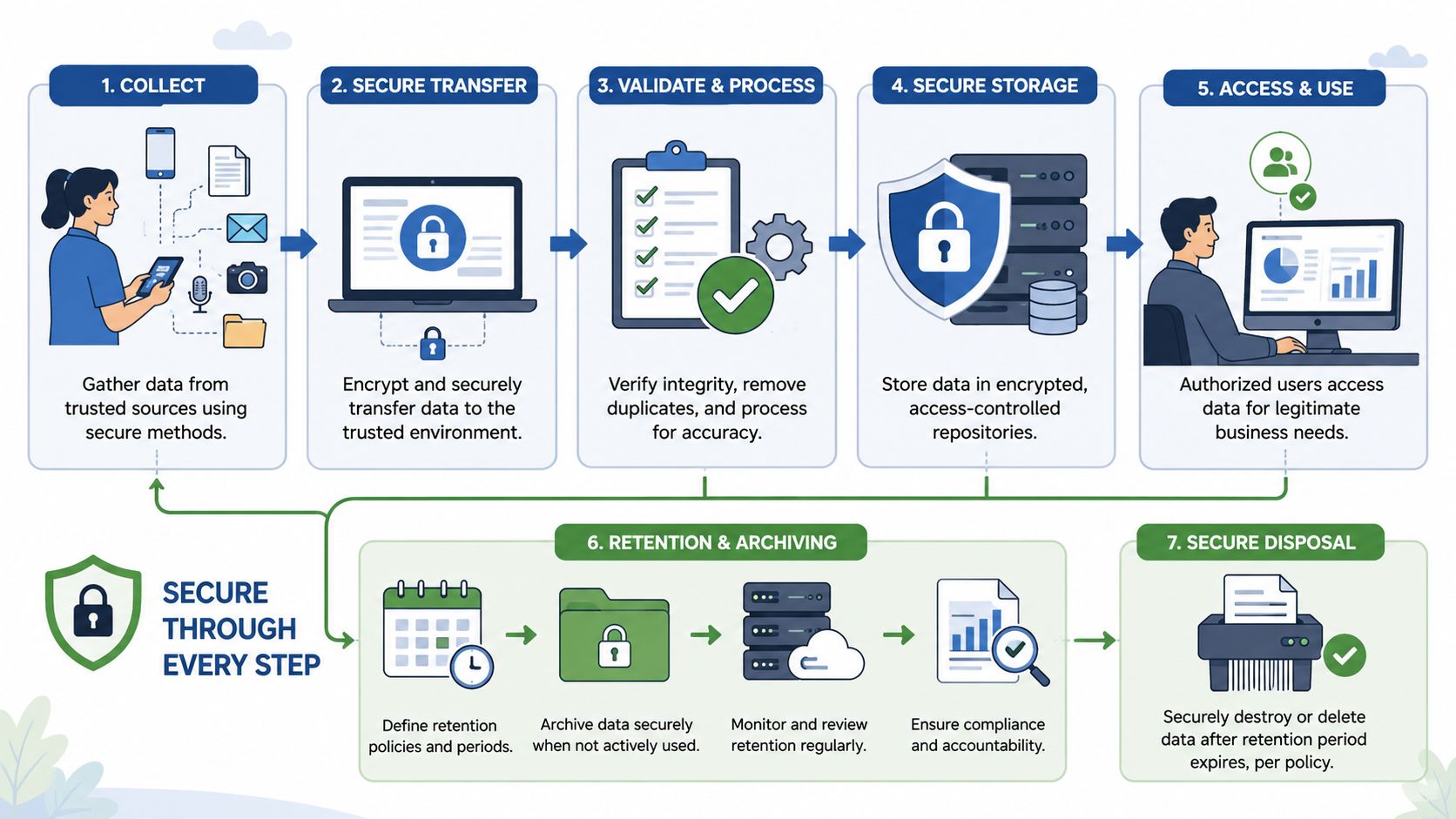
A simple workflow is easier to audit because every step is visible. It also reduces the chance that a requester sends the wrong file to the wrong person, which is how small mistakes become expensive cleanup work.
For a closer look at secure intake design, this secure document collection guide is a useful reference point.
Putting It All Together With Automation and Smart Tools
Once the rules are clear, the key question is whether your team wants to keep managing this by email or move it into a system built for repeatable collection. A good setup should include sector-specific templates, branded client portals, automatic reminders, expiration alerts, validation dashboards, and integrations with eSignature and workflow tools that connect to thousands of other apps.
Those features prevent the usual failure points. They stop teams from chasing expired documents, losing track of which client sent which file, or sending three different versions of the same request. They also make it easier to keep wording consistent across departments, which matters when one team is asking for pay stubs and another is asking for award letters.
If you're comparing how to modernize document workflows more broadly, this guide to 2026 receipt compliance is a useful example of how structured intake cuts down on cleanup later. The same logic applies here, once the request, reminder, and retention steps are standardized, people spend less time asking for files and more time reviewing them.
One concrete option is Superdocu, which offers pre-built templates for legal, real estate, HR, immigration, transportation, and construction workflows, along with white-label portals, a seven-day free trial, and tiered pricing for teams of different sizes. Its document-verification tooling fits the same problem this article has been describing, collecting the right files, keeping them organized, and reducing the back-and-forth that slows decisions. For teams that want a deeper look at the software side, the document verification software overview shows how a structured platform changes the handoff from intake to review.
If you're still handling income verification through email threads and shared folders, Superdocu gives you a cleaner way to request, collect, and review the right documents in one place. Visit Superdocu to see how branded portals, reminders, and document workflows can help your team keep income verification organized, auditable, and much easier to manage.