
At their core, FileInvite and Superdocu are designed for different people. Fileinvite is the heavy-hitter, a powerful and feature-packed platform built for large companies and industries with strict compliance rules that demand deep customization and high-level security. On the other hand, Superdocu is a more straightforward, clean solution that's perfect for small to medium-sized businesses that just want something that works well and is easy to get started with.
Choosing Your Document Collection Platform
Let's be honest, chasing clients for documents is more than just a headache—it’s a major drag on your business. It’s the endless follow-up emails, the confusing attachment chains, and the manual-checking that eats up hours you could be spending on actual work. This kind of friction slows everything down, from loan applications and new client onboarding to preparing legal cases, which ultimately hurts your bottom line and your client relationships.
Today’s businesses need a single place to ask for, receive, and keep track of documents safely and efficiently. Both FileInvite and Superdocu solve this problem, but they come at it from two different angles.
- Fileinvite is all about giving you total control with advanced tools made for complicated, multi-step processes.
- Superdocu prioritizes simplicity, delivering a clean and intuitive experience for both you and your clients.
This guide will go beyond just listing features. We'll dig into how each platform actually works in the real world to help you figure out which one is the right fit for your team. When looking at document tools, it helps to know what’s out there, which might even include finding a free alternative to DocuSign to see the full range of options.
The right platform doesn't just collect files; it transforms a cumbersome administrative task into a smooth, professional, and secure client interaction.
Here’s a quick look at how FileInvite and Superdocu compare at a high level.
| Feature Area | Fileinvite | Superdocu |
|---|---|---|
| Primary Audience | Enterprise & regulated industries | Small to medium-sized businesses |
| User Experience | Feature-rich, more complex | Simple, highly intuitive |
| Customization | Extensive white-labeling | Core branding options |
| Security Focus | SOC 2 Type 2, advanced audits | GDPR compliance, EU hosting |
Ultimately, the choice comes down to what your business truly needs. Are you looking for granular control over every detail, or do you just want straightforward efficiency that gets the job done fast?
A Head to Head Look At Core Features
Let's get down to brass tacks: what really separates these tools in your day-to-day work? It's not just about a long list of features. It's about how those features solve your actual problems. Both Fileinvite and Superdocu promise to make document collection easier, but they come at it from two very different angles. You'll see this clearly when we dig into their workflows, templates, and client portals.
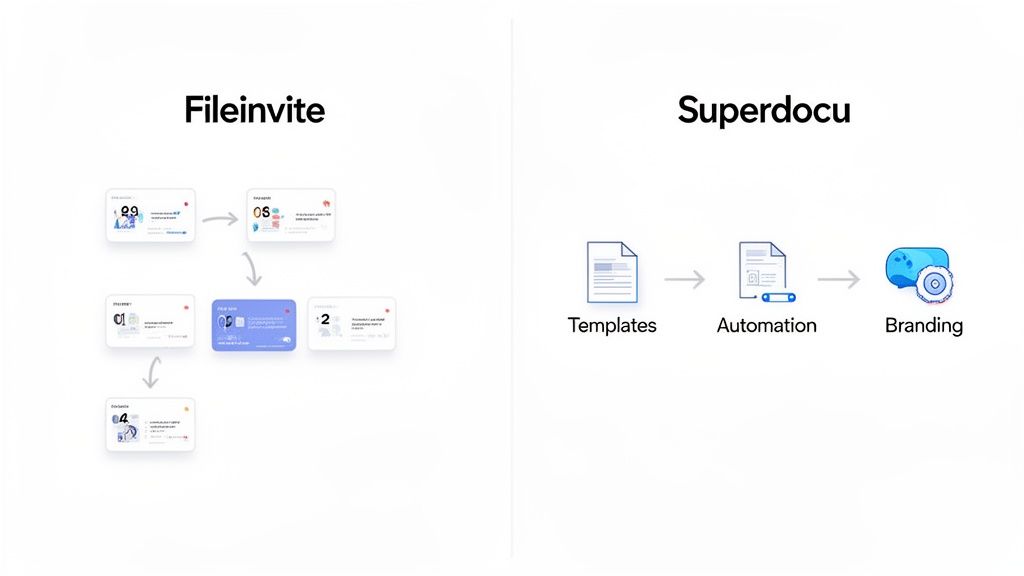
To put it simply, Superdocu is all about speed and simplicity. You can jump in and build a document request in minutes flat, which is a lifesaver for straightforward jobs like onboarding a new hire or grabbing financial statements from a client.
Fileinvite, on the other hand, is built for complexity. Its workflow engine is much more powerful, letting you map out multi-stage approvals, add conditional logic, and even link document dependencies. This is non-negotiable for industries like mortgage lending, where one application involves a mountain of paperwork from several different people.
To give you a clearer picture, let's compare their core features side-by-side.
Core Feature Comparison Fileinvite vs Superdocu
This table breaks down the fundamental differences in how each platform handles the core tasks of document collection and workflow management.
| Fonctionnalité | Fileinvite | Superdocu |
|---|---|---|
| Workflow Automation | Highly granular with multi-stage approvals, conditional logic, and dependencies | Simple, linear workflows designed for speed and ease of use |
| Automated Reminders | Deeply customizable (SMS/email content, timing, triggers) | Clean "set it and forget it" scheduling for automatic follow-ups |
| Modèles | Comprehensive project plans with documents, deadlines, and automation rules | Simple, reusable request lists for quick and easy deployment |
| Branding & Client Portal | Extensive white-labeling (custom URL, emails, UI) for a seamless brand experience | Core branding options (logo, colors) for a clean, professional look |
| Ideal Use Case | Complex, multi-stakeholder projects (e.g., mortgage applications, legal cases) | High-volume, standardized requests (e.g., HR onboarding, client intake) |
As you can see, the choice isn't about which one is "better," but which one is the right fit for the job at hand.
Workflow And Request Automation
The real magic of any document collection tool is taking the tedious follow-up off your plate. Both platforms nail this with automated reminders, but they go about it in different ways.
Superdocu's automation is brilliantly simple. You set a basic reminder schedule, and the system handles the rest, gently nudging your clients until everything is submitted. It’s a true “set it and forget it” system that saves a ton of time for teams handling the same kinds of requests over and over.
Fileinvite gives you the keys to the entire automation engine. You can tweak the content, timing, and triggers for every reminder based on what a client does or doesn't do. For instance, you could set up a rule to fire off a specific SMS reminder only if a critical document is more than 3 days late. This is exactly where Fileinvite becomes indispensable for high-stakes, complex deals.
For businesses managing intricate, multi-step document sequences, the granular control of a platform like Fileinvite is a necessity. For those prioritizing speed and ease of use for simpler tasks, a more direct approach is often better.
Templates And Reusability
Nobody wants to reinvent the wheel. Templates are a must for efficiency, and again, the two platforms show their different philosophies in how they handle them.
Superdocu keeps its templates direct and to the point. You can save any request as a template, which makes it incredibly easy to kick off the same process for a new client with just a couple of clicks. This is a perfect fit for professional service firms with standard intake checklists. If you're looking for ideas on structuring these, our guide on choosing a tool for collecting documents is a great place to start.
With Fileinvite, a template is more like a complete project blueprint. It can contain not just the document checklist but also all the pre-set due dates, team assignments, and the specific automated reminder sequences. You can essentially build an entire client onboarding project into one template, which is huge for maintaining consistency across a large organization.
Think about it this way: an accounting firm chasing standard tax forms from 100 different clients will love the speed of Superdocu's templates. But a law firm managing a complex M&A deal with multiple phases and internal reviews will get far more value from Fileinvite’s all-in-one project templates.
Client Portal And Branding Customization
The portal is where your clients interact with you, so it has to look and feel right. It's a critical part of the client experience.
Superdocu gives you the essential branding tools you need. You can pop in your logo and adjust the color scheme to create a clean, professional portal that matches your brand. The user interface is designed to be so simple that your clients won't need any instructions.
Fileinvite goes all-in on white-labeling. You can completely customize the portal's look and feel—we're talking custom URLs, email designs, and every part of the interface—to make it a seamless extension of your own website. This level of deep branding is often a hard requirement for enterprise companies that need absolute brand consistency.
Comparing Security And Compliance Standards
When you're handling sensitive client documents, security isn't just a box to tick—it's the bedrock of your business. How a platform protects that data can make or break your decision, especially if you're in a highly regulated field like finance, law, or healthcare. Both Fileinvite and Superdocu take this very seriously, but they've built their security around different compliance frameworks to meet different needs.
This isn’t just technical jargon. A platform's security architecture determines how it handles everything from encryption to user access and audit logs. Choosing the right one means aligning its security posture with your specific risks and regulatory obligations.
The Compliance Framework
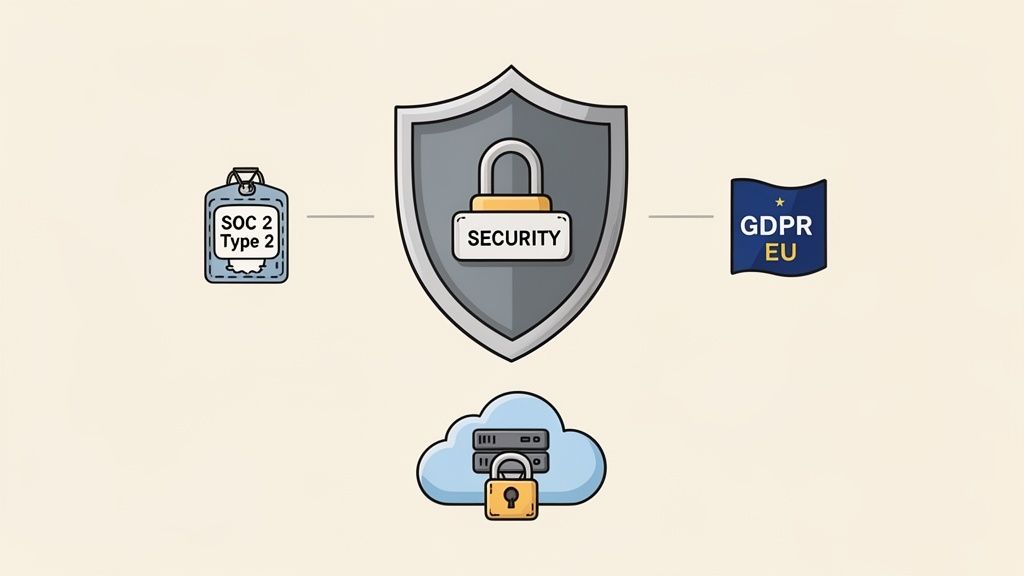
Fileinvite is built to meet the rigorous standards that North American and global enterprises often face. The big highlight here is its SOC 2 Type 2 compliance. This isn't an easy certification to get; it requires a deep, ongoing audit of a company’s systems for security, availability, confidentiality, and privacy.
Superdocu, on the other hand, is laser-focused on European data protection laws. It’s hosted exclusively in Europe and was designed from the ground up to align with the General Data Protection Regulation (GDPR). This makes it a natural fit for businesses operating within the EU or dealing with the personal data of European citizens.
The choice really comes down to your situation. If you're a US-based financial firm that undergoes constant audits, Fileinvite’s SOC 2 certification is a huge advantage. But for a German consulting agency, Superdocu’s built-in GDPR compliance and EU data hosting are absolute must-haves.
Data Encryption And Protection
Great security means protecting data whether it's being uploaded or just sitting on a server. Both platforms use industry-standard encryption to lock down information in transit and at rest, but their infrastructure is a direct reflection of their compliance priorities.
Fileinvite provides a robust security architecture that lines up with its SOC 2 commitments, ensuring data is kept safe across its entire lifecycle. In the world of document collection, Fileinvite has become a go-to for finance and lending teams where compliance is king. With both SOC 2 Type 2 and GDPR standards, it's a trusted name for handling sensitive information securely.
Superdocu guarantees that all client data stays within the EU. For many European businesses, data sovereignty is a major concern, and this approach completely eliminates the headache of international data transfers. It simplifies GDPR compliance and gives you peace of mind that sensitive information isn’t crossing borders without your explicit say-so. If you want to get a better handle on what this all means, this ultimate guide to cyber security is a great place to start.
Access Controls And Audit Trails
Controlling who sees what and keeping a log of every action are non-negotiable for good governance. Both platforms do a great job here, just with different levels of granularity.
Fileinvite shines with its detailed user permissions and comprehensive audit trails. This is critical for larger organizations where you might have loan officers, assistants, and compliance managers all needing different levels of access to the same client files. The audit logs are incredibly thorough, giving you a clear, time-stamped record of every single thing that happens to a document.
Superdocu keeps things simpler with straightforward access controls that are perfect for smaller teams. You can easily manage roles and see who has touched which documents, giving you the oversight you need without getting bogged down in overly complex settings. It’s all about maintaining security without sacrificing that ease of use the platform is known for. For a deeper look at what to look for, check out our guide on choosing a secure document intake platform.
Integrations and Ecosystem Connectivity
A document collection tool doesn’t live on an island. Its true power comes from how well it talks to the other software you use every single day—your CRM, cloud storage, and e-signature apps. A smooth connection means less manual work and fewer headaches.
When we look at FileInvite and Superdocu, it's clear they have different philosophies on how to build these connections.
Ultimately, you want a tool that slots into your existing workflow, not one that forces you to build new processes around it. Let's dig into how each platform approaches this.
Native Integrations
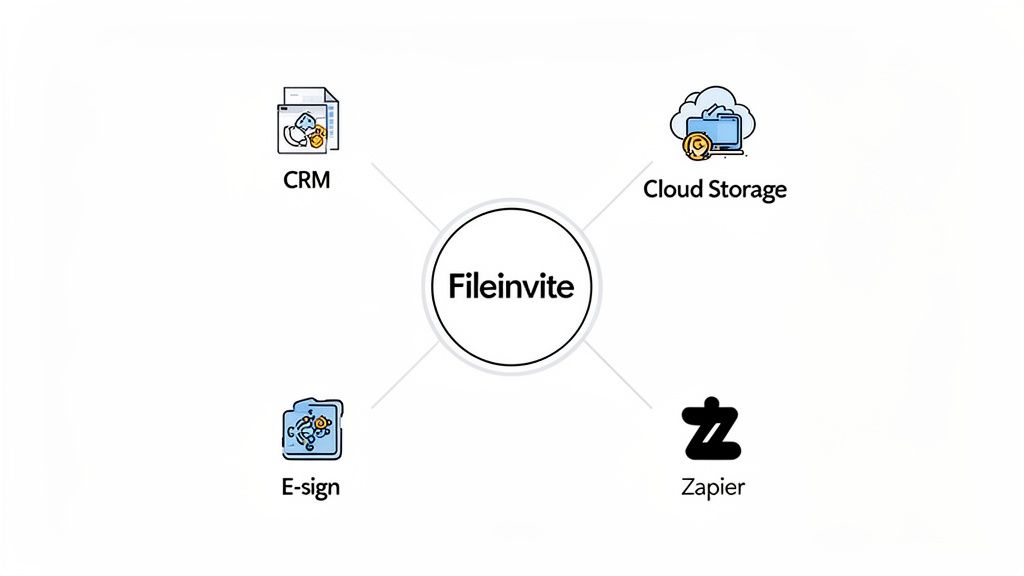
Native integrations are the plug-and-play connections that work right out of the box. Superdocu keeps things simple, focusing on a handful of essential, high-impact integrations. Its link with DocuSign is a great example—it makes adding an e-signature step to any request incredibly straightforward.
FileInvite, on the other hand, goes much wider and deeper, targeting businesses with more complex needs. It offers direct connections to all the major cloud storage platforms you’d expect: Google Drive, OneDrive, Dropbox, and Box.
More importantly for specialized industries, FileInvite connects directly with Loan Origination Systems (LOS) and other specific software used in finance and law. This is a game-changer for those firms. For instance, a mortgage broker can have signed loan applications automatically sent to the right client folder in their LOS, cutting out a ton of manual file shuffling.
The Power of Zapier
For everything else, there’s Zapier. Both platforms use it as a bridge to thousands of other apps, letting you build custom automations without any code. But the devil is in the details—what you can actually do with the integration depends on the triggers and actions each platform supports.
Superdocu’s Zapier connection is clean and effective. You can kick off a workflow when a document request is sent or completed. This is perfect for simple, common tasks like:
- Updating your CRM: Change a contact’s status in HubSpot when they submit their onboarding file.
- Alerting your team: Post a message in a Slack channel when a client's documents are all in.
- Creating follow-ups: Add a "Review new files" task in Asana for your team.
FileInvite provides a much more granular set of triggers and actions through Zapier. This lets you build more sophisticated, multi-step automations that react to specific events inside the platform. You’re not just limited to "request complete"; you can build workflows around a single document being approved or a client sending a message.
The choice here really boils down to your automation needs. If you just need basic notifications and CRM updates, Superdocu’s Zapier link will do the job just fine. But if you need to orchestrate complex workflows tied to specific industry software, FileInvite’s deeper capabilities are a must.
Think of it this way: a law firm could use FileInvite to trigger an automation that not only updates their CRM but also creates a specific folder structure in their document management system based on the type of files submitted. It’s that level of detail that turns FileInvite from a simple collection tool into a real operational hub. In fact, some financial firms have found that they can automate over 40% of their manual work with this kind of setup.
Real World Use Cases By Industry
Features on a spec sheet are one thing, but how a platform actually performs in the trenches of your specific industry is what truly matters. A tool that's perfect for a creative agency might be a nightmare for a law firm. This is where you can really see the different philosophies of FileInvite and Superdocu shine through.
Let's break down how each platform handles the unique pressures of three document-heavy fields: mortgage lending, legal services, and accounting. Seeing them in action will give you a much clearer picture of which one fits your daily grind.
Mortgage Brokers Accelerating Loan Processing
The mortgage world is a pressure cooker of paperwork, tight deadlines, and the absolute need for a perfect audit trail. A single loan file can easily swell with dozens of documents from borrowers, employers, and banks. Any delay isn't just an annoyance—it can sink the whole deal.
This is exactly the kind of complex environment where FileInvite feels right at home. Its real power is in managing these multi-stage, intricate projects. A loan officer can build a master template for a mortgage application that maps out every single document needed, from pay stubs and tax returns to bank statements and gift letters.
It gets even smarter with conditional logic. The system can automatically ask for more documents based on what a borrower submits. For example, if a borrower checks the "self-employed" box, FileInvite can instantly trigger a request for two years of business tax returns without anyone having to lift a finger.
For a high-volume mortgage brokerage, this kind of automation is a game-changer. It’s not just about collecting files; it’s about conducting a complex orchestra of information. One study even found that financial institutions can automate tasks that eat up over 40% of an employee's time.
Superdocu can absolutely handle the basics of collecting loan documents. Its clean interface is a breeze for borrowers to use, and its reminders keep things moving. Where it falls short is in managing the deep, rule-based logic needed for a tangled mortgage file, making it a better fit for smaller, independent brokers with more straightforward caseloads.
Legal Firms Streamlining Client Intake
Legal work is built on a bedrock of secure, accurate documentation. Whether it's client intake, discovery requests, or evidence collection, law firms are constantly handling information that demands total confidentiality and a clear chain of custody.
For a mid-to-large-sized law firm buried in complex litigation, FileInvite has a clear edge. Its heavy-duty security, including SOC 2 Type 2 compliance and detailed audit trails, provides the peace of mind needed when dealing with highly sensitive client data. Paralegals can set up incredibly detailed requests with specific instructions and deadlines for every piece of evidence.
Think about a discovery process. A firm needs to gather financial records, contracts, and emails from a client. The ability to create a secure, branded portal that logs every single action—who uploaded what and when—is absolutely critical for compliance and being able to defend your process.
On the other hand, Superdocu, with its GDPR focus and EU data hosting, is a fantastic option for European law firms or any practice that wants to make client interactions as simple as possible. Its intuitive interface is a huge win for clients who aren't particularly tech-savvy.
For more routine tasks, like onboarding a new client for a will or a simple real estate deal, Superdocu’s no-fuss workflow is perfect. The firm sends a clean, simple request for ID and a few initial documents, and the client can get it done on their phone in minutes. It truly excels where the process is standardized and needs to be fast.
Accounting Firms Managing Tax Season
Nothing tests an accounting firm's efficiency like tax season. It's a mad dash to collect a standard set of documents—W-2s, 1099s, receipts, investment statements—from hundreds, if not thousands, of clients in a very narrow window.
Which platform is best here really comes down to the firm's size and the complexity of its clients.
For a smaller accounting practice or a solo CPA, Superdocu is a brilliant choice. Its strength is pure simplicity and speed. An accountant can whip up a single "Tax Season 2024" template and blast it out to their entire client list in just a few clicks. The clean, mobile-friendly portal makes it incredibly easy for people to upload their documents without getting confused. The automatic reminders are a godsend, chasing down late files so the accountant can focus on the actual tax work.
A larger firm with complex enterprise clients, however, would probably lean toward FileInvite. These clients often come with complicated financial structures—multiple entities, trusts, and investment vehicles. FileInvite lets the firm build out customized request templates for different tiers of clients.
For example, a high-net-worth client’s request could have specific sections for partnership K-1s and foreign asset declarations, and even include internal review steps for the accounting team. The platform’s ability to manage these intricate, multi-part submissions from different people makes it a much better fit for keeping these complex financial profiles organized when things get chaotic.
Making The Right Choice For Your Business
Choosing the right platform really boils down to one question: what’s the core problem you're trying to solve? Are you trying to orchestrate a complex, multi-stage process with lots of moving parts? Or do you just need a simple, fast tool to get rid of daily friction? Your answer points you directly to either FileInvite or Superdocu.
Neither tool is objectively "better" than the other—they’re just built for different jobs. The best fit depends on your team's size, the compliance rules in your industry, and how complicated your day-to-day workflows are.
Who Should Choose FileInvite
FileInvite is the hands-down winner for larger organizations and businesses navigating heavily regulated fields. If your work involves intricate, multi-stakeholder projects like mortgage applications, big legal cases, or enterprise client onboarding, its feature set is practically essential.
You should go with FileInvite if you need:
- Granular Workflow Control: You can’t live without multi-stage approvals, conditional logic, and detailed automation that can handle complex client situations.
- Deep Customization: A fully white-labeled client portal with your own custom URL is non-negotiable for maintaining brand consistency.
- Robust Security and Auditing: SOC 2 Type 2 compliance and detailed audit trails are must-haves to meet strict regulatory demands.
Think of FileInvite as an operational command center. It's built from the ground up for teams that demand power, control, and serious security to manage scale and complexity.
Who Should Choose Superdocu
Superdocu shines for small to medium-sized businesses, solo professionals, and any team that puts speed and simplicity first. If your main goal is to stop chasing clients for the same documents over and over again so you can get your actual work done, Superdocu is your best bet.
The platform is designed to be picked up in minutes, not days. Its real strength is making the most common document collection tasks incredibly efficient for both you and your clients.
You should lean towards Superdocu if you value:
- Simplicity and Speed: You want a tool that makes sense from day one, with a clean interface your clients can use without needing a tutorial.
- "Set It and Forget It" Automation: You need reliable, automated reminders to handle the follow-up for you without a complicated setup process.
- A Painless Client Experience: A mobile-friendly, straightforward portal is far more important to you than deep branding options.
For a bit more context, check out our guide on selecting the right client document request software to see how these priorities match up with different business models. Superdocu is for teams that just need an effective solution that stays out of their way.
Got Questions? Let's Clear Things Up
When you're weighing two platforms like FileInvite and Superdocu, a few common questions always pop up. Getting these sorted is often the last step before making a confident decision.
Let's dive into the specifics that matter most.
Which One Is Actually Easier For My Clients?
Both platforms are designed to be client-friendly, but they approach simplicity in different ways. Superdocu gets a lot of praise for its almost zero-learning-curve interface. It's incredibly straightforward, especially on mobile, meaning your clients can just open the link and get started without any hand-holding.
FileInvite, on the other hand, gives clients a more robust portal with a few more bells and whistles. While it's still clean and easy to navigate, its depth means a less tech-savvy client might need a moment to get their bearings.
Who Wins On Customization and Branding?
This really comes down to how deep you need to go with your branding.
FileInvite is the clear winner if you're looking for a full white-label experience. You can customize nearly everything—the client portal, the emails, even the domain—to make it feel like an extension of your own company. This is a huge plus for larger firms where brand consistency is paramount.
Superdocu provides the essentials that most businesses need: you can add your logo and adjust the color scheme. It keeps things looking professional and clean without getting bogged down in complex configuration, which is often perfect for small to mid-sized teams.
The choice here is simple. If you need a completely seamless brand experience that's indistinguishable from your own website, FileInvite has the advantage. If a polished, professional look is all you need, Superdocu nails it.
How Different Is The Pricing, Really?
Their pricing models are built for different types of businesses, and this is a key distinction.
Superdocu uses a clear, tiered pricing structure. The plans are laid out transparently, making it really easy for individuals and smaller teams to know exactly what they're paying each month. No surprises.
FileInvite often works with custom quotes. Their pricing is built around your specific needs—how many users you have, your document volume, and which advanced features you require. This approach is much better suited for large organizations and enterprise clients with unique, high-volume demands.
Ready to see how a simple, secure, and efficient solution can change your document collection process? Discover how Superdocu can save you time and keep your clients happy. Start your free trial today.